CBD capsules
by Cibdol
We'll only email you about this product — no marketing.
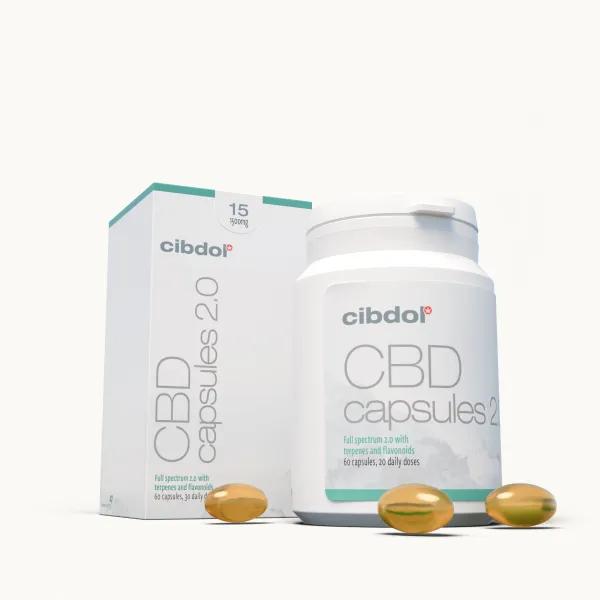
CBD Softgels 15% from Cibdol are pre-dosed capsules delivering 25 mg of cannabidiol per softgel in an easy-to-swallow format. Each bottle contains 60 softgels for a total of 1500 mg CBD, made with Cibdol's updated 2.0 formula — a blend that goes beyond isolated CBD to include a broader cannabinoid profile featuring CBC, CBG, CBN and CBDA, secondary cannabinoids that contribute to a wider entourage effect. If you've been eyeing CBD oils but can't stand the earthy taste, these sidestep that entirely. No dropper, no mirror, no counting drops on a moving tram. Just swallow one with water and get on with your day.
We've carried Cibdol since they were still a small Swiss-Dutch operation, and the jump from their original formula to the 2.0 line was noticeable. The older capsules were straightforward CBD isolate in a carrier oil. The 2.0 version pulls in those additional cannabinoids from the hemp extract, which — according to a review in Frontiers in Pharmacology — may work together more effectively than CBD alone. That's the entourage effect in plain language: the whole extract outperforms any single compound pulled from it.
Softgels suit anyone who wants a fixed dose without fuss. Each capsule is exactly 25 mg — no guesswork, no variation between servings. That consistency matters if you're tracking how you respond over days or weeks. Compared to oils, you lose some flexibility (you can't take half a softgel the way you'd take fewer drops), but you gain precision and discretion. Pop one at your desk, on a flight, at dinner — nobody notices, nobody asks.
If you're new to CBD entirely, 25 mg per capsule is a moderate starting point. According to Medical News Today, a 2024 study found that low doses of CBD (as little as 15 mg) could already support sleep quality. At 25 mg per softgel, you're in that range without needing to stack multiple capsules. For context, clinical research has used doses ranging widely — from 15 mg up to 600 mg daily depending on what was being studied — so one softgel a day sits at the conservative end of the spectrum.
Choosing between CBD products is simpler when you compare mg per dose rather than percentages. A 15% oil and a 15% softgel bottle sound identical, but the actual amount you take per serving can differ wildly depending on drop size, dropper calibration, and how steady your hand is at 7 a.m.
| Format | CBD per serving | Servings per package | Total CBD |
|---|---|---|---|
| CBD Softgels 15% (this product) | 25 mg per softgel | 60 | 1500 mg |
| Cibdol CBD Oil 15% (10 ml) | ~7.5 mg per 3 drops | ~200 drops | 1500 mg |
| CBD Softgels 10% | 16.6 mg per softgel | 60 | 1000 mg |
The takeaway: one softgel gives you roughly the same CBD as 10 drops of Cibdol's 15% oil. If you've been using the oil and want to simplify, the maths translates cleanly. And because the softgel shell protects the CBD from light and air, shelf stability is better than an opened bottle of oil sitting on your nightstand for two months.
| Spec | Value |
|---|---|
| Brand | Cibdol |
| Formula | 2.0 (enhanced cannabinoid profile) |
| CBD per softgel | 25 mg |
| Total CBD per bottle | 1500 mg |
| Softgels per bottle | 60 |
| CBD concentration | 15% |
| Additional cannabinoids | CBC, CBG, CBN, CBDA |
| Format | Soft gelatin capsule |
| Carrier | Olive oil |
| Storage | Cool, dark place — below 25 °C |
Already using CBD softgels and want to layer in a faster-acting format for specific moments? Cibdol's CBD Oil 15% pairs well — use the oil sublingually when you want quicker absorption and the softgels for your daily baseline. If sleep is the main reason you're here, Cibdol's Meladol (CBD + melatonin) is worth a look as a dedicated nighttime formula.
We get asked this at least a few times a week: why capsules when oils exist? Three reasons keep coming up.
First, taste. CBD oil tastes like the inside of a garden shed — earthy, bitter, and lingering. Some people genuinely don't mind. Most people tolerate it. A few people gag. Softgels bypass your taste buds entirely. The gelatin shell dissolves in your stomach, not on your tongue. If the flavour of hemp extract has been putting you off, this is the fix.
Second, dosing accuracy. We've watched customers in the shop try to count drops from a pipette. It's harder than it sounds, especially with thicker oils. One squeeze too many and you've taken 30% more than intended. With softgels, 25 mg means 25 mg. Every time. That consistency is genuinely useful if you're trying to find your personal sweet spot and want to adjust methodically rather than guessing.
Third, portability. A glass dropper bottle in a bag is an anxiety source. Softgels travel in a blister pack or a small pill case — no leaks, no broken glass, no explaining an amber bottle to airport security. The honest limitation? Absorption is slower than sublingual oil. Under-the-tongue dosing lets CBD enter your bloodstream through the mucous membranes in about 15–30 minutes. A softgel has to pass through your digestive system first, so onset is more like 45–90 minutes. That's not a dealbreaker for daily use, but it's worth knowing if you're expecting immediate results.
CBD research has expanded significantly over the past decade, though most large-scale clinical trials have focused on higher doses. According to a review published in PMC, "the purpose of this review was to synthesize available evidence from clinical research regarding the efficacy of CBD as a therapeutic" — and the findings point to varied applications still under investigation (PMC7880228).
On the safety side, according to a 2023 article on CBD metabolism, "in humans, the most reported side effects from CBD include diarrhea, nausea, headache, fatigue, and changes of appetite and weight" (PMC11404724). At 25 mg per softgel, you're well below the doses where these effects typically surface in clinical settings (most studies reporting side effects used 300 mg/day and above), but it's good to know what to watch for.
Research into lower-dose CBD is still catching up. According to a 2023 systematic review, "at doses of 300–400 mg, there is evidence of efficacy with respect to reduced anxiety, as well as anti-addiction effects in drug-dependent individuals" (PMC9841308). The same review noted that more large-scale randomised controlled trials are needed for doses under 200 mg/day — which is where most consumer softgel products sit. Translation: the science is promising but still filling in the lower-dose picture.
One thing worth flagging: CBD can interact with certain medications, particularly those processed by the liver's cytochrome P450 enzyme system. According to a pharmacokinetic trial, repeated CBD dosing can modulate CYP1A2 activity, which affects how your body clears substances like caffeine (PMC10556379). If you're on prescription medication — blood thinners, anti-epileptics, certain antidepressants — talk to your doctor before adding CBD to the mix. That's not a scare tactic; it's basic pharmacology.
After 25-plus years selling supplements from our Amsterdam shop, we've noticed that the customers who stick with CBD long-term almost always land on capsules or softgels eventually. Oils are where most people start — they're flexible, they're visible on the shelf, and they feel more "active" somehow. But the daily ritual of measuring drops gets old. The people who reorder month after month? They switched to softgels for the simplicity and never looked back.
The Cibdol 2.0 formula specifically — we'd pick it over their older capsules without hesitation. The broader cannabinoid profile (CBC, CBG, CBN, CBDA alongside the CBD) gives you more of what the hemp plant actually produces, rather than a stripped-down isolate. Is the difference dramatic? Honestly, it's subtle. But if you're already spending the money, you might as well get the fuller extract. The one product we'd recommend over these softgels is Cibdol's CBD Oil 15% — but only if you genuinely don't mind the taste and want faster onset. For everyone else, the softgels are the better daily driver.
Expect 45–90 minutes. The softgel shell dissolves in your stomach, then the CBD absorbs through your digestive tract. Taking them with a fatty meal can speed this up slightly. Sublingual oils are faster (15–30 minutes) but softgels offer more consistent dosing.
Yes. Each softgel contains 25 mg CBD. Two per day gives you 50 mg, which is still well within the ranges used in clinical research. Start with one for the first week, then adjust based on how you respond. The bottle contains 60 softgels — enough for one to two months depending on your daily intake.
According to research published in PMC, the most commonly reported side effects at higher doses include fatigue, changes in appetite, and digestive upset. At 25 mg per softgel, most users report no noticeable side effects. If you experience persistent drowsiness, try taking your softgel in the evening instead of the morning.
Same active ingredient, different delivery. Softgels are pre-dosed (25 mg each), tasteless, and slower to absorb (45–90 min). Oils are flexible in dosing, have a noticeable hemp taste, and absorb faster sublingually (15–30 min). Softgels win on convenience and consistency; oils win on speed and adjustability.
CBD can affect liver enzymes (particularly CYP1A2 and CYP3A4) that metabolise many common medications. If you take blood thinners, anti-epileptics, or antidepressants, consult your doctor before starting CBD. This applies to all CBD formats, not just softgels.
Cibdol's 2.0 formula includes a broader spectrum of cannabinoids — CBC, CBG, CBN and CBDA alongside CBD — rather than CBD isolate alone. The idea is that these compounds work together (the entourage effect), potentially making the extract more effective than pure CBD by itself.
Last updated: April 2026
Medical disclaimer. This content is for informational purposes only and does not constitute medical advice. Consult a qualified healthcare provider before use of any substance.