Growshop
by Hanna Instruments
We'll only email you about this product — no marketing.
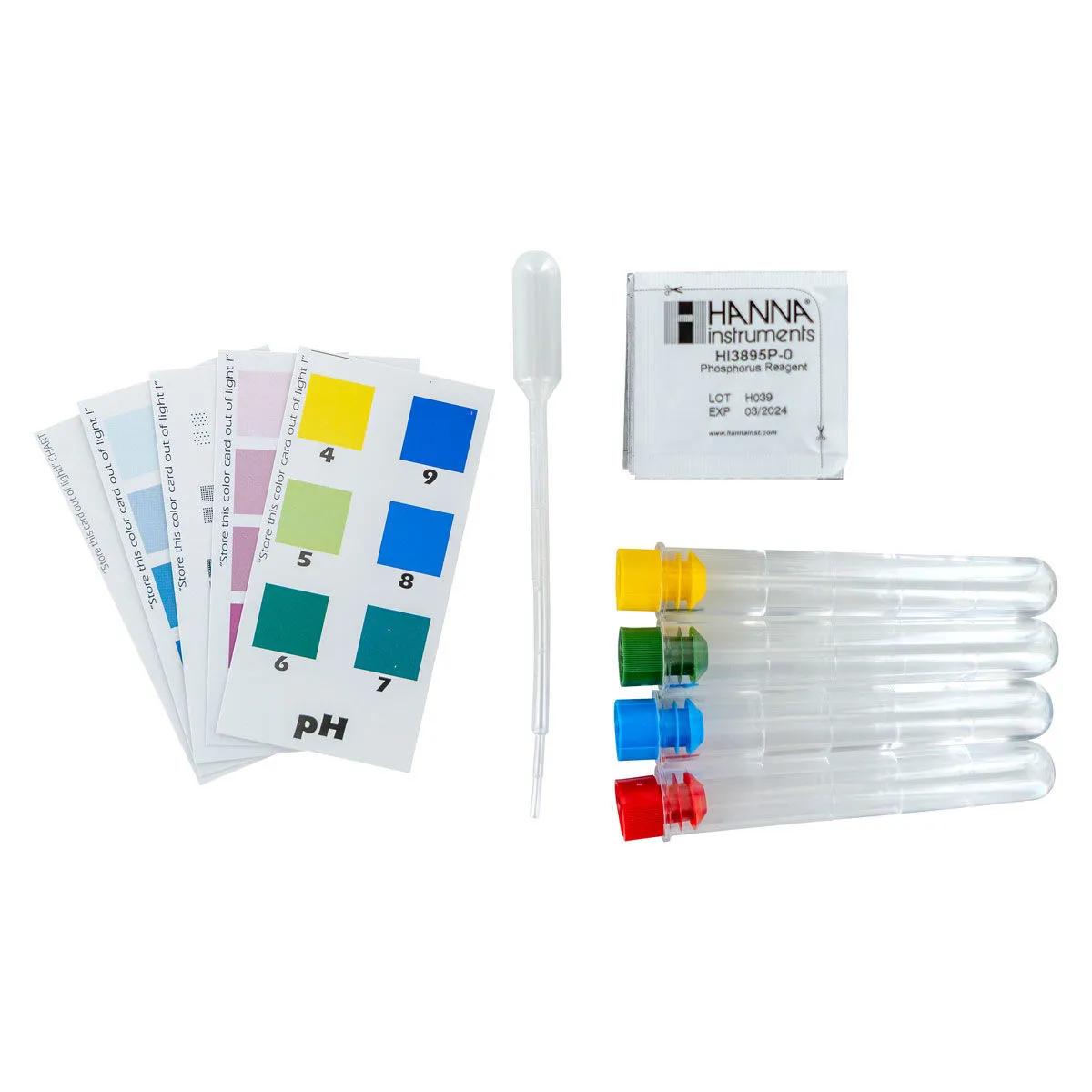
The pH and NPK Soil Test Kit is a chemical testing kit that lets you measure the four values your cannabis soil absolutely must get right: pH, nitrogen (N), phosphorus (P), and potassium (K). Each kit contains enough reagents for 10 separate tests — so you can track a single plant through its entire lifecycle or check multiple pots in one session. No batteries, no calibration, no apps. Just reagents, test tubes, and colour cards that give you a clear reading in minutes.
| Specification | Detail |
|---|---|
| SKU | HS1504 |
| Tests Included | 10 pH, 10 N, 10 P, 10 K (40 individual reagent capsules) |
| Test Method | Chemical reagent with colour comparison card |
| Components | Pre-made reagents, test tubes, colour comparison cards |
| Lot Tracking | Clear lot numbers and expiration dates on each reagent |
| Power Required | None — fully analogue |
| Intended Use | Soil testing for cannabis and other plants |
Complete your grow setup: pair this soil test kit with pH Up and pH Down solutions so you can actually correct what you find. If you're running living soil, a quality organic fertiliser keeps your NPK values where they need to be between tests.
A soil pH and NPK test kit is the cheapest insurance policy in your grow room. Here's the thing we see constantly behind the counter: someone walks in with yellowing leaves, convinced they've got a pest problem, when the real issue is their soil pH sitting at 5.0 and locking out every nutrient they've been pouring in. According to a study published in PMC, soil content of NPK can significantly affect plant growth, development, and the accumulation of medicinal substances (PMC, 2022). That applies directly to cannabis — if your soil is short on phosphorus during flowering, your buds won't fill out no matter how good your light is.
Cannabis is particularly fussy about pH. The sweet spot for soil grows sits between 6.0 and 7.0, and even half a point outside that range starts blocking nutrient uptake. Your plant can be sitting in perfectly balanced soil and still starve because the pH is wrong. That's not a feeding problem — it's an access problem. And you won't spot it by looking at the soil. You need to test it.
The honest limitation here: this is a colour-match kit, not a digital meter. You're comparing a liquid colour against a printed card, which means your reading is approximate — accurate enough to catch problems and guide corrections, but not laboratory-grade. For most home growers running 1–10 plants, that's more than enough. If you're managing a commercial operation and need readings down to 0.1 pH, you'll want a digital meter instead. But at this price point, there's no reason not to have one of these on the shelf.
Each pH and NPK soil test kit arrives ready to use with no additional purchases needed. Here's exactly what you get:
| Component | Quantity / Detail |
|---|---|
| pH Reagents | 10 pre-made capsules |
| Nitrogen (N) Reagents | 10 pre-made capsules |
| Phosphorus (P) Reagents | 10 pre-made capsules |
| Potassium (K) Reagents | 10 pre-made capsules |
| Test Tubes | Separate tube for each test type |
| Colour Comparison Cards | 1 per nutrient + 1 for pH |
| Lot Numbers | Printed on each reagent packet with expiry date |
The fact that every reagent carries a clear lot number and expiration date is a detail worth noting. Expired reagents give false readings, and false readings lead to bad decisions. With dated reagents, you always know whether your kit is still reliable. We'd suggest writing the date you opened the kit on the box — reagents last longer sealed than open.
We get asked this at least twice a week: "How often should I test my soil?" The short answer is 4 times per grow cycle — once before planting, once in early veg, once at the flip to flowering, and once mid-flower. That's 4 of your 10 tests on a single plant, leaving 6 for corrections or additional plants. According to research on long-term NPK fertilisation, the effects of single-factor fertilisation on yield showed significant differences depending on nutrient balance (PMC, 2023). Translation: getting one nutrient right while the others are off still causes problems.
The test that matters most? The one before flowering. Cannabis shifts from nitrogen-hungry in veg to phosphorus- and potassium-hungry in flower. If you've been feeding heavy N through veg (as you should), your P and K values might be lower than expected right when the plant needs them most. A quick test at the flip tells you whether to adjust your feed schedule — and that single test can be the difference between average and properly dense flowers.
One thing to watch out for: don't test immediately after watering with nutrient solution. Wait at least 24 hours for the soil to stabilise, or you'll just be measuring what you poured in rather than what's actually available to the roots.
Testing pH alone is a half-measure. A reading of 6.5 tells you your soil is in the right acidity range, but it says nothing about whether there's actually food in there. Conversely, dumping nutrients into soil with a pH of 5.0 is like stocking a fridge your plant can't open — the food is technically present but completely inaccessible.
Here's what each value tells you in practical terms:
The kit tests all 4 values independently, so you can pinpoint exactly which variable needs adjusting rather than guessing and over-correcting. Over-feeding is just as damaging as under-feeding — according to research, NPK toxicity in plants can cause nutrient imbalances that compound over time, making each subsequent correction harder.
Yes. The reagents measure universal soil chemistry — pH, nitrogen, phosphorus, and potassium — which applies to vegetables, herbs, flowers, and houseplants equally. The colour comparison cards aren't species-specific.
Colour-match kits are accurate within roughly 0.5 pH units and give a good/adequate/deficient reading for NPK rather than a precise ppm number. For home grows of 1–10 plants, that's enough to catch and correct problems. Digital meters offer finer resolution but cost significantly more and need regular calibration.
Yes. Tap water contains dissolved minerals and has its own pH, both of which will skew your results. A 1-litre bottle of distilled water is cheap and will last you well beyond 10 tests.
Each reagent packet is stamped with a lot number and expiration date. Unopened capsules typically last 1–2 years from manufacture. Once the kit is open, store it in a cool, dry place away from direct light to preserve accuracy.
If pH is below 6.0, add dolomite lime or a pH Up solution to raise it. If above 7.0, elemental sulphur or a pH Down solution brings it back. Test again 48 hours after amending to confirm the correction took hold.
You can rinse and reuse them with distilled water between tests. Make sure they're completely clean — residue from a previous reagent will contaminate the next reading. If in doubt, a quick rinse with distilled water and a shake-dry is enough.
For a single plant, 10 tests covers the full cycle with room to spare — 4 scheduled tests (pre-plant, early veg, flip, mid-flower) leaves 6 for follow-up checks or additional plants. For larger grows, grab a second kit.
Last updated: April 2026