Fertilizers & nutrients
by Green House Powder Feeding
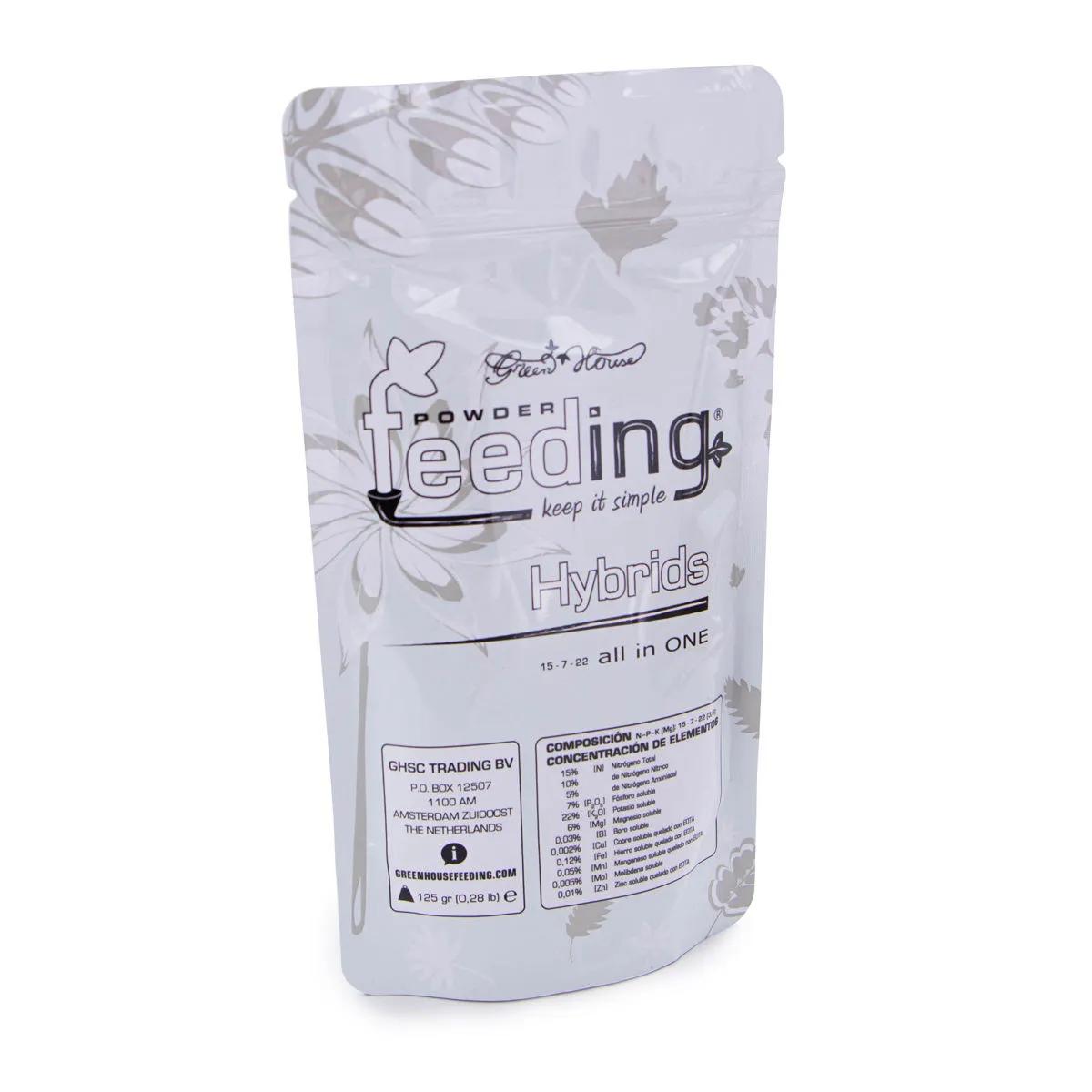
PowderFeeding Hybrids is a water-soluble mineral fertiliser specifically formulated for cannabis hybrids carrying 40–60% Indica genetics. Instead of juggling three bottles and a pH pen, you dissolve a single powder in water and feed. The N-P-K-Mg ratio of 15-7-22-3.6 delivers a potassium-heavy profile with reduced ammoniacal nitrogen and elevated magnesium — exactly what hybrid metabolisms demand across every growth stage. Works in soil, coco, hydroponics, and aeroponics without reformulation.
The 125g bag covers roughly 125 litres of nutrient solution at full-strength vegetative/flowering dose (1g per litre). That's enough for a small tent running 2–4 plants through a full cycle if you're not being wasteful. The full box of 50 bags is the bulk option — if you're running multiple cycles per year or sharing with a mate, the per-gram cost drops significantly and you won't run out mid-flower.
Most liquid nutrient lines ask you to buy a base A, a base B, a bloom booster, a cal-mag supplement, and maybe a root tonic on top. You end up with a shelf that looks like a chemistry lab and a mixing routine that eats 20 minutes every feed. PowderFeeding Hybrids collapses all of that into a single powder. One scoop, one stir, done.
The formula already contains 3.6% soluble magnesium — so you're not chasing cal-mag deficiencies halfway through flower. It also packs six micronutrients (boron at 0.03%, iron at 0.12%, manganese at 0.05%, zinc at 0.01%, copper at 0.002%, and molybdenum at 0.005%) that most base nutrients leave out entirely. We've seen growers blame "genetics" for yellowing leaves when the real culprit was a missing trace element. This powder removes that variable.
The one honest limitation: it's a mineral salt fertiliser, not an organic line. If you're committed to a living soil approach with microbial teas and amendments, this isn't your product. But if you want repeatable, measurable nutrition with zero guesswork — especially in coco or hydro where organic inputs can clog drippers — PowderFeeding Hybrids is about as clean as it gets.
PowderFeeding Hybrids contains a 15-7-22 NPK ratio with 3.6% magnesium — a profile that leans heavily into potassium for flower development while keeping nitrogen moderate for balanced vegetative growth. The nitrogen split between nitrate (10%) and ammoniacal (5%) is deliberate: less ammoniacal nitrogen means less risk of toxicity build-up in the root zone, especially in recirculating hydro systems.
| Element | Content | Form |
|---|---|---|
| Nitrogen (N) | 15% | 10% nitrate / 5% ammoniacal |
| Phosphorus (P2O5) | 7% | Soluble |
| Potassium (K2O) | 22% | Soluble |
| Magnesium (Mg) | 3.6% | Soluble |
| Iron (Fe) | 0.12% | Soluble |
| Manganese (Mn) | 0.05% | Soluble |
| Boron (B) | 0.03% | Soluble |
| Zinc (Zn) | 0.01% | Soluble |
| Molybdenum (Mo) | 0.005% | Soluble |
| Copper (Cu) | 0.002% | Soluble |
That 22% potassium figure is the standout. Potassium drives flower density, sugar transport, and overall plant vigour during bloom. Compared to a general-purpose fertiliser, this is weighted for plants that need to pack on weight in the final weeks. The 0.12% iron content is also worth noting — iron deficiency shows up as interveinal chlorosis on new growth and it's one of the most common micronutrient issues we see photos of in grow forums. Having it baked into the base feed prevents that before it starts.
Dissolve the powder in water, stir until fully dissolved, and feed. The powder dissolves cleanly in lukewarm water — no clumps, no residue at the bottom of the reservoir. If you're mixing in cold water, give it an extra minute of stirring.
The most obvious comparison is against multi-part liquid systems. Here's how PowderFeeding Hybrids stacks up against a typical 3-part liquid nutrient line:
| Feature | PowderFeeding Hybrids | Typical 3-Part Liquid Line |
|---|---|---|
| Number of products needed | 1 | 3–5 (base A, B, bloom, additives) |
| Mixing time | Under 2 minutes | 5–15 minutes (sequential mixing) |
| Micronutrients included | Yes — 6 trace elements | Varies — often requires separate cal-mag |
| Shelf life | Years (dry powder) | 6–12 months once opened |
| Shipping weight | 125g makes 125 litres | 3–5kg for equivalent volume |
| Medium compatibility | Soil, coco, hydro, aero | Often medium-specific formulations |
| Strain-specific formulation | Yes — hybrid-tuned NPK | Generic ratios, adjust manually |
The shelf life point is underrated. Liquid nutrients can precipitate, separate, or grow mould once opened. A sealed bag of PowderFeeding Hybrids sits in your cupboard for years without degrading. If you grow in cycles with breaks between, you're not throwing away half-used bottles.
If you're running a pure sativa or a heavy indica, Green House Powder Feeding makes strain-specific versions for those too. But for the vast majority of modern hybrids — which sit squarely in that 40–60% indica range — this is the best single-product feeding solution we carry.
We've been stocking PowderFeeding since it launched, and the feedback pattern is consistent: growers who switch from liquids to powder almost never switch back. The convenience factor alone converts people. But the real surprise for most is how clean the powder dissolves — there's a mental hurdle where people expect a grainy, milky solution, and instead they get crystal-clear nutrient water.
The most common mistake we see? Overfeeding seedlings. Young plants need a fraction of what a flowering plant consumes. At 2.5g per 10 litres, you're at roughly 0.3–0.4 EC from the powder alone. That's gentle enough for a two-week-old seedling. Jumping straight to 10g per 10 litres on a young plant will burn leaf tips within days. Start low, watch the plant's response, and scale up as it enters vigorous vegetative growth.
One thing the packaging doesn't emphasise enough: water temperature matters. Cold water below 15°C dissolves the powder slowly and can leave undissolved particles that clog drip emitters. Room temperature water — around 20°C — dissolves everything in under 30 seconds with a good stir.
Running PowderFeeding Hybrids in a tent setup? Pair it with a reliable pH meter and an EC meter — accurate measurement is half the game with mineral fertilisers. If you're setting up a new grow space, check out our grow tents and complete grow kits to get the environment right before dialling in nutrition.
In most cases, yes. The 3.6% magnesium content covers the extra mag demand that coco creates. However, if your source water is very soft (below 0.2 EC), you may still want a light calcium supplement during peak flower. Watch for brown spots on lower leaves — that's your calcium deficiency signal.
If the breeder lists the genetics as anywhere between 40% and 60% indica, this is the right formula. Most modern commercial strains fall into this range. If your strain leans heavily sativa (70%+ sativa) or heavily indica (70%+ indica), Green House Powder Feeding makes dedicated formulas for those profiles.
Usually, yes. The dissolved solution tends to land around pH 5.8–6.2 depending on your source water. For hydro and coco, aim for 5.8–6.0. For soil, 6.0–6.5. Always measure after mixing — never assume.
You can, but the formula is designed as a complete feed. Adding extra PK boosters on top risks overfeeding potassium and locking out calcium. If you want to add a root stimulator or beneficial microbes, those are generally safe since they don't alter the mineral balance significantly.
At the full flowering dose of 1g per litre, a 125g bag makes 125 litres of nutrient solution. For a small tent with 2–4 plants watered every 2–3 days at 1–2 litres each, that's roughly 3–5 weeks of feeding. Most growers go through 1–2 bags per full cycle from seed to harvest.
Flushing lets the plant metabolise residual mineral salts stored in the leaves and flowers. Unflushed plants can produce a harsher, more chemical-tasting end product. Ten days of plain water is the manufacturer's recommendation and lines up with what most experienced growers practise.
No. It's a mineral salt fertiliser — synthetic, precise, and fast-acting. If you need certified organic inputs, this isn't the right product. The trade-off is that mineral salts give you exact control over nutrient ratios, which organic amendments can't match.
Last updated: April 2026