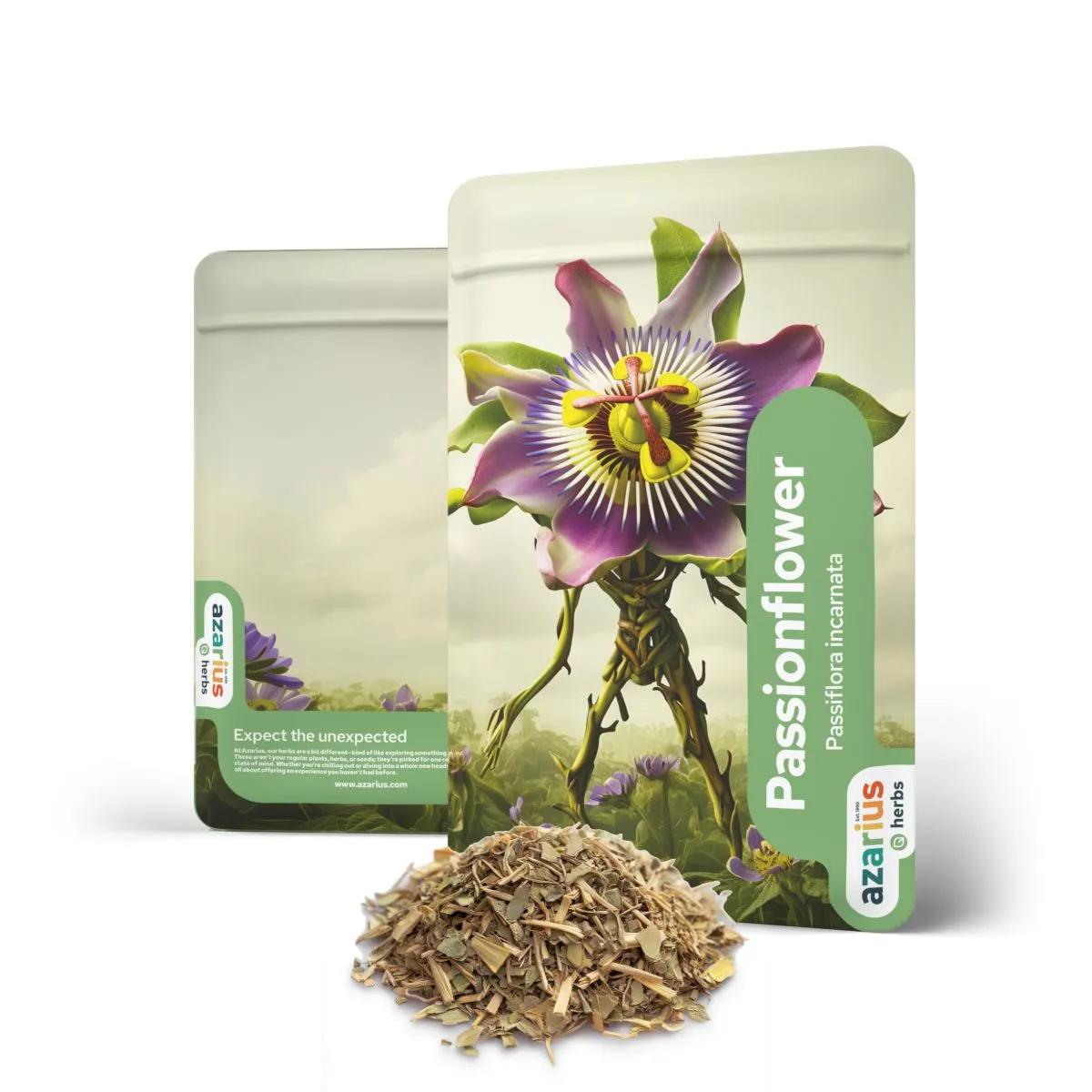
Passionflower
by Azarius
Passionflower leaves are dried, cut botanical leaves from the Passiflora incarnata vine — a traditional calming herb that brews into a mildly bitter, earthy tea with a hay-like finish. We've carried these since the early days of the shop, and they remain one of our most consistently reordered herbs. The reason is straightforward: steep a cup about an hour before bed, and you'll notice the shift. No drama, no heavy sedation — just the edge taken off your evening.
These are cut-and-sifted dried leaves from organically grown Passiflora incarnata — the species with the longest track record in European herbalism and the one most frequently studied in clinical research. The cut is coarse enough for a tea strainer but fine enough to blend evenly into a smoking mix. When you open the bag, you'll catch a dry, grassy scent — somewhere between fresh hay and chamomile, with a faintly green undertone. The flavour in tea is mild and slightly bitter, the kind that grows on you after the third or fourth cup. Adding a spoonful of honey rounds it out nicely.
Honestly, the one limitation with passionflower tea is the taste on its own. It's not unpleasant, but it's not exactly something you'd serve to impress guests either. That's why most of our regulars blend it — chamomile softens the bitterness, valerian adds body, and a bit of lemon balm brightens the whole cup. On its own, it's functional. Blended, it's genuinely enjoyable.
| Specification | Detail |
|---|---|
| Botanical Name | Passiflora incarnata L. |
| Common Names | Passionflower, Maypop, Purple Passionflower |
| Plant Part | Dried cut leaves |
| Cultivation | Organically grown |
| Preparation Methods | Tea infusion, smoking blend, herbal mix |
| Flavour Profile | Mildly bitter, earthy, hay-like with grassy undertone |
| Origin | Native to southeastern North America |
| Key Compound Groups | Flavonoids (chrysin, vitexin), alkaloids, glycosides |
Passionflower has been used in herbal traditions for hundreds of years. Native American peoples prepared it in various ways long before European contact, and once it crossed the Atlantic, it became a staple in European herbalism — particularly for evening teas. The name itself comes from Latin: passio (suffering) and flora (flower), a reference to early Christian missionaries who saw the intricate flower structure as a symbol of the crucifixion. Nothing to do with the kind of passion you might be thinking of.
What keeps it on our shelves after 25-plus years isn't the history — it's the reorder rate. Customers come back for passionflower leaves more consistently than for most herbs we stock. According to a systematic review of nine clinical trials published in Current Drug Discovery Technologies, Passiflora incarnata showed effects on sleep quality and anxious feelings across study durations ranging from a single day up to 30 days (Janda et al., 2020). A randomised, double-blind, placebo-controlled trial found that participants drinking passionflower tea showed measurable improvements on the Insomnia Severity Index over a 30-day period compared to placebo (PubMed, 2024). And a separate double-blind study on polysomnographic sleep parameters — the kind measured in a sleep lab — observed that passionflower consumption was associated with changes in sleep architecture (Ngan & Conduit, 2011).
We're not saying it'll knock you out like a pharmaceutical. It won't. But the research lines up with what we hear from customers: a gentler wind-down, an easier time falling asleep, and a morning that doesn't start with grogginess. That's the sweet spot for a dried herb you can buy for a few quid.
After thousands of conversations about this herb, we've noticed three main use cases. The first and most popular is a straightforward evening tea — steep 1–2 teaspoons in freshly boiled water for 10–15 minutes, strain, drink about an hour before you want to sleep. Clinical studies have used doses ranging from 500–1,200mg of dried passionflower herb daily (Ngan & Conduit, 2011), which roughly translates to 1–3 cups of tea depending on how strong you brew it.
The second use is in herbal smoking blends. Passionflower leaves burn evenly and produce a smooth, light smoke that works well as a base. They don't have a strong flavour when smoked, which makes them good for blending with more aromatic herbs like damiana or mugwort. If you're rolling your own herbal blends, passionflower gives you volume and an even burn without overpowering anything else in the mix.
The third — and this is the one we'd personally recommend — is blending it into a bedtime tea ritual with other calming herbs. Passionflower plus chamomile plus valerian root is the combination we hear about most. Each brings something different to the cup, and together they make for a genuinely pleasant evening drink rather than something you're just choking down for the effect.
Passionflower is one of the better-studied calming herbs, which is part of why we keep recommending it. According to an ethnopharmacological review, clinical studies on Passiflora incarnata preparations reveal effects that researchers describe as relevant to both sleep and anxious states (Miroddi et al., 2013). The active compounds include flavonoids like chrysin and vitexin, along with alkaloids and glycosides — a profile that distinguishes it from single-compound supplements.
A 2024 study examining passionflower's anxiolytic potential noted that pharmacologically active compounds including flavonoids, alkaloids, and glycosides contribute to its observed effects in both animal and human models (PubMed, 2025). And research into its effects on the central nervous system has documented both calming and mild sedative activity in animal models (Lee et al., 2017).
We should be honest about what we don't know, too. Most clinical trials have been relatively small and short-term. The mechanisms aren't fully mapped out. And individual responses vary — some people notice a clear difference from the first cup, others need a week of regular use before anything shifts. That's the reality with botanical herbs, and anyone telling you otherwise is overselling.
Passionflower is generally well-tolerated. Side effects reported in clinical literature are rare but include drowsiness, mental slowing, nausea, rapid heartbeat, and in uncommon cases, vomiting. These tend to appear at higher doses or in combination with other sedating substances.
The critical interaction to flag: passionflower may increase the effects of benzodiazepines and barbiturates like pentobarbital. If you're taking any medication that causes drowsiness or affects the central nervous system, talk to your doctor before adding passionflower to your routine. This isn't a throwaway warning — the interaction with CNS depressants is well-documented and worth taking seriously.
| Safety Consideration | Detail |
|---|---|
| Common Side Effects | Drowsiness, mild nausea (rare) |
| Uncommon Side Effects | Rapid heartbeat, vomiting, mental slowing |
| Drug Interactions | Benzodiazepines, barbiturates, other CNS depressants |
| Pregnancy/Nursing | Insufficient safety data — avoid |
| Research Dose Range | 500–1,200mg dried herb daily in clinical studies |
Passionflower leaves pair brilliantly with chamomile flowers and valerian root for a complete bedtime tea blend. If you're building a herbal smoking mix, damiana leaves add a warm, slightly sweet note that complements passionflower's neutral burn. All available in the herbshop.
Most people notice the calming effect within 30–60 minutes of drinking a cup. Clinical studies typically had participants consume passionflower tea about an hour before bed. Brew it before your evening wind-down routine, not right as you're climbing into bed.
Yes. Dried passionflower leaves burn evenly and produce a mild, smooth smoke. They work best as a base in herbal smoking blends rather than on their own, since the flavour when smoked is quite neutral. Blend with damiana or mugwort for a more aromatic mix.
Mildly bitter with an earthy, hay-like flavour and a faintly grassy undertone. It's not unpleasant, but it's not exactly exciting on its own either. A spoonful of honey or a chamomile blend makes a noticeable difference. The taste genuinely grows on you after a few cups.
Use 1–2 teaspoons of dried leaves per 200–250ml of boiling water. Clinical studies have used doses of 500–1,200mg daily of dried herb. One strong cup falls within that range. Steep for 10–15 minutes with a lid on for best extraction.
This is actually the most popular combination we hear about from customers. Passionflower and valerian root complement each other well in an evening tea blend — passionflower brings the lighter, grassy notes while valerian adds depth and body. Add chamomile to round it out.
Yes — passionflower may increase the effects of benzodiazepines, barbiturates, and other medications that cause drowsiness or affect the central nervous system. If you're on any CNS-active medication, speak with your doctor before using passionflower regularly.
Keep them in an airtight container away from direct sunlight and moisture. A sealed jar in a kitchen cupboard works fine. Stored properly, dried passionflower leaves maintain their potency for 12–18 months. You'll know they're past their best when the hay-like aroma fades significantly.
Last updated: April 2026
Medical disclaimer. This content is for informational purposes only and does not constitute medical advice. Consult a qualified healthcare provider before use of any substance.