Cultivation supplies
by Bemis
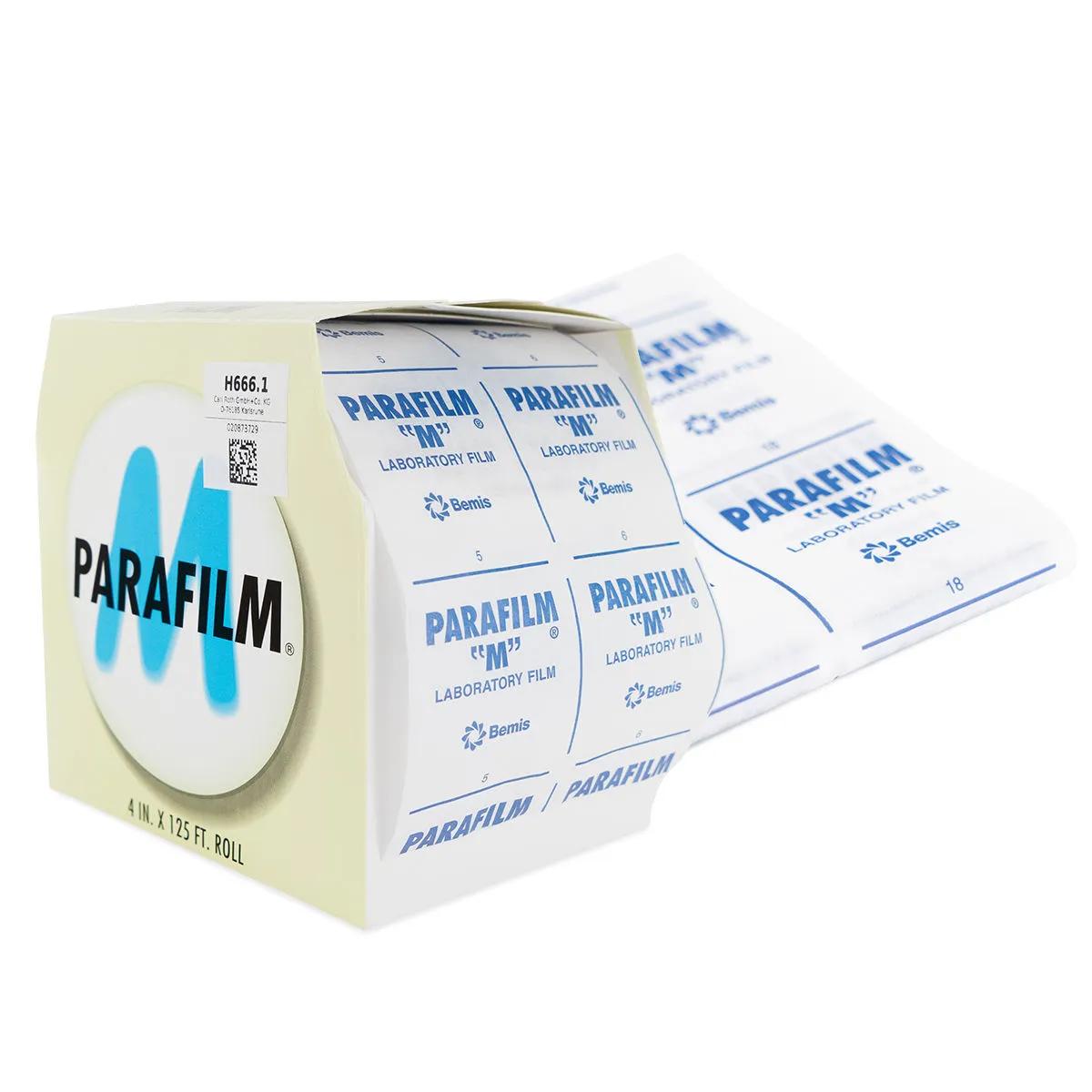
Parafilm is a semi-permeable sealing film that keeps contaminants out while letting gas exchange happen naturally. Originally a laboratory staple for sealing Erlenmeyer flasks and petri dishes, it's become one of the most useful bits of kit in any mushroom grower's toolkit. The film is 10 cm wide, stretches to 3–4 times its original length, and moulds itself around virtually any container shape you throw at it.
We carry two variants. The 1-metre cut is your best bet if you're sealing a handful of petri dishes or agar plates for a single project — enough for roughly 8–12 dishes depending on how generous you are with overlap. The 38-metre roll is what we'd pick if you're doing any amount of regular work. At nearly 40 metres, it'll last months of agar transfers, grain jar prep, and dish storage. Once you start using Parafilm, you go through it faster than you'd expect.
| Spec | Value |
|---|---|
| Width | 10 cm (approx. 4 inches) |
| Length (small) | 1 metre |
| Length (full roll) | 38 metres |
| Stretch capacity | 3–4 times original length |
| Material | Polyolefin / paraffin wax blend |
| Latex content | Latex-free |
| Permeability | Semi-permeable (allows O₂/CO₂ exchange, blocks bacteria) |
| SKU (1 m) | SH0011 |
| SKU (38 m) | SH0012 |
Complete your cultivation setup with agar plates, a pressure cooker for sterilisation, and a still air box or flow hood. Parafilm pairs directly with petri dishes and Erlenmeyer flasks — if you're doing agar work, you'll want all three on your bench.
Contamination kills more grows than bad genetics ever will. We've seen customers lose entire batches of agar plates to a single exposed dish left overnight. The problem isn't dramatic — it's invisible. Mould spores and bacteria float around every room in your house, and they only need a fraction of a second of exposure to land on your nutrient-rich media and start colonising.
Parafilm solves this in a way that cling film, aluminium foil, and electrical tape simply don't. It's semi-permeable — meaning oxygen and carbon dioxide pass through the film while bacterial contaminants and mould spores can't. According to research published in PMC (2023), Parafilm has been assessed for its ability to contain biological material during transport, confirming its effectiveness as a barrier against microbial contamination. A separate study published in PMC (2023) also validated Parafilm as a sterile transport matrix for biological samples, noting that sheets can be prepared under complete sterility beforehand.
That gas exchange bit is critical. If you seal a petri dish with standard cling film or tape, you create an airtight environment. Your mycelium needs to breathe. Wrap it in Parafilm instead, and you get a sealed dish that still allows fresh air in — the best of both worlds. One thing to watch: a 2025 study in PMC noted that different sealing films can alter O₂ and CO₂ concentrations inside petri dishes, so don't go wrapping 6 layers thick. A single stretched layer does the job.
The texture of Parafilm is unlike anything else you'll handle in a grow setup. It feels waxy and slightly tacky between your fingers — somewhere between cling film and a strip of chewing gum. That tackiness is what makes it self-sealing. Once you stretch a piece and wrap it around a dish rim, it grips itself and stays put without any tape, glue, or clips. It's oddly satisfying to work with.
One honest limitation: Parafilm isn't resistant to all solvents. It holds up well against water and most polar substances for up to 48 hours, but chlorinated solvents and aromatic compounds will eat through it. For mushroom cultivation, this is irrelevant — you're sealing agar and grain, not chemical solutions. But if you're using it in a broader lab context, keep that in mind.
Compared to using micropore tape (the other common option for sealing dishes), Parafilm gives you a more complete seal with better visibility. Micropore tape works well on jar lids and filter patches, but for petri dishes specifically, Parafilm is the better tool. It wraps around curved rims cleanly, and you can see through it to check for contamination without opening the dish. We'd use micropore tape on spawn jars and Parafilm on agar plates — each has its place.
It's a blend of polyolefin and paraffin wax, which gives it that waxy, self-sealing texture. It contains no latex, so it's safe for anyone with latex sensitivities. The material is what makes it semi-permeable — gases pass through, bacteria don't.
Technically you can re-stretch a used piece, but we wouldn't recommend it for sterile work. Once a strip has been peeled off a dish, it's been exposed to whatever's in your environment. Fresh strips are cheap — use a new one each time.
Keep it in a cool, dry place away from direct sunlight. The roll doesn't expire in any practical sense, but heat can make it overly soft and sticky. Room temperature in a drawer or cupboard is fine. The 38-metre roll will last months even with regular use.
They serve different purposes. Parafilm excels on petri dishes and flasks where you need a complete seal with gas exchange. Micropore tape is better for jar lids and filter patches on spawn bags. Most growers keep both on hand.
A standard 90 mm petri dish needs roughly 15–20 cm of unstretched Parafilm. Once stretched to 3–4 times that width, one strip wraps the entire rim with overlap. From a 1-metre cut, you'll seal about 5–6 dishes comfortably. The 38-metre roll covers approximately 190–250 dishes.
No — and that's the whole point. It's semi-permeable, allowing oxygen and CO₂ to pass through while blocking bacterial contaminants and mould spores. Your mycelium can breathe without being exposed to the open air.
Parafilm has a relatively low melting point due to its paraffin wax content, so it won't survive a standard autoclave cycle at 121°C. Apply it after sterilisation, not before. Work in front of a still air box or flow hood for best results.
Last updated: April 2026
Medical disclaimer. This content is for informational purposes only and does not constitute medical advice. Consult a qualified healthcare provider before use of any substance.