Spore Vials
by Mondo
The Mondo Vial Psilocybe cubensis B+ is a 10 ml spore suspension vial designed for mycological research and microscopy work. B+ is one of the most widely cultivated Psilocybe cubensis strains on the planet, and for good reason: it produces absolutely massive fruit bodies — we're talking mushrooms that can stretch to 30 cm in length on the right substrate. The strain tolerates cooler conditions than most cubensis varieties, colonising and even fruiting at temperatures as low as 15 degrees C (60 degrees F), which makes it a forgiving choice for researchers working outside climate-controlled labs.
The B+ (sometimes written "Be Positive") was originally marketed as a Psilocybe azurescens/cubensis hybrid, but genetic analysis has confirmed it is 100% Psilocybe cubensis. That myth still circulates online, so now you know. What actually sets B+ apart is its cold tolerance and sheer size. Most cubensis strains want 22-25 degrees C to colonise comfortably. B+ will push through at 15 degrees C — not quickly, but it will get there. That resilience extends to substrate versatility: cased grains, compost, pasteurised straw, and supplemented sawdust all work. On nutritious substrates like cased rye grain, the fruit bodies grow thick-stemmed and tall, sometimes reaching 30 cm from base to cap.
From a research perspective, B+ spores are dense and easy to observe under a microscope at 400-1000x magnification. The spore print is dark purplish-brown, typical of Psilocybe cubensis, and the suspension in this vial is well-distributed — you should see a slight cloudiness when you hold it up to the light. If the liquid looks completely clear, give the vial a gentle shake before drawing up your sample.
According to a 2025 study published in PMC, "numerous studies have highlighted the therapeutic potential of psychedelics in clinical applications, particularly in treating mental health disorders," with Psilocybe cubensis strains being among the most frequently studied species (PMC, 2025). The active compounds in cubensis — psilocybin and psilocin — are tryptamines structurally similar to serotonin, as confirmed by stability research published in PubMed (Gotvaldova et al., 2020).
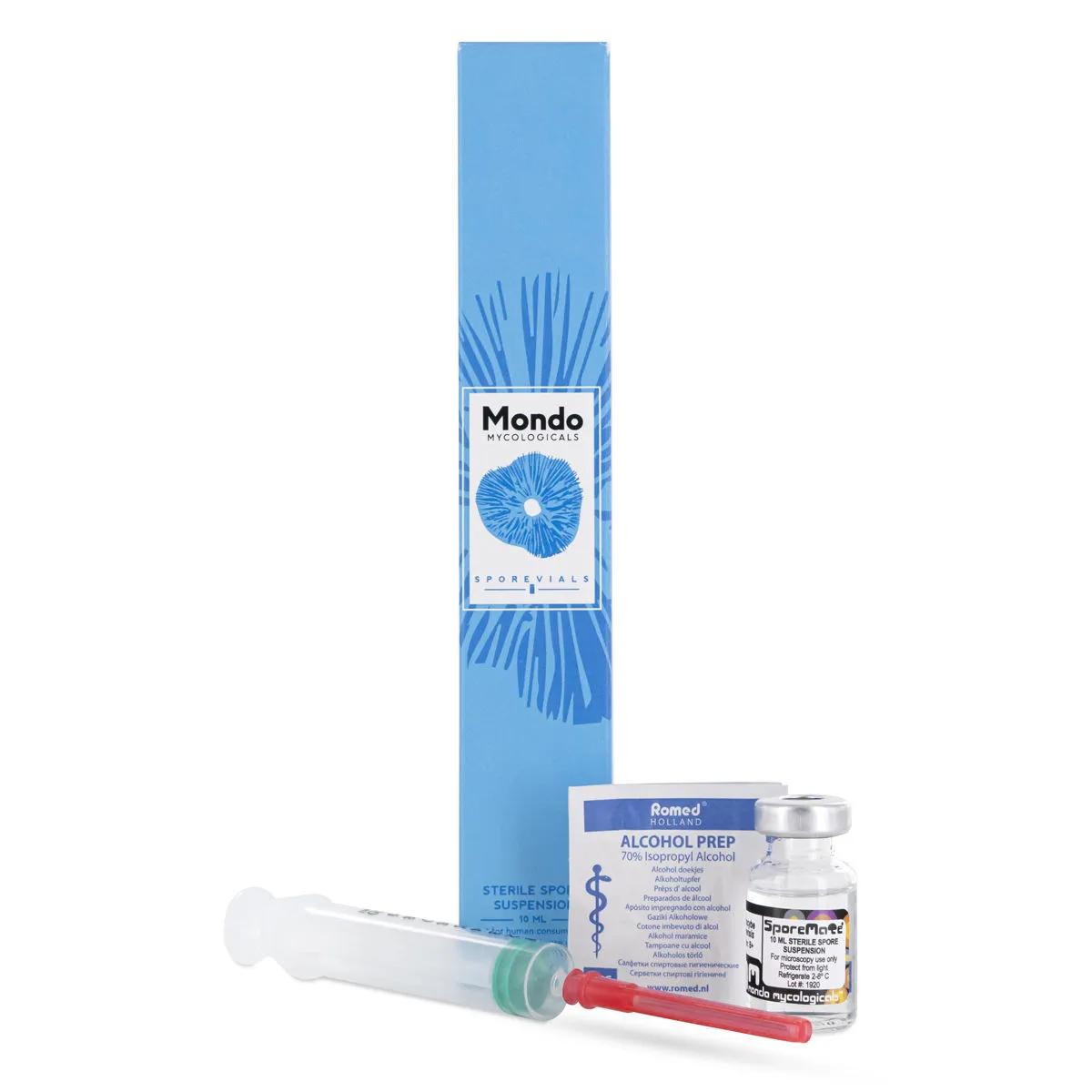
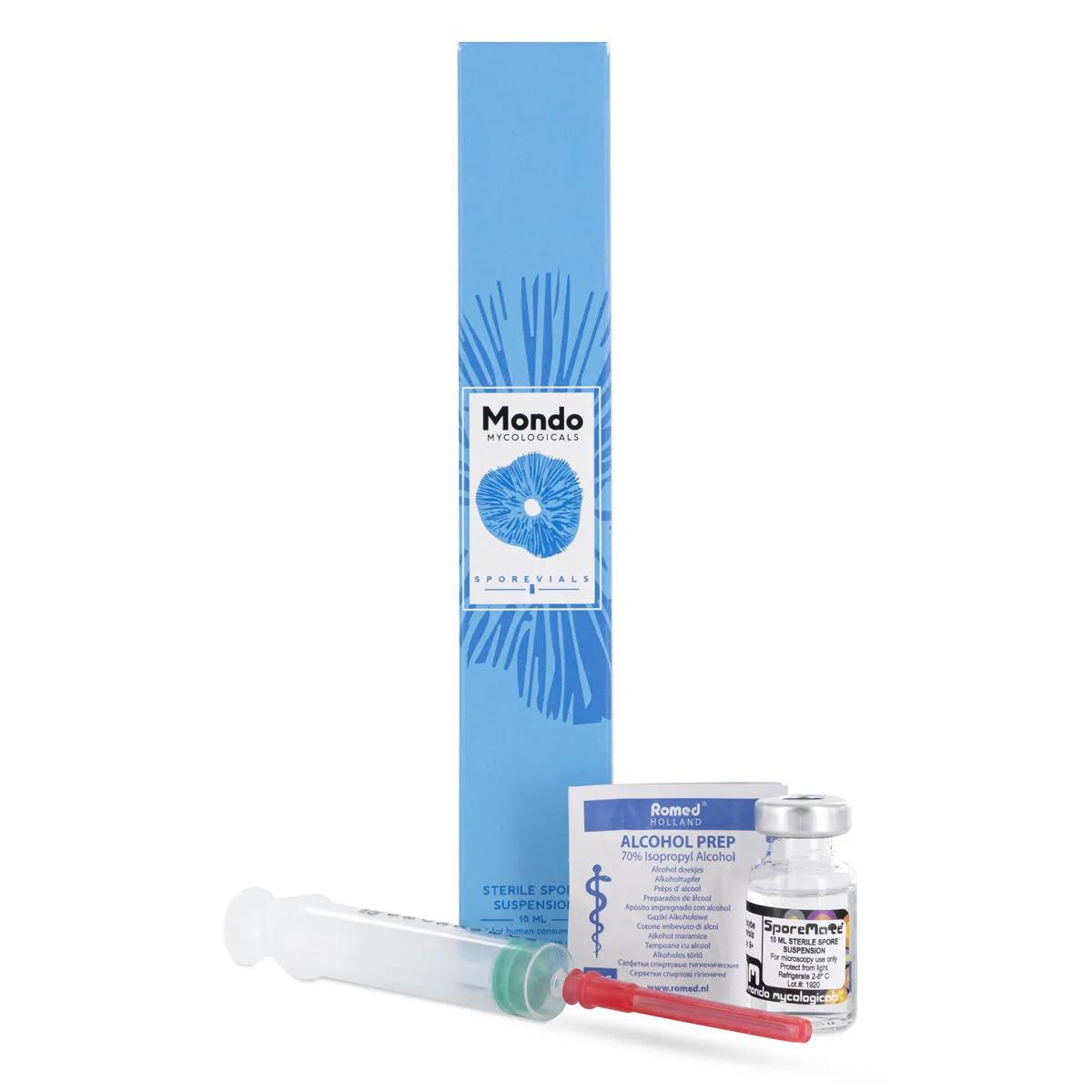
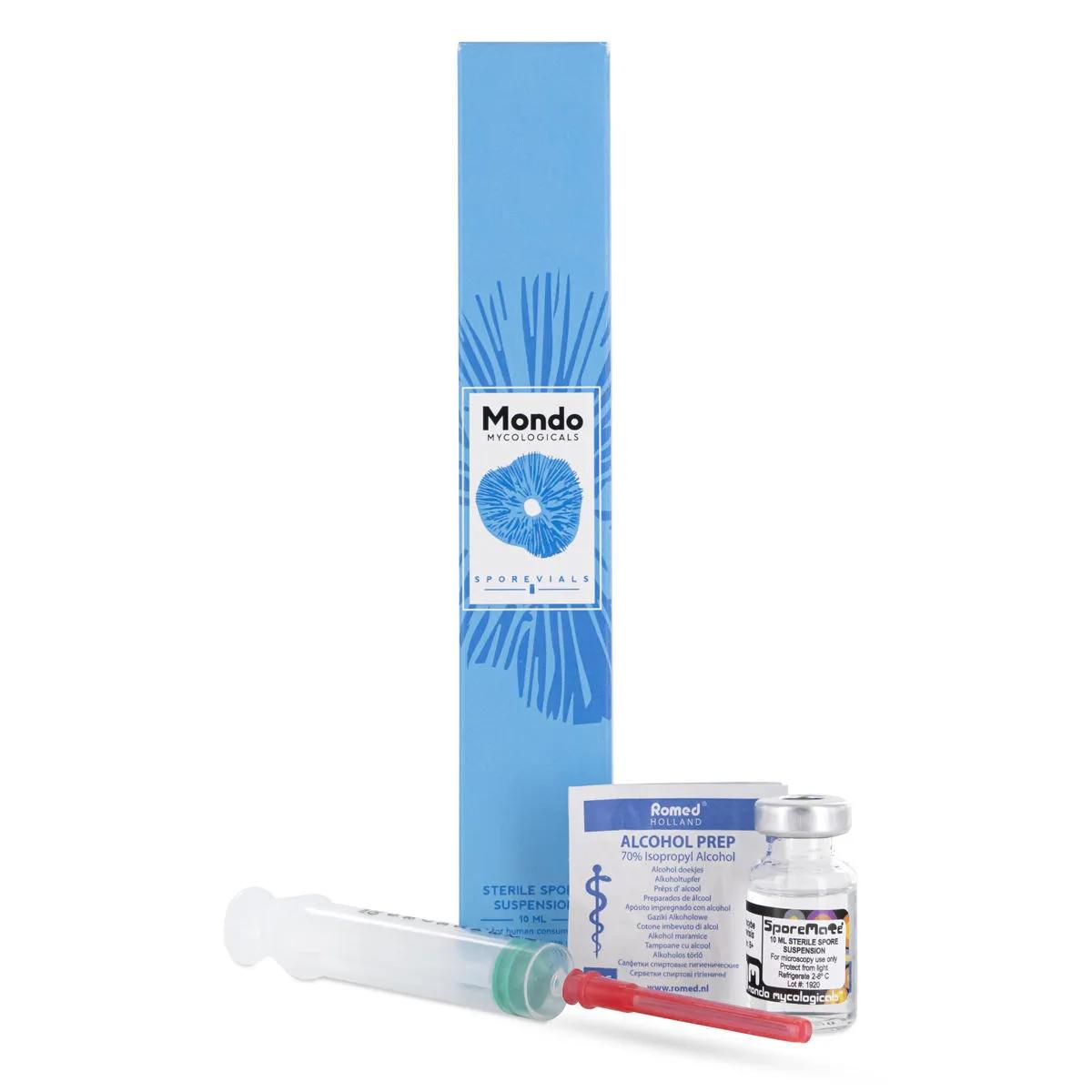
Mondo packages these vials properly. No loose syringes rattling around in an envelope — everything arrives sealed and sterile.
| Item | Details |
|---|---|
| Spore vial | 10 ml suspension of Psilocybe cubensis B+ spores in sterile water |
| Syringe | Empty, individually wrapped, sterile |
| Alcohol swabs | 2 included for wiping injection ports or slide surfaces |
| SKU | SH0024 |
The vial format has an advantage over spore syringes: because the spores are stored separately from the syringe, there is less chance of contamination during storage. You draw up exactly the amount you need, when you need it, and the vial stays sealed in between. One 10 ml vial gives you enough suspension for roughly 10-20 inoculation points, depending on how much you use per point (0.5-1 ml is typical).
| Spec | Value |
|---|---|
| Species | Psilocybe cubensis |
| Strain | B+ (Be Positive) |
| Volume | 10 ml |
| Format | Spore suspension in sterile vial |
| Colonisation temperature | 15-28 degrees C (60-82 degrees F) |
| Optimal fruiting temperature | 21-24 degrees C (70-75 degrees F) |
| Fruit body size | Up to 30 cm on nutritious substrates |
| Spore print colour | Dark purplish-brown |
| Suitable substrates | Cased grains, compost, pasteurised straw |
| Brand | Mondo |
| Storage | Cool and dark (2-8 degrees C recommended) |
| Shelf life | Up to 2 years when stored correctly |
Complete your mycology setup with the Mondo Grow Kit Psilocybe cubensis B+ if you want a fully colonised, ready-to-fruit substrate. Already have your own grain jars? A still air box and a decent thermometer are the two items that separate clean results from contaminated ones. Pair this vial with sterile grain spawn bags for a straightforward inoculation workflow.
We have been selling spore vials since the early 2000s, and the question we hear most often is: "Which strain should I start with?" The answer has not changed in 25 years. B+ is the one. Not because it is the most potent (it is moderate), and not because it is the most exotic (it is not). It is the best starting strain because it tolerates your mistakes.
Temperature swings that would stall a Thai or Cambodian strain barely slow B+ down. The minimum colonisation temperature of 15 degrees C means an unheated spare room in autumn is still viable. Contamination resistance is above average for a cubensis — not bulletproof, but forgiving enough that a slightly imperfect sterile technique will not automatically ruin your work. And when it fruits, it fruits big. There is something deeply satisfying about opening a tub and seeing mushrooms the length of your forearm.
The honest limitation: B+ is not the fastest coloniser. Strains like Golden Teacher or Ecuador will typically show full colonisation 3-5 days sooner under identical conditions. If speed matters to you, those are worth considering. But for overall reliability and fruit body size, B+ is hard to beat.
Compared to the Mondo Vial Psilocybe cubensis PES Amazonian — another popular choice — B+ produces similarly large fruit bodies but handles temperature drops better. PES Amazonian prefers a steady 23-25 degrees C and can stall below 20 degrees C. If your workspace runs cool, B+ is the smarter pick.
Sterile technique is everything. One ungloved fingerprint on a needle tip can introduce enough bacteria to ruin a jar. We have seen it happen hundreds of times — do not skip the basics.
Spore vials last significantly longer than pre-filled syringes when stored properly. Keep the Mondo B+ vial in a fridge (2-8 degrees C), away from light, and it will remain viable for up to 2 years. At room temperature, viability drops noticeably after 6-8 months. Never freeze the vial — ice crystals can damage spore cell walls and reduce germination rates.
One thing we have noticed over the years: vials that have been left at room temperature for weeks sometimes show clumping of the spore material. This does not mean the spores are dead. Give the vial a firm shake for 20-30 seconds and the clumps should break up. If the suspension turns a strange colour (greenish, yellowish) or smells off when you open it, that indicates bacterial contamination — do not use it.
Psilocybe cubensis contains the tryptamine alkaloids psilocybin, psilocin, baeocystin, norbaeocystin, and aeruginascin. According to Gotvaldova et al. (2020), these compounds are "structurally similar to the neurotransmitter serotonin," which explains their affinity for 5-HT2A receptors in the brain (PubMed). The same research team studied the stability of these alkaloids in dried cubensis biomass, providing valuable data for researchers working with stored material.
A 2024 study on Psilocybe cubensis extract found that it "potently prevents fear" in animal models, with the principal active compounds being psilocybin and psilocin (PubMed, 2024). Meanwhile, research into the broader chemical composition of Psilocybe mushrooms has identified gaps in our understanding — a 2025 PMC review catalogued 74 articles on the chemical composition and biological activities of Psilocybe species, noting that much remains to be explored (PMC, 2025).
This is exactly the kind of work that spore vials like this one support. Microscopic examination of B+ spores reveals the characteristic ellipsoid shape and dark pigmentation of Psilocybe cubensis, making it a useful reference specimen for anyone building familiarity with fungal taxonomy.
Between 10 and 20, depending on how much you use per point. At 0.5 ml per inoculation, you get 20 uses. At 1 ml — which is more common for grain jars — you get 10. Either way, one vial goes a long way compared to a single-use spore syringe.
A spore syringe comes pre-filled — the spores are already inside the syringe. A vial stores the suspension separately, and you draw up what you need with the included sterile syringe. The vial format reduces contamination risk during storage because the suspension stays sealed until you puncture the septum.
Yes — it is the strain we recommend most often for first-time researchers. B+ tolerates temperature fluctuations, colonises reliably on multiple substrate types, and resists contamination better than many cubensis varieties. The fruit bodies are impressively large, which makes observation and documentation straightforward.
It can colonise and even produce fruit bodies at 15 degrees C, though growth will be significantly slower than at the optimal 21-24 degrees C range. Think of 15 degrees C as the survival floor, not the target. You will get results, but expect them to take 30-50% longer than at warmer temperatures.
In a fridge at 2-8 degrees C, away from light. Do not freeze it — ice crystal formation damages spore viability. Stored correctly, the vial remains viable for up to 2 years. At room temperature, plan to use it within 6-8 months for best results.
No. It was originally marketed that way, but B+ is confirmed to be 100% Psilocybe cubensis. The hybrid claim has been debunked — azurescens and cubensis are genetically distinct enough that a stable hybrid is not feasible with current cultivation methods.
Cased rye grain produces the largest fruit bodies. Pasteurised straw and compost-based substrates also work well. B+ is not picky — it colonises most standard mycology substrates without issue. For microscopy work only, agar plates with malt extract are standard.
Healthy suspension looks slightly cloudy with a neutral smell. If the liquid has turned green, yellow, or has visible floating masses that do not break up with shaking, bacterial or mould contamination is likely. A foul smell when the septum is punctured is another clear sign. Do not use a contaminated vial.
Last updated: April 2026
Medical disclaimer. This content is for informational purposes only and does not constitute medical advice. Consult a qualified healthcare provider before use of any substance.