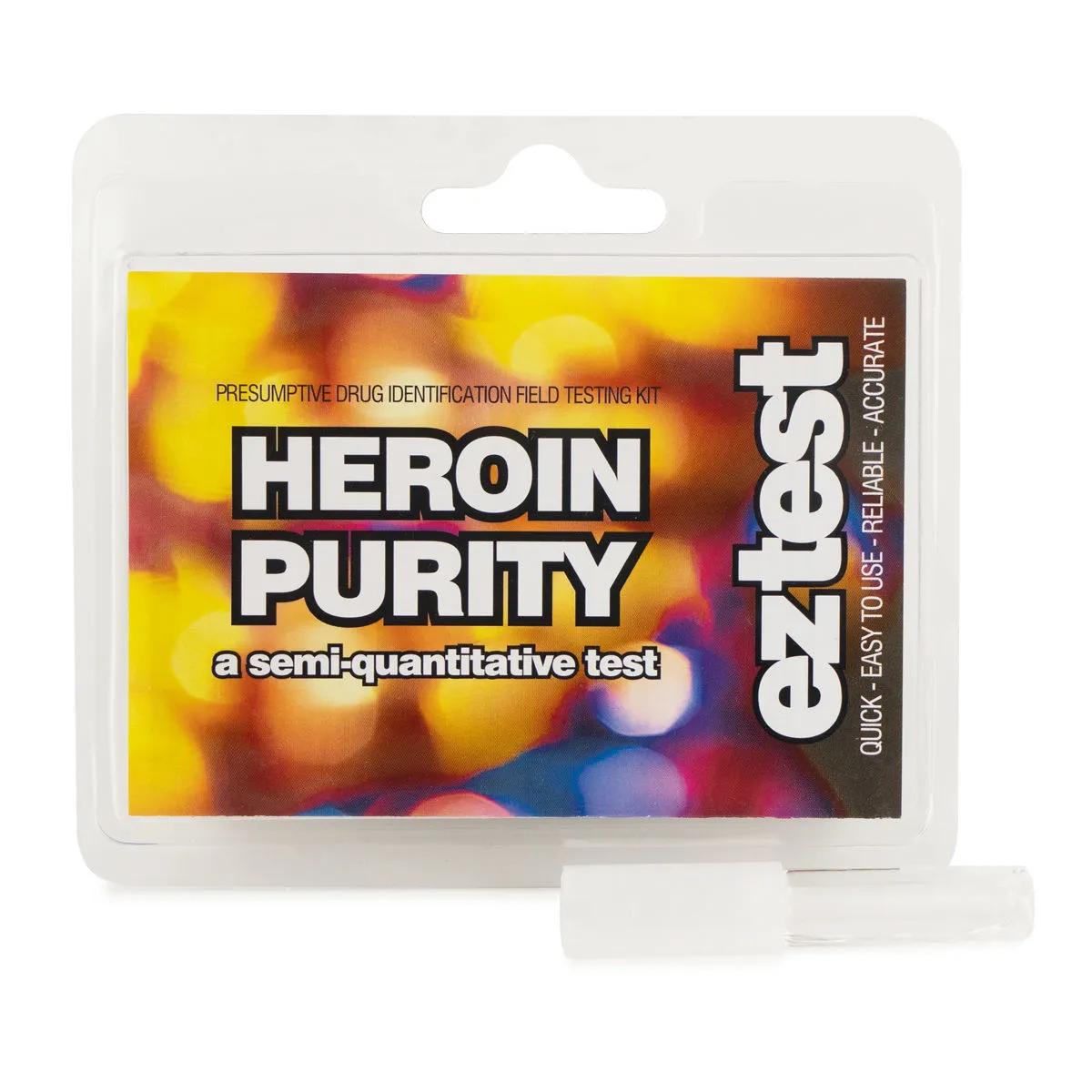
The EZ Test Heroin Purity is a single-use reagent kit that gives you a rough indication of how much actual heroin is in your sample — and how much of it is cutting agents. Drop 20mg of finely powdered sample into the vial, watch the reagent shift towards yellow/orange, and compare against the included colour chart. The darker the result, the higher the purity.
Street heroin is rarely sold pure. The brown powder in your bag could be 5% heroin and 95% something else — caffeine, paracetamol, quinine, talc, fentanyl analogues, or worse. Knowing where your sample lands on the purity scale is the difference between dosing carefully and dosing blind.
Why a heroin purity test matters
Heroin overdose risk scales directly with potency variation. According to Heroin Toxicity (StatPearls, NCBI Bookshelf), clinicians play a vital role in reducing heroin-related morbidity and mortality through prevention and patient education — and unpredictable purity is one of the biggest drivers of accidental overdose. A user dosing for 10% purity gear who suddenly gets 40% material is in serious trouble before they know what's happening.
The other half of the problem: cutting agents. Some are inert. Many aren't. According to Opioid Toxicity (StatPearls, NCBI Bookshelf), opioids exert their clinical effects via μ, κ, and δ receptors — but adulterants don't play by those rules. Insoluble cuts can block blood vessels when injected; active adulterants can stack respiratory depression on top of what the heroin is already doing. According to WebMD's Heroin: Effects, Addiction, Withdrawal Symptoms, heroin blocks pain signals and slows heart rate and breathing — and if you overdose, you may stop breathing and die. Anything that adds to that depression is a problem.
A purity test won't tell you exactly what's in the cut, and it won't catch fentanyl. What it does tell you: roughly how much of your sample is actual heroin. That number alone is enough to inform dosing decisions and spot a bag that's wildly off from what you expected.
Which variant should you pick?
| Pack size | Tests included | Best for |
|---|---|---|
| 1 Test (SM0379) | 1 | One-off check or trying the system before committing |
| 5 Tests (SM0391) | 5 | Regular use — test each new bag from a new source |
| 10 Tests (SM0381) | 10 | Best value per test, plus a buffer for shared use |
Start here if you're new to reagent testing: grab the single test, run it once, see how the colour chart compares to your sample. If you test regularly, the 10-pack is the obvious pick — same reagent, lower cost per test, and you've always got one on hand when a new batch shows up.
How to use the EZ Test Heroin Purity
- Grind your sample finely. Lumpy or uneven powder gives a smeared result.
- Measure out 20mg — that's all you need. More sample doesn't give a better reading, it gives a darker one that throws off the chart.
- Add the powder to the test vial containing the reagent fluid.
- Cap the vial and swirl gently. Don't shake hard — you want the reagent to interact with the sample, not foam up.
- Wait the time specified in the instructions, then compare the fluid colour against the included chart in good daylight (artificial light skews the reading).
- The darker the yellow/orange, the higher the purity. A pale or barely-shifted result means your sample is mostly cut.
What the test can and can't do
Honest limitations matter more here than on most products. This is a semi-quantitative reagent test — it gives you a colour band, not a lab-grade percentage. It does not identify what the cutting agents are, and critically, it does not detect fentanyl or fentanyl analogues. If fentanyl contamination is a concern in your area, you need a separate fentanyl strip test alongside this one.
What it does well: tells you within seconds whether your sample is roughly in the range you expected, or whether something is badly off. That's the call you actually need to make before dosing.
Specifications
| Test type | Single-use reagent (colourimetric) |
| Target | Heroin (diacetylmorphine) purity estimate |
| Sample size | 20mg of finely powdered sample |
| Result format | Colour shift (yellow/orange) compared to chart |
| Time to result | Seconds to minutes (see instructions) |
| Pack sizes | 1, 5, or 10 tests |
| Included | Reagent vial(s), detailed instructions, colour chart |
| Detects fentanyl? | No — use a separate fentanyl strip test |
Pairs well with fentanyl test strips for full sample screening, and with a precision milligram scale so you can hit that 20mg sample size accurately instead of guessing. If you also test other substances, the EZ Test Cocaine Purity Test and EZ Test MDMA Purity use the same colour-chart system.
Frequently Asked Questions
Does this test detect fentanyl?
No. The EZ Test Heroin Purity estimates how much heroin is in your sample, not what the cutting agents are. For fentanyl detection you need dedicated fentanyl test strips, which work on a different principle and target fentanyl/analogues specifically.
What are the cutting agents in heroin?
Common cuts include caffeine, paracetamol, quinine, lactose, talc, and sometimes other opioids or benzodiazepine analogues. According to Opioid Toxicity (StatPearls), adulterants that interact with opioid receptors or cause vasoconstriction can compound the risks of the heroin itself. This test won't identify them — it only tells you how much of your sample is actual heroin.
How accurate is a 20mg sample?
Accurate enough to give you a meaningful purity band when measured properly with a milligram scale. Eyeballing the amount is the main source of bad readings — under-dosing the test gives a pale result, over-dosing skews it dark. Use a 0.001g precision scale.
What are the short-term effects of heroin?
According to WebMD's Heroin entry, heroin blocks pain signals and slows heart rate and breathing. Overdose can stop breathing entirely. This guide is written for adults aged 18 and over; the substance and its risks are not appropriate for anyone under 18.
Can you overdose on heroin?
Yes. According to Heroin Toxicity (StatPearls, NCBI Bookshelf), heroin overdose is life-threatening and a major contributor to opioid mortality. Unpredictable purity is one of the biggest overdose risk factors — which is exactly why a purity test matters before you dose.
Why use a purity test at all?
Because the difference between a 10% bag and a 40% bag is the difference between a normal dose and a respiratory emergency. According to research on objective drug testing (PMC4920965), drug tests are commonly used in clinical settings to inform decisions — the same logic applies before use, not after.
Last updated: April 2026