Drug tests
by Dope or Nope
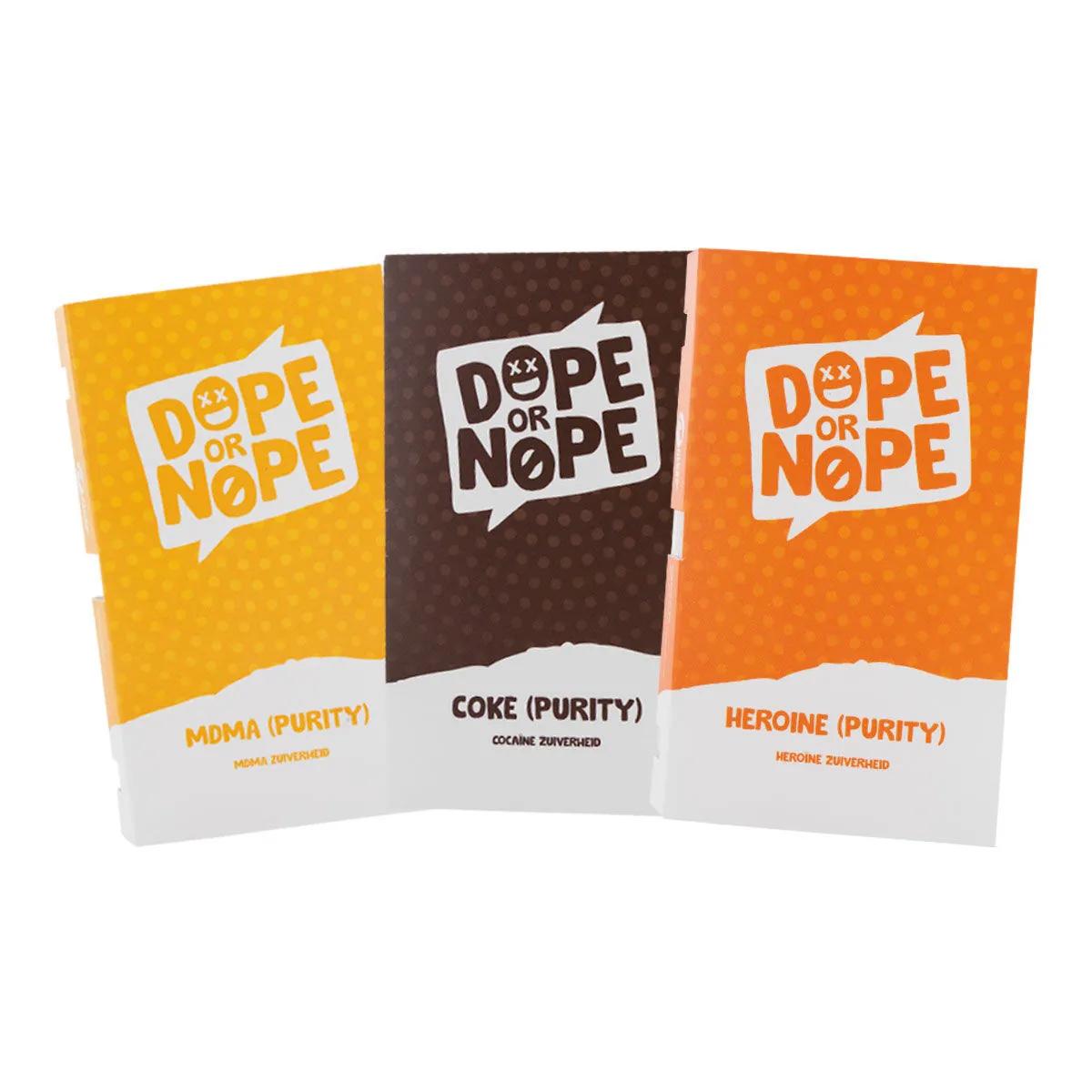
The Dope or Nope Purity Drug Test is a semi-quantitative reagent kit that estimates the purity of cocaine, MDMA, or heroin in seconds. Drop a small sample into the ampoule, compare the colour change against the included chart, and you've got a rough percentage reading — not just a yes-or-no identification, but an actual purity estimate. Three variants cover the three substances most commonly cut with adulterants on the unregulated market.
Each test is formulated for one specific substance. They are not interchangeable — the reagent chemistry differs between variants. Pick the one that matches what you're testing.
| Variant | SKU | Tests for |
|---|---|---|
| Cocaine | SM0334 | Cocaine purity — estimates percentage, flags heavy adulteration |
| MDMA/XTC | SM0335 | MDMA purity — helps gauge how much active compound is actually present |
| Heroin | SM0333 | Heroin purity — gives a rough read on how cut the sample is |
If you're unsure what a substance even is — rather than how pure it is — you want an identification test first (like the Dope or Nope General Drug Test), then follow up with the purity test.
The unregulated market doesn't come with a certificate of analysis. What's sold as one thing can be heavily cut, adulterated, or contaminated with compounds you didn't sign up for. According to research published in the International Journal of Drug Policy, exposure to fentanyl-contaminated heroin has been directly linked to overdose clusters — users had no idea what was actually in their supply (PMC5560423). And it's not just opioids: according to a study in Substance Use & Misuse, poly-drug exposure through adulterated substances can lead to distinct morbidity and mortality consequences (PMC2577634).
A purity test won't tell you everything. It won't identify every possible cutting agent by name, and it won't make a substance safe. But it gives you a data point you didn't have before. If you're expecting cocaine and the purity reading comes back at 15%, that tells you 85% of what you're holding is something else entirely. That's information worth having before you put anything in your body.
We've stocked reagent tests at Azarius since the early 2000s. The single most common thing we hear from customers who start testing is: "I had no idea it was that cut." That moment of realisation is exactly the point. You can't make an informed decision without information.
A reagent purity test uses a chemical reaction between the reagent liquid and your sample to produce a colour change. The intensity and shade of that colour correspond to approximate purity percentages on the included comparison chart. This is semi-quantitative — meaning it gives you an estimated range (say, 40-60% purity) rather than a lab-grade figure down to the decimal. For a field test that takes under 60 seconds, that's genuinely useful.
The Dope or Nope system uses a sealed glass ampoule. You crack it open, add a tiny amount of your sample, and the reagent does the rest. No mixing bottles, no counting drops, no separate test tubes. One ampoule, one test, one result. The trade-off is that each kit is single-use — you can't re-seal it for later. If you test regularly, stock a few.
| Feature | Detail |
|---|---|
| Test type | Semi-quantitative reagent purity test |
| Format | Sealed glass ampoule with reagent |
| Sample size needed | Approximately 20mg (a small pinch) |
| Time to result | Seconds — compare colour immediately |
| Uses per kit | 1 (single-use ampoule) |
| Reading method | Visual colour comparison against included chart |
| Variants available | Cocaine, MDMA/XTC, Heroin |
| Manufacturer | Dope or Nope |
Let's be straight about the limitations, because no harm-reduction tool works if you overestimate what it can do. The Dope or Nope Purity Test tells you roughly how pure a sample is — it does not identify specific cutting agents. If your cocaine reads at 30% purity, you know 70% is filler, but you won't know whether that filler is relatively inert (like caffeine or mannitol) or something nastier. For cutting-agent identification, you'd need a different type of test entirely.
It also doesn't detect fentanyl at trace levels. If fentanyl contamination is your primary concern — and according to research into opioid-related overdose clusters, it absolutely should be for anyone handling opioids (PMC5560423) — pair this with dedicated fentanyl test strips. The purity test and the fentanyl strip answer different questions. Use both.
One more thing: the reagent liquid inside the ampoule is corrosive. If it gets on your skin, rinse the area with water for several minutes. Don't crack the ampoule over your favourite shirt. We've seen a few customers learn that the hard way. Handle it over a hard surface, keep it away from your eyes, and dispose of the used ampoule responsibly.
The whole process takes under 60 seconds from cracking the ampoule to reading your result. No laboratory experience needed, no special equipment. Good lighting helps — do this somewhere well-lit so you can match colours accurately. Dim club lighting is not the place to squint at a colour chart.
Anyone who doesn't have access to professional drug checking services — and that's most people. According to research into attitudes toward harm reduction, chronic health conditions associated with long-term drug use pose additional risks, making informed decisions about substance purity even more critical (PMC9675127). A purity test is one of the simplest harm-reduction tools available. It costs less than a round of drinks and takes less time than rolling a cigarette.
If you've ever looked at a substance and thought "this doesn't look right" or "this doesn't feel like what I've had before," that instinct is worth following up with data. A semi-quantitative purity reading turns a gut feeling into something concrete.
Pair the Purity Drug Test with the Dope or Nope General Drug Test for a two-step approach: first confirm what a substance is, then measure how pure it is. If fentanyl contamination is a concern, add dedicated fentanyl test strips to your kit. Testing is most useful when you layer different tools together — each one answers a different question.
It means the test gives you an approximate purity range — say 40-60% — rather than an exact figure like 47.3%. You're comparing a colour against a printed chart, not running a mass spectrometer. It's accurate enough to flag a heavily adulterated sample, which is the point.
No. Each variant contains a different reagent formulated for a specific substance. Using the wrong test will produce a colour change that doesn't correspond to the chart, giving you a meaningless or misleading result. Always match the variant to the substance.
Not specifically. The purity test measures overall purity — if fentanyl is present as a cutting agent, it may show as reduced purity, but you won't know it's fentanyl. For fentanyl detection, use dedicated fentanyl test strips alongside this kit.
About 20mg — roughly a match-head-sized pinch. You don't need to weigh it precisely. Using significantly more won't improve accuracy and wastes material.
Yes, it's corrosive. If it contacts your skin, rinse with water for several minutes. Avoid eye contact entirely. Handle the ampoule over a hard surface, not over your lap, and dispose of it carefully after use.
No. Each ampoule is single-use. Once cracked, the reagent is exposed and begins degrading. If you test regularly, buy several kits at once so you always have one on hand.
A professional lab using gas chromatography will give you exact percentages. This gives you a ballpark range. It's not lab-grade, but it's vastly better than nothing — and it takes seconds instead of days. Think of it as a smoke alarm, not a fire investigation.
Estimate the midpoint. If the colour sits between the 40% and 60% markers, you're looking at roughly 50% purity. Good lighting makes colour matching easier — don't try this under UV or dim conditions.
Last updated: April 2026
Medical disclaimer. This content is for informational purposes only and does not constitute medical advice. Consult a qualified healthcare provider before use of any substance.