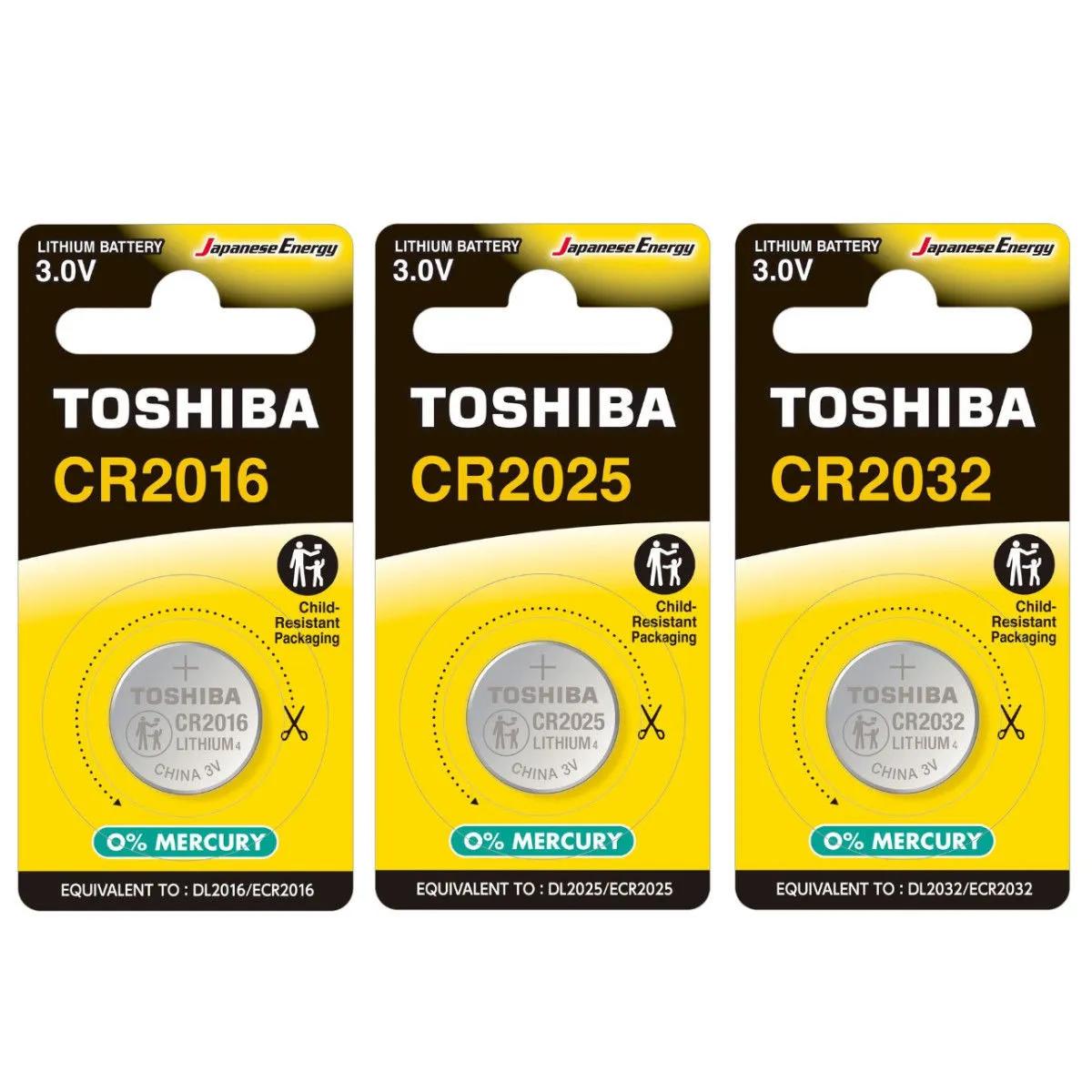
Toshiba lithium coin batteries are compact 3V power cells that keep small electronics running for years — watches, car keys, kitchen scales, fitness trackers, calculators, and the LED lights you forgot you had. Three sizes, one trusted brand, zero faff.
Why Toshiba lithium coin batteries are worth the swap
If you've ever fished a corroded no-name battery out of a bathroom scale, you already know the answer. Toshiba's CR-series lithium coin cells deliver a steady 3V output across the full discharge curve — meaning your watch hands don't slow down at month 11 and your car key works the same on day one as on day 800. They're rated for up to 10 years of shelf life, which matters because most people buy a four-pack and use one.
We've been selling batteries alongside scales, vapes, and gadgets since 1999, and the question we get most often is "which CR do I need?" — so we put the answer right at the top of this page. Pick by the number printed on the old battery. That's it.
CR2016 vs CR2025 vs CR2032 — which size do you need?
The number is the size. All three are 20mm wide and run at 3V; only the thickness changes. CR2016 is 1.6mm thick, CR2025 is 2.5mm, CR2032 is 3.2mm. Thicker = more capacity = longer runtime.
| Size | Thickness | Capacity | Typical use |
|---|---|---|---|
| CR2016 | 1.6 mm | ~90 mAh | Slim watches, small remotes, fitness bands |
| CR2025 | 2.5 mm | ~165 mAh | Car key fobs, calculators, motherboards |
| CR2032 | 3.2 mm | ~225 mAh | Kitchen scales, LED tea lights, larger key fobs, medical sensors |
Quick rule: CR2032 holds roughly 2.5× the energy of a CR2016 — so if the slot accepts both (some do), the thicker cell lasts much longer. If you're unsure, pop the old one out and read the print.
Specifications
| Brand | Toshiba |
| Chemistry | Lithium manganese dioxide (Li/MnO₂) |
| Nominal voltage | 3V |
| Diameter | 20 mm (all variants) |
| Shelf life | Up to 10 years |
| Operating temperature | −20°C to +60°C |
| Mercury content | 0% (mercury-free) |
| Variants | CR2016, CR2025, CR2032 |
What lithium coin cells actually power — 14 common uses
Coin cells are the quiet workhorses of low-drain electronics. Anything that sips power rather than gulps it tends to run on one of these three sizes.
- Wristwatches (quartz movements)
- Car key fobs and remote starters
- Digital kitchen and bathroom scales
- Calculators (scientific and basic)
- Computer motherboard CMOS / BIOS backup
- Fitness trackers and pedometers
- LED tea lights and throwies
- Medical devices (glucose meters, thermometers)
- Garage door remotes
- Heart-rate monitor chest straps
- Laser pointers
- Hearing aid remotes
- Tyre pressure sensors
- Small handheld games and toys
How to swap a coin battery without bricking your device
- Note the size printed on the old battery — CR2016, CR2025 or CR2032. Don't guess by eye; the thickness differences are small.
- Check the orientation before removing the old cell. The flat side with the print is almost always the positive (+) terminal facing up.
- Use a non-metallic tool if possible (plastic spudger, fingernail). Metal tweezers across both terminals can short the cell.
- Don't touch both faces of the new battery with bare fingers — skin oils reduce contact and skin moisture can cause slow discharge. Hold it by the edge.
- Slide the new cell in, positive side up (unless your device specifies otherwise), and close the compartment. Test before reassembling fully.
From our counter — the honest limitations
Coin cells are not rechargeable. CR-series lithium cells are single-use; trying to charge them is a fire hazard. If you're after rechargeables for high-drain gear, you want a different chemistry entirely (Li-ion 18650s, for example).
They're also not interchangeable with button-cell silver-oxide batteries (SR-series, like SR626 for watches) or alkaline LR44s. The voltages and chemistries differ. Always match the code on the old battery.
One more thing: keep them away from kids and pets. Swallowed coin cells are a genuine medical emergency — the current causes tissue burns within hours. Store the spares in a drawer, not a fruit bowl.
Pairs well with our digital pocket scales and herb grinders with built-in storage — both run on CR2032s. If you're restocking the household drawer, grab one of each size and you'll be covered for a decade.
Frequently Asked Questions
Can I use a CR2025 instead of a CR2032?
Sometimes, yes — if the battery holder has enough spring tension to make contact with the thinner cell. The CR2025 will work but won't last as long (roughly 70% of the runtime). The reverse — forcing a CR2032 into a CR2025 slot — usually doesn't fit and risks damaging the contacts.
How long do Toshiba lithium coin batteries last?
In low-drain devices like a watch or scale, expect 2–5 years of active use. Unused on the shelf, they hold their charge for up to 10 years thanks to the lithium chemistry's very low self-discharge rate.
Are CR2032 batteries the same as 2032 or DL2032?
Yes — CR2032, 2032, BR2032, and DL2032 all refer to the same 20mm × 3.2mm 3V lithium coin cell. "CR" is the IEC standard prefix for lithium-manganese chemistry; "DL" is Duracell's house code. They're interchangeable.
Can these batteries be recharged?
No. Toshiba CR2016, CR2025 and CR2032 cells are primary (single-use) lithium batteries. Attempting to recharge them can cause leakage, venting, or fire. When they're done, drop them in a battery recycling bin.
Why does my new coin battery seem dead already?
Usually it's a contact issue, not a dead battery. Wipe both faces of the cell with a dry cloth to remove skin oils, check the orientation (flat side with print is usually +), and make sure the spring contact in the device hasn't been bent flat. If your stash has been sitting around for years, check the date code on the packaging.
How should I store spare coin batteries?
In their original packaging, at room temperature, away from metal objects (keys, coins) that could short the terminals. A drawer or sealed plastic bag works fine. Avoid the fridge — condensation does more harm than the cool storage helps.
Last updated: April 2026