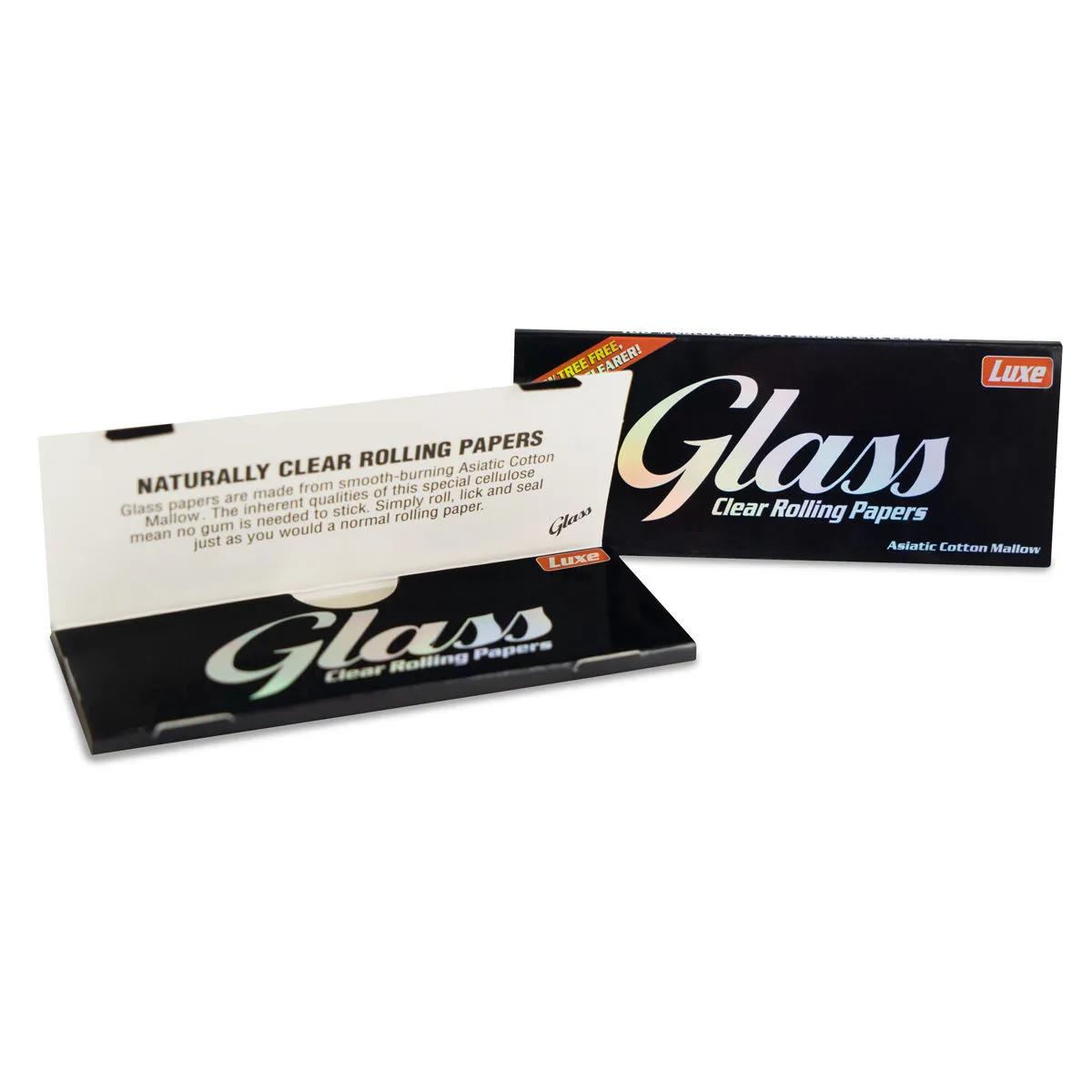
Rolling papers
by Glass
Glass Transparent Rolling Papers are see-through King Size papers made from 100% natural plant cellulose that let you watch your blend as you roll it. They're not crystal-clear — more of a frosted translucent — but they give you enough visibility to check how evenly your material is distributed before you spark up. A novelty? Sure. But a functional one that's also 100% biodegradable.
Standard rice or hemp papers do the job — nobody's arguing that. But transparent cellulose papers solve one specific problem that regular papers can't: you can actually see what's going on inside your roll. If you've ever lit up a joint only to find it canoes because the blend was lumpy on one side, you know the frustration. With Glass transparent rolling papers, you spot the uneven bits before you seal it.
There's also the party trick factor. Pull one of these out at a session and people notice. The translucent look is genuinely striking — your herbs are visible through the paper, giving the whole thing an almost sculptural quality. It's a thin, slightly plasticky feel between your fingers compared to a classic hemp paper, but it burns evenly and doesn't leave an odd aftertaste. We've had customers describe the burn as "clean" — no papery flavour competing with whatever you've rolled inside.
The honest limitation? They're slightly trickier to roll with than standard papers. Cellulose doesn't grip the way hemp or rice paper does, so if you're still learning to roll, you might fumble the first couple. Stick with it — once you get the tuck right, they seal nicely with a bit of moisture. If you're a seasoned roller, you'll adapt in about two attempts.
The main difference comes down to material and visibility. Here's a quick breakdown so you can decide which suits your style.
| Feature | Glass Transparent (Cellulose) | Standard Hemp Papers |
|---|---|---|
| Material | 100% natural plant cellulose | Hemp fibre |
| Transparency | Semi-transparent — you can see your blend | Opaque |
| Biodegradable | Yes, 100% | Yes |
| Taste | Neutral — minimal paper flavour | Slight earthy note |
| Rolling difficulty | Slightly harder — less grip | Standard — good tack |
| Burn | Even, slow | Even, medium |
| Leaves per booklet | 40 | Typically 32–50 |
Both are solid choices. Hemp papers are the workhorse — reliable, easy to roll, and you can't go wrong. Glass transparent papers are for when you want something different: the visual element, the conversation starter, and a burn that lets your blend's flavour come through without interference. We'd pick these for a weekend session where you're showing off a particularly nice strain. For your daily driver, hemp papers are hard to beat on pure ease of use.
| Spec | Value |
|---|---|
| Brand | Glass |
| Size | King Size — 108mm x 34mm |
| Material | 100% natural plant cellulose |
| Leaves per booklet | 40 |
| Biodegradable | Yes — 100% |
| Transparency | Semi-transparent (translucent) |
| SKU | HS0527 |
Complete your rolling setup with a grinder for a consistent, even grind — lumpy material is the enemy of a smooth roll, and that goes double with transparent papers where you can literally see every clump. A set of filter tips also helps keep the structure tight from end to end.
We've sold transparent cellulose papers for years, and the feedback splits neatly into two camps. Experienced rollers love them — they appreciate the visual check, the clean burn, and the novelty. Newer rollers sometimes come back saying they wasted 3 or 4 sheets before getting the hang of it. That's normal. Cellulose is slippier than hemp or rice, so you need a slightly firmer tuck.
One thing worth mentioning: according to a study on the elemental composition of commercially available rolling papers, some papers on the market have been found to contain heavy metals above acceptable limits (PMC11064008). Plant cellulose papers like these Glass ones sidestep much of that concern — the material is simpler and the manufacturing process doesn't involve the same bleaching or treatment chains. It's one of those details most people never think about, but if you're rolling daily, the paper you use adds up over time.
The 40-leaf count per booklet is generous. Most King Size booklets give you 32 or 33 sheets, so you're getting roughly 20% more papers here. At this price point, that's a nice touch.
They're made from 100% natural plant cellulose with no added chemicals or bleach. Research into rolling paper composition has flagged heavy metals in some conventional papers (PMC11064008), but pure cellulose papers avoid the processing steps that introduce those contaminants.
Most people report a cleaner, more neutral taste. There's no papery or woody flavour — the cellulose burns without adding much of its own character, so your blend's flavour comes through more clearly.
Yes, slightly. The material is smoother and less grippy than hemp or rice paper, so the initial tuck takes a bit more practice. After 2 or 3 attempts, most rollers adjust. Using a filter tip as an anchor helps a lot.
Each booklet contains 40 leaves. That's about 20% more than the typical 32–33 sheets you get in most King Size booklets from other brands.
Yes, 100%. Plant cellulose breaks down naturally. You're not leaving behind plastic or synthetic residue — just decomposed plant material.
Not with perfect clarity — they're translucent rather than fully transparent. You can see the general shape and density of your blend, which is enough to spot uneven packing, but you won't be reading text through them.
No. They burn at a similar rate to standard King Size papers — slow and even. The cellulose material doesn't flare or run if your blend is distributed properly.
Last updated: April 2026