CBD capsules
by Cibdol
We'll only email you about this product — no marketing.
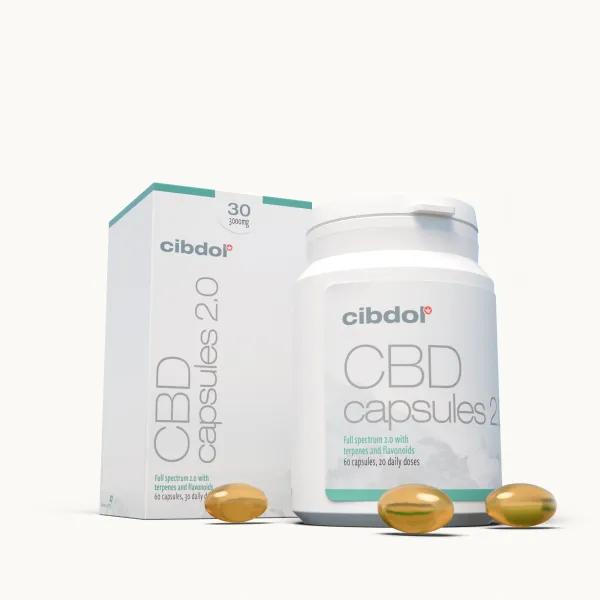
CBD Softgels 30% are pre-measured capsules from Cibdol containing 50 mg of CBD each, blended with olive oil and naturally occurring terpenes from hemp. If you've ever stood in front of a mirror trying to count drops from a pipette at 7 AM, you already know why softgels exist. Each capsule delivers exactly 50 mg — no measuring, no taste, no mess. The bottle holds 60 softgels for a total of 3000 mg of CBD, which at one capsule per day gives you a two-month supply.
Cibdol is a Swiss-based CBD manufacturer that's been around since the early days of the European CBD market. They use naturally grown European hemp and a CO2 extraction process that preserves the plant's terpene profile — those aromatic compounds that, according to the entourage effect theory, work alongside CBD to produce a broader range of effects than isolated CBD alone. The olive oil carrier isn't just filler: it improves absorption of fat-soluble cannabinoids in your gut. You'll notice the softgels themselves have a smooth, slightly glossy shell — easy to swallow, no aftertaste, about the size of a standard fish oil capsule.
The active ingredient is the same. The difference is delivery. CBD oil gives you flexibility — you can adjust dose drop by drop, hold it under your tongue for faster sublingual absorption, and feel effects within 15–30 minutes. Softgels trade that flexibility for precision and convenience. They pass through your digestive system, so onset is slower (typically 45–90 minutes), but the effects tend to last longer because absorption is more gradual.
We get asked about this comparison at least a few times a week. Here's the honest take: if you already know your dose and you want something you can throw in a bag without worrying about leaks or glass bottles, softgels are the better format. If you're still experimenting with how much CBD works for you and 50 mg per capsule feels like a big jump, start with a lower-concentration CBD oil — Cibdol's 5% or 10% oils let you dial in by the drop. You can always switch to softgels once you've found your sweet spot.
| Format | Onset | Duration | Dose control | Portability |
|---|---|---|---|---|
| CBD oil (sublingual) | 15–30 min | 4–6 hours | Drop-by-drop | Glass bottle, pipette |
| CBD softgels | 45–90 min | 6–8 hours | Fixed 50 mg per capsule | Bottle or pill case |
| Specification | Detail |
|---|---|
| Brand | Cibdol |
| CBD concentration | 30% |
| Total CBD per bottle | 3000 mg |
| CBD per softgel | 50 mg |
| Number of softgels | 60 |
| Carrier oil | Olive oil |
| Additional compounds | Naturally occurring hemp terpenes |
| Hemp source | Naturally grown European hemp |
| Extraction method | CO2 extraction |
| THC content | <0.05% (non-intoxicating) |
| Shell type | Bovine gelatin softgel |
| Suggested use | 1 softgel daily with water |
| Storage | Cool, dry place away from direct sunlight |
At 50 mg per capsule, these sit at the higher end of daily CBD intake. For context, commonly referenced dosing ranges in research and general guidance vary widely. According to general CBD dosing guidance, many people start with 10–20 mg daily and adjust from there, while 30–60 mg per day is a commonly referenced maintenance range. Clinical studies have used doses ranging from 150 mg to 600 mg daily for specific research purposes (Therapeutic Efficacy of Cannabidiol (CBD): A Review of the Evidence, PMC7880228).
If 50 mg feels like more than you need, these softgels aren't designed to be split — the gelatin shell doesn't cut cleanly, and you'll end up with oil on your fingers and an inconsistent dose. Better to step down to Cibdol's 10% or 20% softgels, which deliver lower amounts per capsule. If you're already taking 40–60 mg daily via oil and want the same dose in capsule form, these are a direct swap.
The number one thing we've seen over 25 years of selling supplements and botanicals: consistency matters more than format. The best CBD product is the one you actually take every day. And that's where softgels quietly win for a lot of people.
CBD oil requires a mirror, a steady hand, and a willingness to hold something under your tongue for 60 seconds. It tastes earthy — some people don't mind, others genuinely dislike it. Softgels skip all of that. Pop one with your morning coffee or evening meal, done. No taste, no ritual, no chance of accidentally squeezing out too much. If you travel regularly, a small pill case is far less hassle than a glass bottle with a pipette.
The limitation is flexibility. You're locked into 50 mg increments. If your body responds best to 35 mg or 75 mg, you can't fine-tune with softgels the way you can with oil. That's the trade-off, and it's worth knowing before you buy. For most people who've already dialled in their dose, it's not an issue.
The most common question we hear isn't about dosing — it's "will I feel anything?" CBD is not intoxicating. These softgels contain less than 0.05% THC, which is functionally zero. You won't feel altered, sedated, or impaired. What many regular users describe is a general sense of equilibrium — but this is subjective and individual. According to a WHO Critical Review Report on cannabidiol, CBD has a good safety profile and is generally well tolerated in humans (WHO CBD Report, 2018).
The second most common question: "Can I take these with my medication?" This one we can't answer for you — and neither should anyone on the internet. According to research on CBD drug interactions, CBD has been reported to interact with anti-epileptic drugs, antidepressants, opioid analgesics, and several other common medications including acetaminophen (PMC10556379). If you take prescription medication, speak to your doctor or pharmacist before adding CBD to your routine. We mean that genuinely, not as a disclaimer.
CBD is generally well tolerated. According to a review in Cannabidiol Drugs Clinical Trial Outcomes and Adverse Effects (PMC7053164), reported side effects in clinical settings have included diarrhoea, fatigue, changes in appetite, and changes in weight. These were observed primarily at higher clinical doses (300–1500 mg daily), well above the 50 mg per softgel here. A separate review noted that elevated liver enzymes were observed in some participants taking high-dose CBD alongside other medications (Update on Cannabidiol Clinical Toxicity, PMC10556379).
The honest limitation of any CBD softgel — not just Cibdol's — is bioavailability. Oral CBD passes through your liver before reaching your bloodstream (first-pass metabolism), which means a portion is broken down before it can do anything. Estimates vary, but oral bioavailability of CBD is generally cited at 6–19%. Sublingual oils bypass some of this. Softgels don't. You're trading peak bioavailability for convenience and consistency. For most daily users, that's a fair swap.
If you're new to CBD and 50 mg per capsule feels like jumping in at the deep end, Cibdol's CBD Oil 5% lets you start at around 2 mg per drop and scale up gradually. Already sorted on CBD and looking to broaden your cannabinoid intake? Cibdol's CBN Oil or CBG Oil introduce secondary cannabinoids — CBN is being researched for its potential role in sleep, while CBG is an earlier-stage cannabinoid attracting interest for its distinct receptor activity.
CBD softgels are gelatin capsules filled with CBD extract dissolved in a carrier oil — in this case, olive oil. Each Cibdol CBD Softgel 30% contains a fixed 50 mg of CBD, so you get the same dose every time without measuring drops.
You can, but absorption improves when taken with food containing fat. The olive oil inside the softgel helps, but a meal with nuts, avocado, or cheese gives your body more fat to work with, increasing how much CBD reaches your bloodstream.
Expect 45–90 minutes. Softgels are digested like food, so they're slower than sublingual oil (15–30 minutes). The trade-off is that effects from oral CBD tend to last longer — roughly 6–8 hours compared to 4–6 for sublingual.
No. These contain less than 0.05% THC, which is non-intoxicating. CBD does not produce the altered state associated with THC. You can take these during the day, before work, or before driving without impairment.
Not recommended. The gelatin shell doesn't split cleanly, and you'll lose oil and get an uneven dose. If 50 mg is more than you need, switch to a lower-strength softgel or use CBD oil where you can adjust drop by drop.
According to clinical reviews (PMC7053164), side effects at standard doses are uncommon but can include fatigue, diarrhoea, and appetite changes. These were mostly observed at much higher doses than 50 mg. If you take other medications, consult your doctor — CBD can interact with certain drugs.
Keep them in a cool, dry place away from direct sunlight. Heat and UV light degrade cannabinoids over time. A kitchen cupboard or bedside drawer works fine — just not a windowsill or car dashboard.
Last updated: April 2026
Medical disclaimer. This content is for informational purposes only and does not constitute medical advice. Consult a qualified healthcare provider before use of any substance.