LED grow lights
by Vanguard Hydroponics
We'll only email you about this product — no marketing.
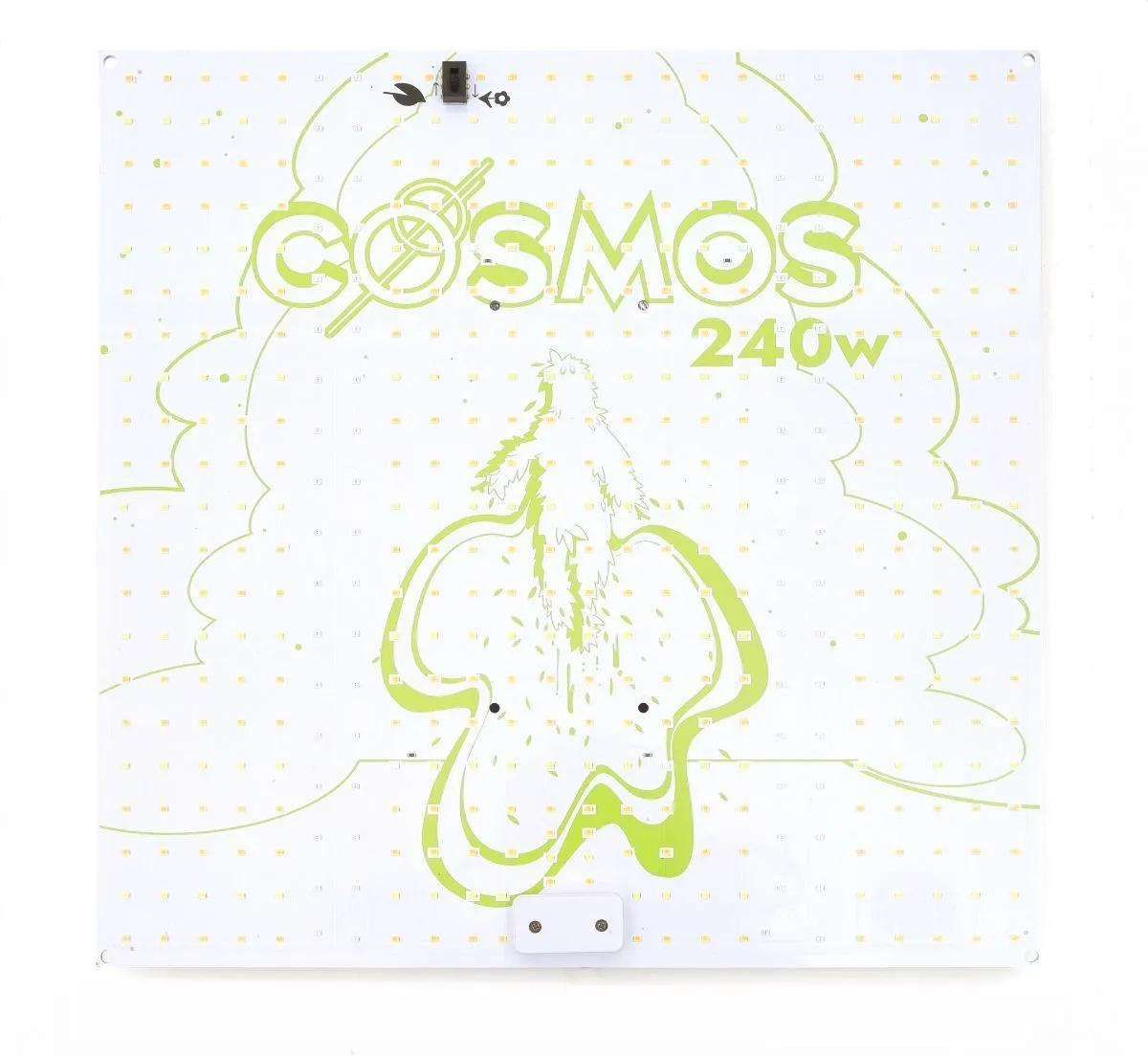
The Cosmos LED Board 240W is a full-spectrum LED grow light from Vanguard Hydroponics that covers every stage of indoor plant growth — from seedling through veg to flower — in a single, energy-efficient panel. At 240 watts actual draw, it sits in the sweet spot for small to mid-sized tents (80x80 to 100x100 cm), delivering enough photosynthetically active radiation (PAR) to drive proper canopy development without melting your electricity bill. If you've been running a 400W HPS and wondering whether LED is worth the switch, this is the board that makes the maths work.
Inside the box you get the LED board itself, a meanwell-style driver (mounted externally to keep heat off the canopy), hanging hardware, and a power cable. The driver sits outside the grow space, which is a design choice we appreciate — it means less heat inside your tent and a longer lifespan for the electronics. The board is a flat, slim panel that hangs flush, so headroom isn't an issue even in shorter tents.
| Specification | Detail |
|---|---|
| Brand | Vanguard Hydroponics |
| Model | Cosmos LED Board 240W |
| Actual Power Draw | 240W |
| Spectrum | Full spectrum (veg + flower) |
| Dimming | Adjustable output settings |
| Driver | External, reduces heat in canopy zone |
| Recommended Coverage | 80x80 cm (flower) / 100x100 cm (veg) |
| Suitable Stages | Seedling, vegetative, flowering |
| SKU | GS0032 |
We've sold a lot of grow lights over the years, and the single biggest shift we've seen is growers moving from HPS to LED — not for ideology, but for the electricity savings. A 240W LED board like the Cosmos replaces a 400W HPS in terms of usable light on the canopy, but draws roughly 40% less power. Over a 12-week cycle running 18/6 then 12/12, that difference adds up to tens of euros on your energy bill. And because LEDs convert less energy to heat, your extraction fan and climate control work less hard too.
The full-spectrum output is the other big selling point. Older LED panels used separate red and blue diodes — those blurple lights that made your grow room look like a nightclub. The Cosmos uses a white-light full spectrum with supplemental red, which means your plants get wavelengths across the entire PAR range (roughly 400–700 nm). That matters because chlorophyll a and chlorophyll b absorb at different peaks, and carotenoids fill in the gaps. A full spectrum board feeds all of them simultaneously, supporting photosynthesis across the board rather than forcing the plant to compensate for missing wavelengths.
The dimmer function is genuinely useful, not just a spec-sheet feature. Seedlings and young clones don't need 240W blasting them from 30 cm away — you'd stress them, cause light burn, or stunt early root development. Being able to dial the board down to 50–60% for the first two weeks, then ramp up as the canopy fills out, gives you control that a fixed-output light simply can't match. We'd go so far as to say adjustable output is the single most underrated feature on a grow light.
The Cosmos 240W is not a tent-filling monster. If you're running a 120x120 cm space and expecting wall-to-wall flower coverage, you'll find the edges underlit. For a tent that size, you'd want to either run two of these boards or step up to something in the 400–600W range. In an 80x80, though, it's spot on — and in a 100x100 during veg, coverage is solid because vegetative plants are more forgiving of slightly lower PPFD at the edges.
One thing it doesn't come with: a timer. You'll need a separate plug timer or smart controller to manage your light schedule. That's standard for boards at this price point, but worth mentioning if you're building your first setup from scratch. A basic mechanical timer costs a few euros and does the job.
Weight-wise, the board itself is light — noticeably lighter than an HPS reflector-and-ballast combo. The slim profile means you can hang it closer to the canopy without worrying about hot spots the way you would with a high-intensity discharge lamp. Just keep 30–40 cm distance during full-power flower and you're sorted.
Complete your setup: pair the Cosmos 240W with a Dark Box 80x80 grow tent for the right footprint match, and add a carbon filter kit if you're growing anything aromatic. A clip fan for air circulation below the canopy rounds out a proper indoor garden.
The Cosmos 240W sits in a competitive bracket. Compared to the Vanguard Cosmos X200 (a 200W model from the same brand), the 240W gives you a meaningful 20% bump in output — enough to push flower density in a properly filled 80x80 tent. If you're growing in a 60x60, the X200 is probably sufficient and saves a bit on running costs. But for anything 80x80 or larger, the 240W is the better pick.
| Feature | Cosmos 240W | Cosmos X200 | Lumatek Zeus 1000W |
|---|---|---|---|
| Wattage | 240W | 200W | 1000W |
| Spectrum | Full spectrum | Full spectrum | Full spectrum + UV/IR |
| Best Tent Size | 80x80 – 100x100 cm | 60x60 – 80x80 cm | 150x150 cm+ |
| Dimming | Yes | Yes | Yes |
| Target Grower | Small-to-mid tent | Compact spaces | Large-scale / commercial |
The Lumatek Zeus 1000W is in a completely different league — it's a commercial-grade fixture for large rooms and CO2-enriched environments. We mention it only because it shows up in every "best LED" search. If you're growing in a single tent at home, the Cosmos 240W is the right scale. Don't overbuy wattage for a space that can't use it.
We've had growers come in convinced they need 600W for a single 80x80 tent. They don't. A well-positioned 240W full-spectrum board, hung at the right height with a proper dimming schedule, will push a small canopy just as hard as an oversized light — without the heat problems, without the electricity spike, and without cooking the top colas. The most common mistake we see isn't too little light. It's too much light too close, too early.
The Cosmos board feels solid in hand — the aluminium heatsink on the back has decent mass to it, and the diode layout is evenly spaced across the board. No dead spots in the centre, no dim corners. The external driver cable is long enough to route comfortably outside a standard tent, which is a small detail that matters more than you'd think when you're trying to manage temperatures in a 80x80 during summer.
Yes. The full-spectrum output covers the wavelength range needed for vegetative growth and flowering. You don't need to swap bulbs or panels between stages — just adjust the height and dimmer setting as your plants develop.
An 80x80 cm tent is the sweet spot for flowering. During veg, you can stretch coverage to a 100x100 cm space since vegetative plants tolerate slightly lower light intensity at the canopy edges. For 120x120 cm tents, you'd want two boards.
Start at 50–60 cm for seedlings with the dimmer at 50–60%. During full-power flowering, lower it to 30–40 cm. If upper leaves start bleaching or curling upward (tacoing), raise the light or reduce output slightly.
It produces noticeably less heat than a comparable HPS setup. The external driver keeps the main heat source outside your tent. Expect canopy-level temperatures to stay manageable with basic extraction, though summer months in small spaces may still need attention.
The product data doesn't confirm a daisy-chain feature. If you're running two boards in a larger tent, plan for two separate power connections and timer channels, or use a power strip on a single timer.
At 240W running 18 hours a day (veg schedule), that's roughly 4.32 kWh per day or about 130 kWh per month. On a 12/12 flower schedule, it drops to around 86 kWh per month. Significantly less than a 400W HPS on the same schedule.
No. You'll need a separate plug timer or smart controller to automate your light schedule. A basic mechanical segment timer works fine and costs very little.
Last updated: April 2026