LED grow lights
by Vanguard Hydroponics
We'll only email you about this product — no marketing.
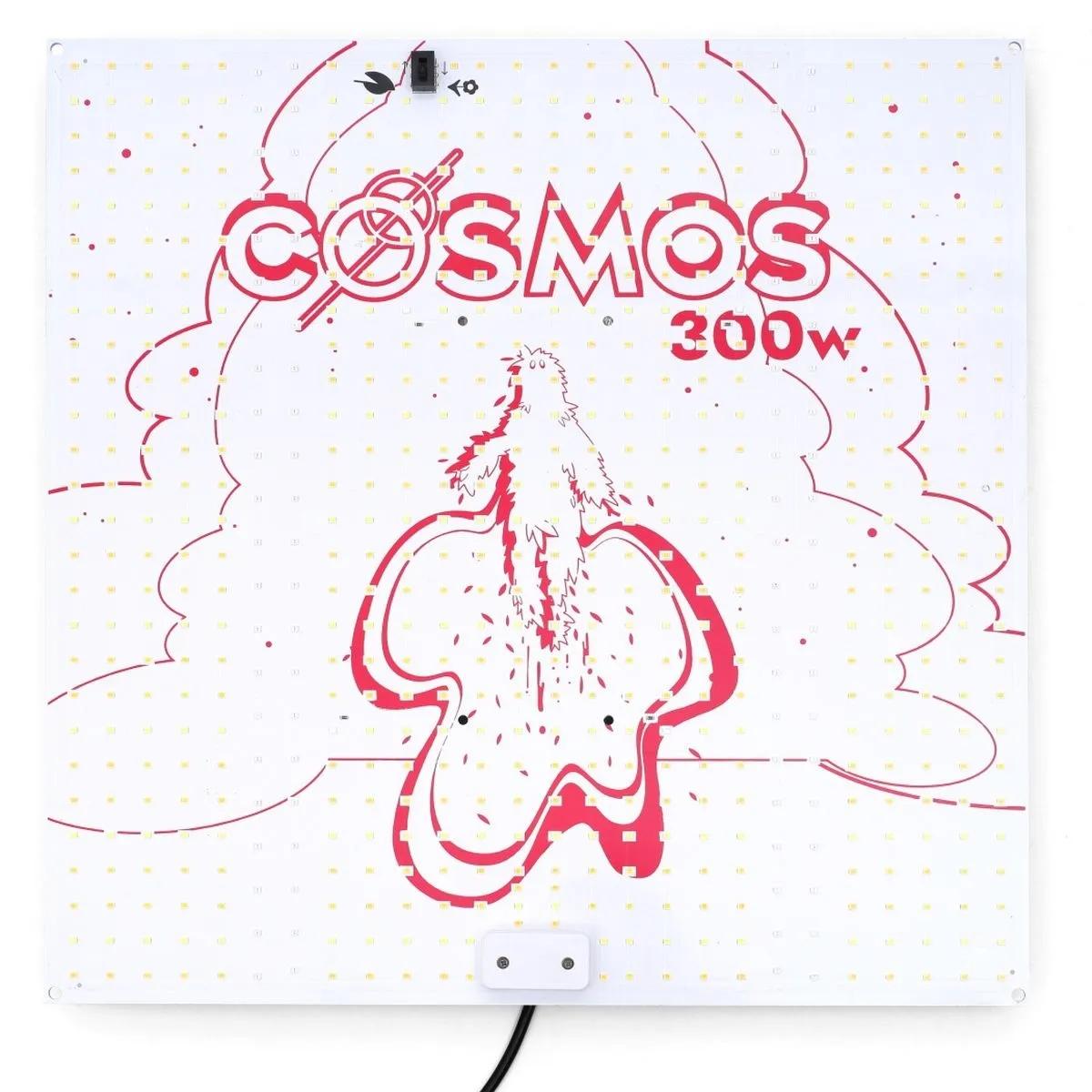
The Cosmos LED Board 300W is a board-style full-spectrum LED grow light that delivers balanced canopy coverage across both vegetative and flowering stages. Built by Vanguard Hydroponics, it packs a multi-band spectrum — including far-red 730nm — into an aluminium housing that stays cool without fans. If you're running a grow tent and want one light that handles the full cycle, this is a solid option that won't cook your plants or your electricity bill.
The Cosmos LED Board 300W arrives ready to hang. Here's what comes in the box:
No separate ballast, no external driver box cluttering your tent. The board format keeps things compact and the weight distributed evenly, which matters when you're suspending it above your canopy from tent poles that aren't exactly industrial-grade.
| Spec | Value |
|---|---|
| Brand | Vanguard Hydroponics |
| Model | Cosmos LED Board 300W |
| Power Draw | 300W |
| Spectrum Type | Full-spectrum multi-band |
| Wavelengths | 395nm, 3000K, 5000K, 660nm, 730nm |
| Spectrum Modes | Switchable veg / flower (onboard switch) |
| Cooling | Passive (aluminium housing, no fans) |
| IP Rating | IP54 (dust and splash resistant) |
| Rated Lifespan | Up to 50,000 hours |
| Form Factor | Board-style panel |
| SKU | GS0035 |
We've sold a fair few grow lights over the years, and the question is always the same: "Do I really need to spend more?" Sometimes yes, sometimes no. The Cosmos LED Board 300W sits in that sweet spot where you're getting proper full-spectrum output — not just a bunch of cheap white LEDs with "full spectrum" slapped on the box — without paying flagship prices.
The multi-band mix is where this light earns its keep. You're getting 395nm (near-UV), warm 3000K and cool 5000K white LEDs, deep red at 660nm, and far-red at 730nm. That 730nm inclusion is worth noting — far-red wavelengths play a role in the Emerson effect, where combining red and far-red light drives photosynthesis more efficiently than either wavelength alone. Most budget boards skip far-red entirely. The Cosmos doesn't.
The switchable veg/flower mode via the onboard switch is genuinely useful. During vegetative growth, your plants want more blue-heavy light to encourage compact, bushy structure. Flip to flower mode and the red wavelengths take over, pushing your plants into bloom. One light, two stages, no swapping fixtures halfway through your grow. That alone saves you money and hassle.
The honest limitation? At 300W, this isn't going to light up a 150x150cm tent edge to edge. It's best suited for a 100x100cm footprint, maybe 120x120cm if you're not chasing maximum density. If you're running a larger space, you'd want two of these or step up to a higher-wattage fixture. But for a single-tent setup with 2-4 plants, it covers the canopy properly without leaving dark corners.
The aluminium housing on the Cosmos 300W isn't just for looks — it's the entire cooling system. Aluminium acts as a heatsink, spreading heat across the body of the panel and radiating it away without needing fans. No fans means no fan noise, no fan failure, and no dust getting pulled through your light fixture. In a grow tent where humidity and particulates are a constant, that matters more than people realise.
The IP54 rating adds a layer of protection against dust ingress and water splashes. If you've ever had a foliar spray go slightly wrong and hit your light, you'll appreciate that rating. It's not waterproof — don't hose it down — but it handles the reality of grow-room conditions without drama.
At 50,000 hours of rated lifespan, you're looking at roughly 5-6 years of continuous use running 18/6 veg cycles, or even longer if you factor in dark periods during flower. LEDs degrade gradually rather than burning out suddenly, so you'll notice a slow drop in output over years rather than a sudden failure. That's a long return on your investment.
How does the Cosmos stack up? Here's a quick comparison against lights you might be considering:
| Feature | Cosmos LED Board 300W | Typical Budget 300W Panel | Lumatek Zeus 1000W |
|---|---|---|---|
| Spectrum | Multi-band (395nm, 3000K, 5000K, 660nm, 730nm) | White LEDs only (3500K-4000K) | Full spectrum with UV and far-red |
| Far-Red (730nm) | Yes | Usually no | Yes |
| Switchable Modes | Yes (veg/flower) | Rarely | Dimmable with app control |
| Cooling | Passive (fanless) | Often fan-cooled | Passive |
| IP Rating | IP54 | Varies (often IP20) | IP65 |
| Coverage | 100x100cm optimal | 80x80cm realistic | 150x150cm+ |
| Best For | Single tent, 2-4 plants | Very small spaces | Large commercial setups |
The Cosmos sits comfortably between budget panels and professional-tier fixtures. If you're running a single 100x100cm tent, the Zeus 1000W is overkill (and significantly more expensive). But if you're comparing against a generic 300W panel, the Cosmos wins on spectrum quality — that 730nm far-red and the 395nm near-UV make a real difference to plant development that basic white-only boards simply can't match.
Specs are just numbers until you know what they mean for your plants. Here's the practical breakdown of the Cosmos 300W's multi-band spectrum:
Five distinct spectral bands in one board. That's not marketing fluff — it's a genuine advantage over single-colour-temperature panels that rely on one white LED chip to cover the entire spectrum.
Complete your grow setup with a proper tent and ventilation. Pair the Cosmos LED Board 300W with a 100x100cm grow tent for optimal coverage, and add a carbon filter and extraction fan to manage heat and odour. A clip-on oscillating fan keeps air moving across the canopy and helps strengthen stems. If you're growing in hydro, a pH meter and CalMag supplement are worth grabbing alongside your light — healthy roots and proper nutrient uptake make the most of every photon this board puts out.
Board-style LED panels have largely replaced the old blurple (blue-purple) fixtures for good reason. We've watched growers switch from 600W HPS setups to 300W LED boards and pull comparable yields at half the electricity cost and a fraction of the heat. The Cosmos 300W runs noticeably cooler than an HPS — you can hold your hand under it at 30cm without discomfort, which tells you something about what your plant canopy is experiencing.
The one thing we always tell people: don't hang it too close too early. New growers get excited, drop the light to 20cm above seedlings, and wonder why the leaves are curling and bleaching. Start high — 60-70cm — and lower it gradually over a couple of weeks. Your plants will tell you when it's too close. Pale, bleached tips and upward-curling leaves are the warning signs. If you see them, raise the light 10cm and give it a few days.
Also worth mentioning: the fanless design means this light is genuinely quiet. If you're growing in a bedroom or spare room, the only noise in your tent will be the extraction fan. That might sound like a small thing, but anyone who's lived with a buzzing ballast or whining fan-cooled LED panel knows how much it matters at 2am.
The Cosmos 300W covers a 100x100cm footprint optimally. You can stretch it to 120x120cm for less demanding plants, but expect weaker light intensity at the edges. For a 60x60cm tent, it's more than enough — you'd be running it at a higher hang distance.
You can run it in flower mode for the entire grow and your plants will survive, but you'll get better results switching. Veg mode emphasises blue light for compact growth; flower mode shifts to red wavelengths that drive bloom. The switch takes two seconds — use it.
It draws 300W from the wall. A comparable HPS setup (400-600W bulb plus ballast) draws 450-650W for similar output. Over a full grow cycle of 3-4 months, that difference adds up to a meaningful reduction on your electricity bill — roughly 40-50% less power consumption.
Warm, not hot. The aluminium housing acts as a passive heatsink, spreading heat across the panel surface. It runs significantly cooler than HPS lights and even fan-cooled LED panels. You won't need extra cooling in most grow tents, though good extraction airflow is still recommended.
IP54 means the light is protected against dust ingress (won't affect function) and water splashes from any direction. It handles the humidity and occasional spray mist of a typical grow room. It's not submersible — keep it out of standing water — but for normal tent conditions, it's well protected.
The product doesn't specify daisy-chain capability. If you're running multiple boards in a larger tent, plan for individual power connections for each unit. Use a power strip with surge protection rated for the combined wattage.
The rated lifespan is 50,000 hours. Running an 18/6 light cycle, that's over 7 years before you'd notice significant output degradation. LEDs dim gradually rather than failing suddenly, so you'll get plenty of warning before replacement is needed.
Last updated: April 2026