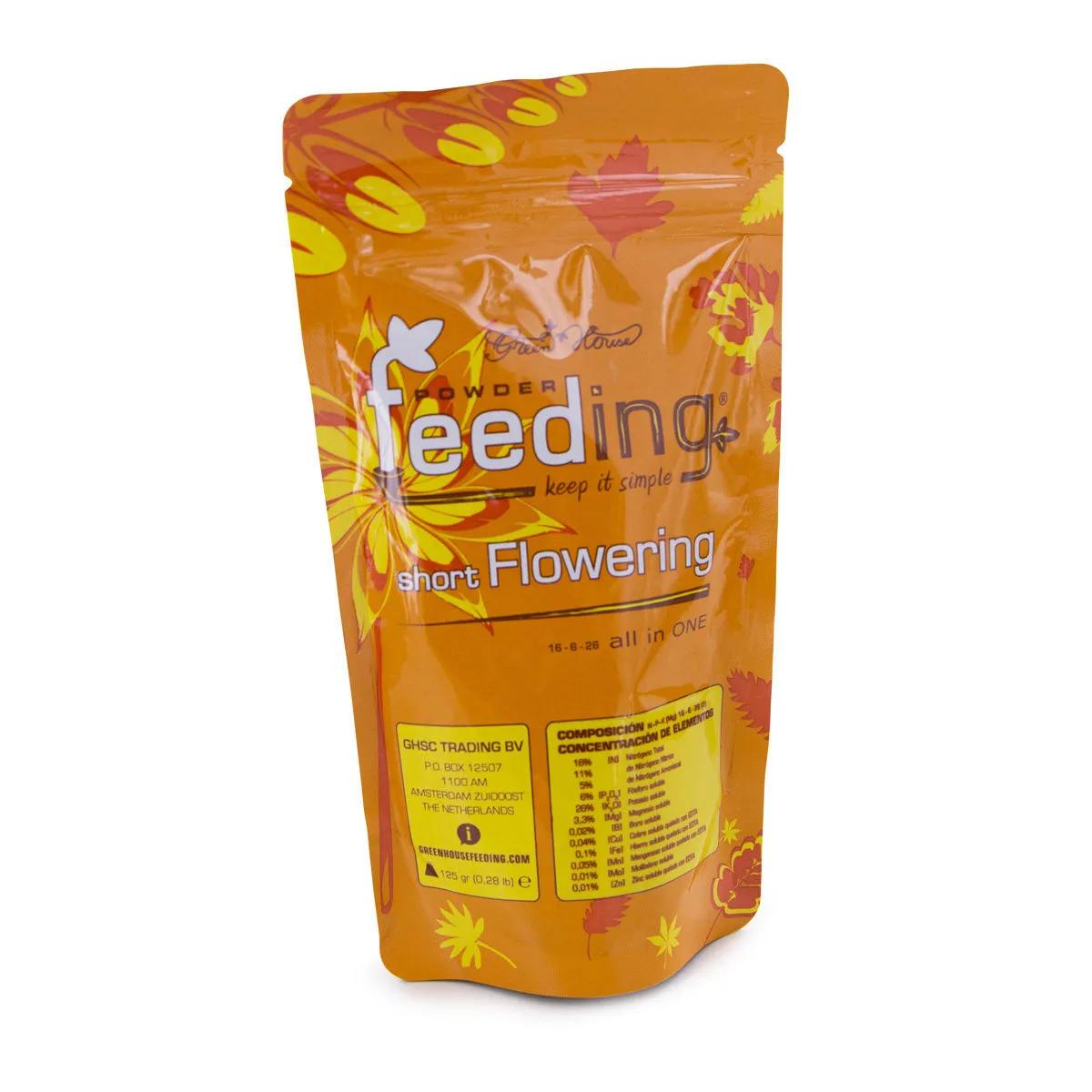
PowderFeeding Short Flowering
Fertilizers & nutrients
by Green House Feeding
PowderFeeding Short Flowering — One-Part Fertiliser for Indica-Dominant Strains
PowderFeeding Short Flowering is a dry, water-soluble fertiliser from Greenhouse Seeds designed specifically for strains with at least 60% Indica genetics. One powder covers every stage from seedling to harvest — just adjust the dose. With an N-P-K-Mg ratio of 16-6-26-2, it delivers the heavy potassium load that short-flowering plants demand during their compressed bloom phase, while keeping nitrogen high enough for vigorous vegetative growth. Works in soil, coco, hydro, and aeroponics without reformulation.
Which Size Do You Need?
The 125g bag mixes roughly 12.5 litres of full-strength nutrient solution (at 10g per 10L) — enough for a single small plant through its entire cycle, or a few weeks of feeding for 2-4 plants. If you're running a multi-plant setup or planning successive grows, the full box of 50 bags is the bulk option that keeps your cost per gram well down. Dry powder stores for years in a cool, dark cupboard, so there's no waste risk with buying ahead.
Why PowderFeeding Short Flowering Works for Indica Genetics
Indica-dominant strains — Kush varieties, the "White" family, many OG crosses — push through flowering in roughly 7-9 weeks. That compressed timeline means the plant's nutrient uptake is front-loaded and intense. It needs potassium and magnesium available immediately, not gradually building over 12 weeks like a Sativa would prefer.
This is where the 16-6-26 ratio earns its keep. The potassium content (26% K2O) is significantly higher than what you'd find in a general-purpose feed, driving flower density and resin production during that short window. Phosphorus sits at a moderate 6% P2O5 — enough to support root development and bloom initiation without the excess that can lock out other elements in the substrate. The 2% soluble magnesium prevents the interveinal chlorosis that shows up mid-flower when plants are burning through energy reserves faster than a balanced feed can replace them.
We've seen growers overcomplicate Indica feeds with three-part liquid systems, cal-mag boosters, and PK additives stacked on top of each other. Half the time they end up chasing pH swings caused by the interactions between all those bottles. PowderFeeding rolls it into one product. Less room for error, fewer bottles cluttering the grow space.
Full Nutrient Profile — What's Inside
| Element | Content | Form |
|---|---|---|
| Nitrogen (N) | 16% | 11% nitrate, 5% ammoniacal |
| Phosphorus (P2O5) | 6% | Soluble |
| Potassium (K2O) | 26% | Soluble |
| Magnesium (Mg) | 2% | Soluble |
| Boron (B) | 0.02% | Soluble |
| Copper (Cu) | 0.04% | Soluble |
| Iron (Fe) | 0.1% | Soluble |
| Manganese (Mn) | 0.05% | Soluble |
| Molybdenum (Mo) | 0.01% | Soluble |
| Zinc (Zn) | 0.01% | Soluble |
The trace element spread — iron at 0.1%, manganese at 0.05%, zinc and molybdenum at 0.01% — is calibrated so you're not supplementing micronutrients separately. Iron and manganese are the two most common micro deficiencies in indoor grows, and both are present here in chelated, soluble form. That matters because unchelated iron precipitates out of solution above pH 6.5, which is exactly where most soil growers sit.
The nitrogen split is worth noting: 11% nitrate to 5% ammoniacal. Nitrate nitrogen is immediately plant-available and doesn't acidify the root zone the way ammoniacal nitrogen does. The 5% ammoniacal portion provides a slower-release nitrogen source and helps keep pH from drifting too high in unbuffered substrates. It's a sensible ratio for the full cycle — you get enough ammoniacal N for early veg push without the pH crash that comes from heavy ammonium feeds in flower.
How to Use PowderFeeding Short Flowering
- Measure your water. Use 10 litres of room-temperature water (18-22°C) as your base. Tap water is fine in most European cities — if your EC is above 0.4 out of the tap, factor that into your target.
- Weigh the powder. For seedlings and young plants, use 2.5-5g per 10L. For vegetative growth and flowering, use 10g per 10L. A cheap 0.1g kitchen scale is all you need — eyeballing powder feeds is how people end up with burned tips.
- Dissolve completely. Add the powder to water and stir for 30-60 seconds. The powder dissolves cleanly without residue. If you're mixing in a reservoir, let it circulate for 5 minutes before checking EC.
- Check your pH. Adjust to 5.8-6.2 for hydro and coco, 6.0-6.5 for soil. The dissolved solution tends to sit around 5.5-6.0 depending on your water source, so you may need pH up in soft-water areas.
- Feed with every watering or alternate feed-water-feed depending on your substrate's buffering capacity. In coco, feed every time. In rich organic soil, you can alternate.
- Stop feeding 10 days before harvest. Flush with plain, pH-adjusted water for the final 10 days. This clears residual salts from the substrate and lets the plant use up stored nutrients, which improves the final product's smoothness.
One honest limitation: this is a one-part powder, which means you can't independently adjust the N-P-K ratio week by week. If you're the type who likes to dial nitrogen down to zero in late flower while cranking phosphorus, you'll find this approach less flexible than a multi-part liquid system. But for the vast majority of growers — especially those running 2-6 plants — the simplicity more than compensates. We'd pick consistent, repeatable results over tinkering any day.
PowderFeeding Short Flowering vs Long Flowering — Which One?
The Short Flowering formula (16-6-26) runs higher potassium and lower phosphorus than the Long Flowering variant (15-7-22). That's because Indica-dominant plants pack on weight fast and need potassium to drive that rapid cell expansion. Sativa-dominant strains, which flower over 10-14 weeks, benefit from a more gradual phosphorus ramp — hence the higher P in the Long Flowering formula.
| Specification | Short Flowering | Long Flowering |
|---|---|---|
| Target genetics | 60%+ Indica | 60%+ Sativa |
| N-P-K-Mg | 16-6-26-2 | 15-7-22-4 |
| Potassium (K2O) | 26% | 22% |
| Phosphorus (P2O5) | 6% | 7% |
| Magnesium (Mg) | 2% | 4% |
| Typical flower period | 7-9 weeks | 10-14 weeks |
| Dosage (full strength) | 10g / 10L | 10g / 10L |
Running a hybrid that sits around 50/50? PowderFeeding Hybrids exists for exactly that situation. If you're unsure about your strain's genetic split, check the breeder's specs — most seed banks list the Indica/Sativa percentage on the packet.
From Our Counter: What We've Learned
We've been stocking PowderFeeding since Greenhouse Seeds launched the line, and the thing customers come back for is the consistency. Liquid nutrients degrade — bottles crystallise, concentrations shift if they freeze in transit, and that half-used bottle from last season is anyone's guess. Dry powder doesn't have those problems. A sealed bag of PowderFeeding stored in a cupboard is identical in composition whether you open it next week or next year.
The most common mistake we see? Overfeeding seedlings. At 10g per 10L, this is a full-strength bloom feed — dumping that on a two-week-old plant will fry the roots. Start at 2.5g per 10L and work up gradually. The plant will tell you when it's hungry (pale new growth, slow development) long before it tells you it's overfed (burnt leaf tips, nutrient lockout). By then you're already behind.
The powder has a faint mineral smell when you open the bag — dry, slightly metallic, not unpleasant. It's fine-grained and dissolves faster than some competing powders we've tried. No clumping issues even in humid grow rooms, provided you reseal the bag properly.
Complete your feeding setup with PowderFeeding Calcium for hard-water correction, or grab PowderFeeding Hybrids if you're running mixed-genetics tents. A digital pH meter and EC meter are non-negotiable companions — accurate readings are the difference between dialled-in feeds and guesswork.
Frequently Asked Questions
Can I use PowderFeeding Short Flowering in coco coir?
Yes. It dissolves completely and works in coco, soil, hydro, and aeroponics. In coco, feed with every watering since the substrate has no inherent nutrient buffer. Keep your EC in the 1.2-1.8 range during flower and always check runoff.
How much PowderFeeding Short Flowering do I use for seedlings?
Between 2.5g and 5g per 10 litres of water. Start at 2.5g for very young plants and increase to 5g once they have 3-4 sets of true leaves. Full-strength dosing (10g per 10L) is for established plants in veg and flower only.
Do I need to add CalMag separately with this fertiliser?
It already contains 2% magnesium plus calcium from the mineral salts. In most tap water situations, that's sufficient. If you're using reverse osmosis water or very soft water (EC below 0.2), a small CalMag supplement can help — but test first before adding.
When should I stop feeding before harvest?
Stop feeding and flush with plain, pH-adjusted water 10 days before you plan to chop. This lets the plant metabolise residual nutrients stored in the leaves and substrate, resulting in a cleaner final product.
What's the difference between Short Flowering and Hybrids PowderFeeding?
Short Flowering (16-6-26) has higher potassium for the fast, dense bloom phase of Indica-dominant plants. Hybrids has a more balanced ratio for 50/50 genetics. If your strain is 60%+ Indica — Kush, White family, most OG crosses — go with Short Flowering.
How long does an opened bag of PowderFeeding last?
Indefinitely, as long as you keep it sealed and dry. Powder fertilisers don't degrade like liquids. Store in a cool, dark place away from moisture. No refrigeration needed.
Can I mix PowderFeeding Short Flowering with other nutrient brands?
It's designed as a complete one-part feed, so mixing with other base nutrients risks overloading specific elements. You can add PK boosters or enzymes from other brands, but check your EC after mixing — don't exceed 2.0 in flower unless your strain is a known heavy feeder.
Last updated: April 2026