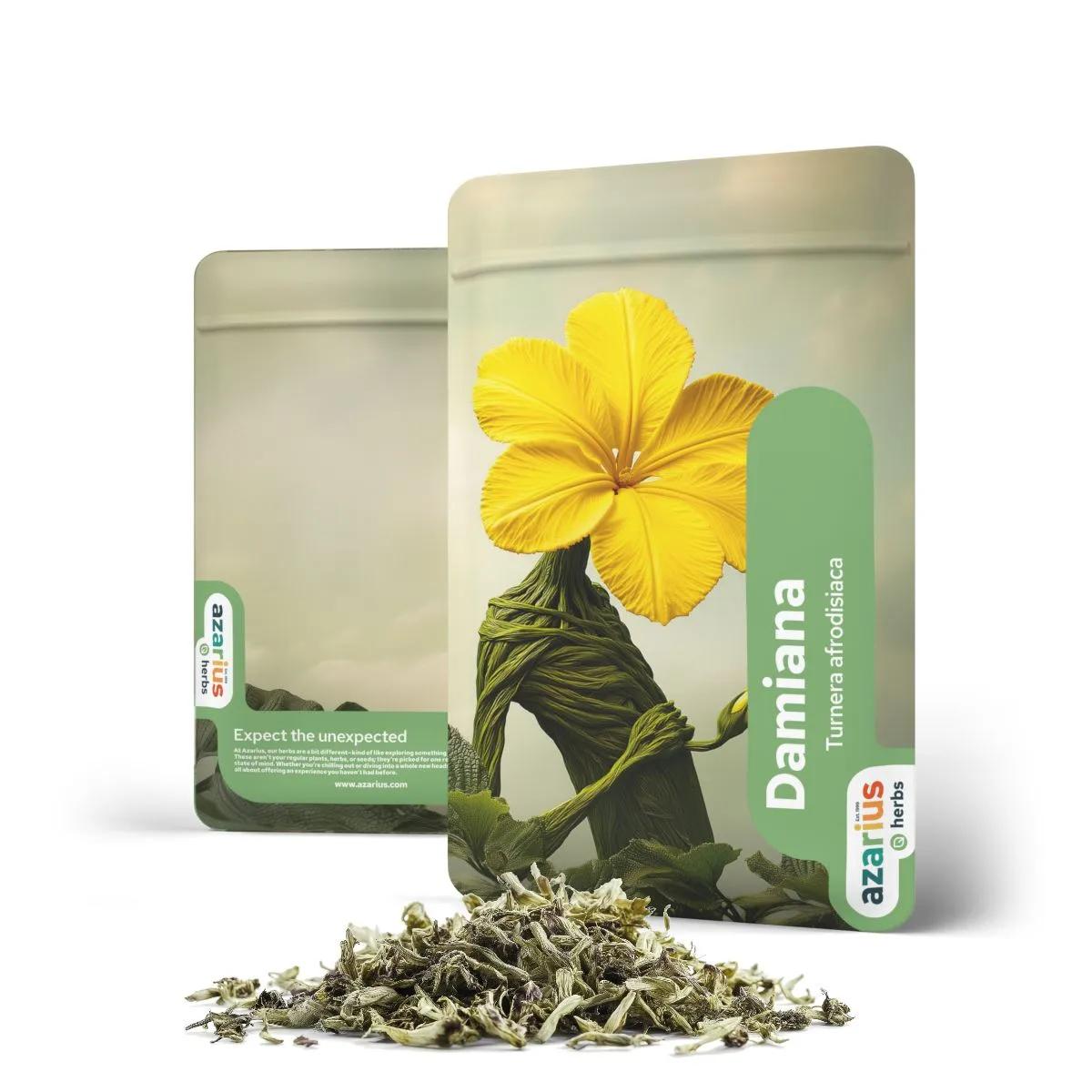
Damiana
by Azarius
Damiana leaves are dried botanical leaves from Turnera diffusa, a small aromatic shrub native to Central and South America, traditionally used as a natural aphrodisiac and gentle relaxant. The leaves carry a distinctive warm, slightly bitter flavour with herbal-sweet undertones — somewhere between chamomile and green tea, but earthier and more resinous. Open the bag and you get this lovely honeyed, almost hay-like scent that tells you straight away this isn't your standard herbal tea.
Damiana has been part of Mexican and Central American herbalism for centuries, and its Latin synonym — Turnera aphrodisiaca — gives you a pretty clear idea of the reputation it carries. According to a review published in Exploring Scientifically Proven Herbal Aphrodisiacs (PMC3731873), researchers found evidence supporting damiana's traditional folk use as an aphrodisiac. According to research in Bioactivity of the Genus Turnera (PMC10675026), Shah et al. conducted a clinical study evaluating an herbal mixture containing T. diffusa for its effectiveness in sexual health contexts. And according to a study published in the Journal of Ethnopharmacology (PubMed 19501274), Turnera diffusa at doses of 20–80 mg/kg helped recover sexual behaviour in exhausted male rats — alongside yohimbine at 2 mg/kg.
Beyond the bedroom angle, damiana has a calming quality that's made it a staple in herbal relaxation blends. According to a bibliographic survey published in Effects of Panax ginseng, Turnera diffusa and Heteropterys tomentosa (PMC4872888), Turnera diffusa fits within the adaptogenic concept — meaning it's traditionally grouped among herbs that may support the body's response to stress. According to research in Cytotoxic Activity of the Methanolic Extract of Turnera diffusa (PMC4350145), damiana is employed in traditional medicine as a stimulant, aphrodisiac, and diuretic, with its leaves and stems being the primary parts used.
One honest note: damiana is gentle. If you're expecting something dramatic from a single cup of tea, you'll be underwhelmed. This is a slow-burn herb — the kind that works its way into your routine over days and weeks rather than hitting you over the head on the first go. We've had customers come back after a fortnight saying they finally noticed the difference. Patience is part of the deal.
The first thing you notice when you open the bag is the scent — warm, resinous, slightly sweet, with a hint of dried fig. It's a comforting smell, the kind that makes you want to brew a cup immediately. The flavour is mildly bitter with herbal-sweet undertones. Think chamomile's earthier cousin. Some people find it a touch astringent on its own, which is why it blends so well with other herbs. A squeeze of honey or a few drops of lemon rounds it out nicely if you're drinking it straight.
When smoked, damiana has a smooth, light character — less harsh than many dried herbs, with that same warm, slightly sweet note. It's one of the more pleasant base herbs for herbal smoking blends, which is why you'll find it in so many pre-mixed blends on the market.
| Specification | Detail |
|---|---|
| Botanical name | Turnera diffusa Willd. ex Schult. |
| Plant family | Turneraceae |
| Common names | Damiana, Mexican damiana, Turnera aphrodisiaca |
| Part used | Dried leaves |
| Origin | Central and South America |
| Form | Cut and sifted, ready to use |
| Sourcing | Ethically harvested |
| Preparation methods | Tea, smoking blend, tincture |
Damiana leaves are versatile enough to fit into several routines. Here are the three most common methods — pick whichever suits your evening best.
We've stocked damiana leaves since the early days of the shop, and it's one of those herbs that quietly builds a loyal following. Most people come in looking for it specifically — they've read about it, a friend recommended it, or they've tried it in a pre-mixed blend and want the pure leaf. The most common question we get: "Does it actually work as an aphrodisiac?" Honestly, it's subtle. Don't expect fireworks from one cup. But as a regular evening tea over a couple of weeks, plenty of our customers report a noticeable warming, relaxing effect that sets the right mood. According to a study on Turnera diffusa leaf supplementation (PMC12843111), researchers have evaluated the effects of T. diffusa on testicular function, suggesting the plant's traditional reputation has attracted genuine scientific interest.
The other thing worth knowing: damiana pairs brilliantly with other herbs. On its own it's pleasant but mild. Mixed into a blend — say, with passionflower and lemon balm for relaxation, or with blue lotus and wild dagga for a herbal smoke — it really comes into its own. Think of it as a solid team player rather than a solo act.
| Use | Best Pairing |
|---|---|
| Relaxation tea | Passionflower, lemon balm, valerian root |
| Aphrodisiac blend | Muira puama, maca root |
| Herbal smoking mix | Blue lotus, mullein, marshmallow leaf |
| Tincture base | Combine with other adaptogenic herbs |
Building a herbal smoking blend? Pair damiana leaves with blue lotus for aromatic depth and mullein for a smoother smoke. Brewing a relaxation tea? Passionflower and valerian root complement damiana's warm, calming character. All available separately in the herbshop.
Damiana is generally well-tolerated at standard amounts. There is limited clinical information regarding adverse reactions associated with damiana use (Duke 2002, Rowland 2003). That said, high amounts over a long period have been associated with mild side effects in some reports — nausea being the most commonly mentioned. If you're pregnant, breastfeeding, or managing diabetes, speak with a healthcare provider before adding damiana to your routine. The same applies if you're taking other medications, particularly anything affecting blood sugar levels. According to research published in Damiana (Turnera diffusa) Reduces Adipocyte Cell (PubMed 40125913), T. diffusa leaf has been used in traditional medicine in the management of diabetes, which suggests potential interactions worth being aware of.
Storage is straightforward: keep the leaves in a sealed bag or airtight jar, away from direct sunlight and moisture. Stored properly, dried damiana leaves hold their flavour and aroma for 12–18 months without any trouble.
The evidence is promising but not conclusive. According to research in Exploring Scientifically Proven Herbal Aphrodisiacs (PMC3731873), studies found evidence supporting damiana's traditional aphrodisiac reputation. Most customers find the effect subtle and cumulative rather than immediate — regular use over 1–2 weeks tends to produce the most noticeable results.
A standard preparation uses 1–2 teaspoons (roughly 1–2g) of dried leaf per cup, steeped in freshly boiled water for 5–10 minutes. Traditional herbalism references and clinical studies have typically used around 2g of dried herb per cup as a baseline.
Yes, and it's one of the most popular base herbs for herbal smoking blends. Damiana burns evenly, produces a smooth smoke, and has a warm, slightly sweet flavour. It works well on its own or mixed with mullein, blue lotus, or marshmallow leaf.
Warm, mildly bitter, with herbal-sweet undertones — somewhere between chamomile and green tea but earthier. A touch of honey or lemon balances the slight astringency if you find it too bitter on its own.
At standard amounts, side effects are rare. There is limited clinical information regarding adverse reactions (Duke 2002, Rowland 2003). High doses over extended periods may cause mild nausea. Avoid if pregnant, breastfeeding, or managing diabetes without consulting a healthcare provider first.
Stored in a sealed bag or airtight jar away from sunlight and moisture, dried damiana leaves keep their flavour and potency for 12–18 months. You'll know they've gone stale when the warm, resinous scent fades to almost nothing.
Absolutely — damiana is a team player. For relaxation teas, it pairs well with passionflower and lemon balm. For aphrodisiac blends, try it alongside muira puama or maca. In smoking mixes, blue lotus and mullein are classic companions.
Last updated: April 2026
Medical disclaimer. This content is for informational purposes only and does not constitute medical advice. Consult a qualified healthcare provider before use of any substance.