Lion's Mane
by Holy Flavour
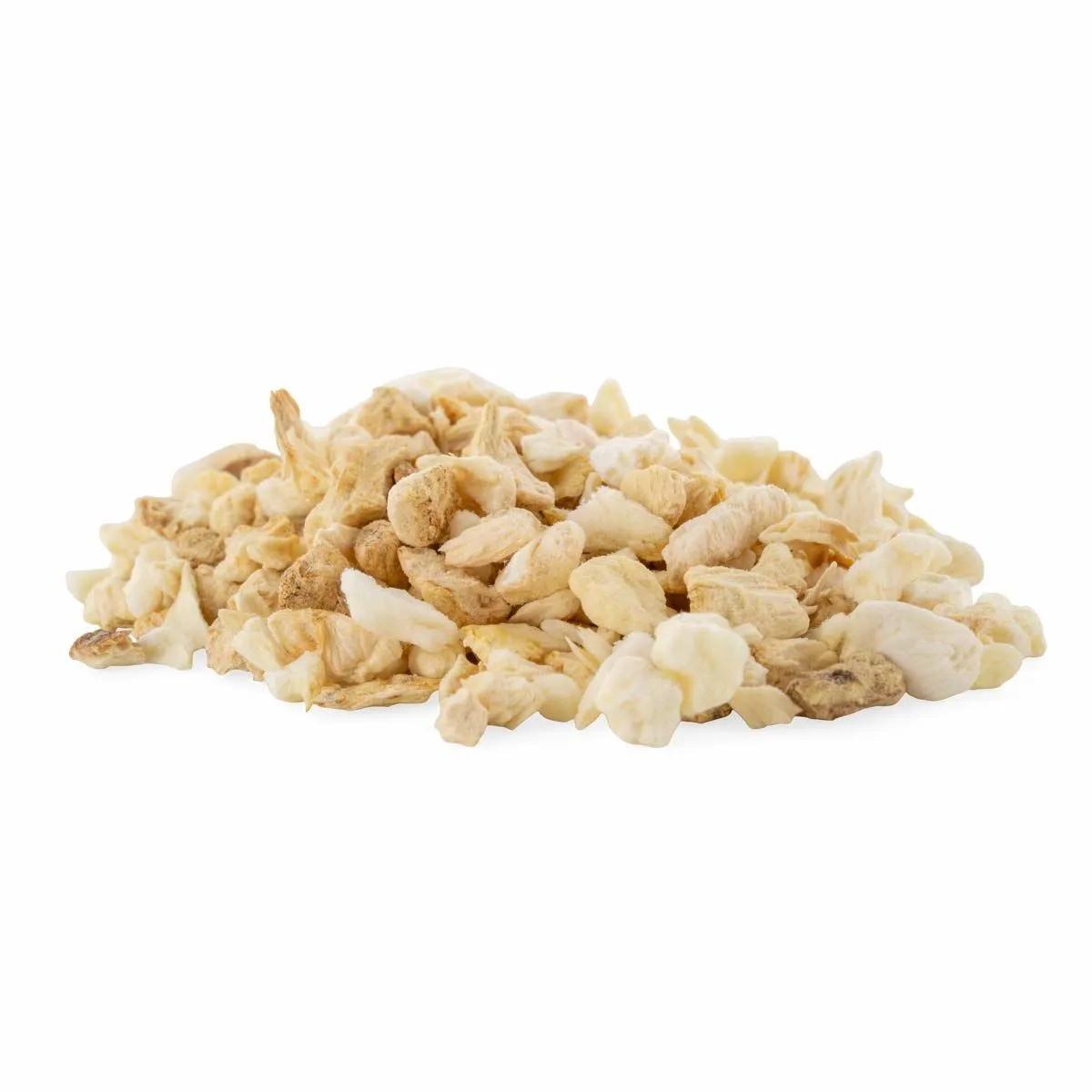
Hericium erinaceus Lion's Mane granulate is a certified organic mushroom supplement made from 100% fruiting bodies, designed for flexible daily dosing without capsules. The 4–6mm particle size sits between a fine powder and a chunky cut — easy to pinch, easy to weigh, and it won't blow off your scale when you breathe near it. If you already measure your own supplements or brew loose-leaf teas, this format slots straight into your routine. No fillers, no mycelium-on-grain padding, no additives. Just the mushroom.
Loose granulate gives you something capsules never will: complete control over your dose. You weigh exactly what you need, adjust day by day, and skip the binders, flow agents, and capsule shells that come standard with pre-made pills. For a 75kg person, the standard daily dose works out to roughly 2,500mg — that's five capsules in most brands, or one scoop on a kitchen scale with this granulate.
The texture is coarse and dry, somewhere between granola crumbs and dried herb. It doesn't clump in humid weather and it doesn't create dust clouds when you pour it. Drop it into hot water and it softens within a couple of minutes, releasing a mild, slightly earthy flavour that's closer to a light broth than anything mushroomy. Honestly, it's one of the more pleasant-tasting functional mushrooms we carry — nothing like the bitter wallop you get from reishi.
The one limitation worth knowing: granulate takes a moment longer to prepare than popping a capsule. You need a scale (even a basic kitchen scale accurate to 0.1g works), and you need 30 seconds to weigh and stir. If that sounds like too much faff for your morning, capsules exist for a reason. But if you're the type who already weighs coffee beans or loose-leaf tea, this won't slow you down at all.
Lion's Mane has been studied more than most functional mushrooms, and the findings are genuinely interesting — not just marketing fluff.
According to a review published in PMC, "one of the most significant clinical trials investigated the effects of H. erinaceus supplementation on cognitive function in 50- to 80-year-old Japanese adults" (PMC, 2024). That trial found measurable improvements in cognitive scores during the supplementation period.
According to Healthline, "studies have found that lion's mane mushrooms contain two special compounds that can stimulate the growth of brain cells: hericenones and erinacines" (Healthline). These compounds are unique to Hericium erinaceus — you won't find them in reishi, chaga, or cordyceps.
A 2019 study concluded that "oral intake of H. erinaceus is safe and hericenones in the mushroom have multiple effects to the brain neural networks and may improve cognitive functions" (PubMed, 2019). And a randomised, placebo-controlled crossover study investigated "the potential benefits of an acute dose" of a standardised Hericium erinaceus extract, adding to the growing body of clinical work on this species (PubMed, 2025).
According to a PMC review on neurotrophic and neuroprotective effects, clinical supplementation protocols have used "1.2g per capsule, 3 capsules daily" of Hericium erinaceus preparations combining mycelia and fruiting body material (PMC, 2023). This granulate uses 100% fruiting bodies — no mycelium filler — which means a higher concentration of the compounds researchers are actually interested in.
None of this means Lion's Mane is a miracle pill. The research is promising but still developing, and most trials have used relatively small sample sizes. What we can say is that Hericium erinaceus has more clinical backing than the vast majority of functional mushrooms on the market.
The manufacturer's standard daily dose is 500mg per 15kg of body weight. Clinical studies have typically used doses ranging from 750mg to 3,000mg daily, so this sits comfortably within the researched range.
Here's what that looks like in practice:
| Body Weight | Standard Daily Dose | Maximum Daily Dose |
|---|---|---|
| 60 kg | 2,000 mg (2.0 g) | 6,000 mg (6.0 g) |
| 75 kg | 2,500 mg (2.5 g) | 7,500 mg (7.5 g) |
| 90 kg | 3,000 mg (3.0 g) | 9,000 mg (9.0 g) |
The maximum dose caps at 1g per 10kg of body weight — so a 75kg person should never exceed 7,500mg (7.5g) in a single day. Weigh your dose on a kitchen scale accurate to at least 0.1g. The 4–6mm particle size makes this straightforward: no static, no powder sticking to the sides of your container.
Because Lion's Mane is naturally rich in minerals and amino acids, pairing your dose with a vitamin C source significantly improves nutrient uptake. A squeeze of lemon in your tea or a glass of orange juice alongside your morning dose does the job. This isn't optional advice — it's the difference between decent absorption and good absorption.
| Specification | Detail |
|---|---|
| Species | Hericium erinaceus |
| Common Name | Lion's Mane |
| Format | Loose granulate |
| Particle Size | 4–6 mm |
| Source Material | 100% fruiting bodies |
| Certification | Certified organic |
| Mycelium Content | None (zero mycelium-on-grain) |
| Additives | None |
| Allergens | Free from common allergens |
| Standard Dose | 500 mg per 15 kg body weight |
| Maximum Dose | 1 g per 10 kg body weight |
| Traditional Use | Centuries of use in Chinese culinary and traditional practices |
Pair it up: Lion's Mane and Reishi make a solid daily stack — Lion's Mane for the daytime cognitive angle, Reishi for evening wind-down. If you're building a functional mushroom routine, grab both and alternate through the day. A basic vitamin C supplement or a bag of dried rosehips for your tea also makes a practical companion to improve mineral and amino acid uptake from every dose.
We've been carrying functional mushrooms since long before they turned up in every influencer's smoothie bowl, and Lion's Mane is consistently the one people come back for. Not because it hits you over the head with an obvious effect — it doesn't. It's subtler than that. Customers who stick with it for 2–4 weeks tend to describe a kind of background clarity: fewer foggy mornings, slightly sharper recall. The ones who try it for three days and expect fireworks are usually disappointed.
The granulate format sells particularly well to people who already have a loose-leaf tea setup or who weigh their supplement stacks. If you're used to capsules and you don't own a scale, be honest with yourself — you might find the extra step annoying. But if precision matters to you, this is the cleanest format available. No capsule shells, no flow agents, no rice flour hiding in the ingredient list. Just Hericium erinaceus fruiting body, dried and cut to 4–6mm.
One thing we always mention: the "100% fruiting bodies" claim actually matters here. A lot of cheaper Lion's Mane products use mycelium grown on grain, which means a significant percentage of what you're swallowing is starch from the growing substrate, not actual mushroom. This granulate skips that entirely. You're getting the part of the mushroom that contains the hericenones and erinacines researchers are studying — not filler grain dressed up as a supplement.
According to LiverTox (NCBI), chemical analyses of Hericium erinaceus demonstrate "multiple constituents including unique hericenones" and the mushroom has a generally well-tolerated safety profile in studies conducted to date (NCBI Bookshelf). Side effects in clinical trials have been rare and mild.
That said, if you're taking sedatives — benzodiazepines, barbiturates, or similar — talk to your doctor before adding Lion's Mane. Research has flagged potential sedative properties that could interact with CNS depressants. The same applies if you're on blood thinners or cholesterol-lowering medication, as some animal studies have observed effects on lipid profiles.
If you're pregnant, breastfeeding, or on any ongoing medication, check with a healthcare professional first. Not because Lion's Mane is dangerous — the safety data is reassuring — but because interactions with specific drugs haven't been exhaustively mapped yet. We'd rather you ask and be sure.
The standard dose is 500mg per 15kg of body weight. A 75kg person takes roughly 2,500mg (2.5g) per day. The maximum is 1g per 10kg body weight — so 7,500mg for a 75kg person. Weigh it on a kitchen scale for accuracy.
Mild and slightly earthy — closer to a light vegetable broth than a strong mushroom flavour. Nothing like the bitterness of reishi. Most people find it easy to drink as tea or blend into a smoothie without masking it.
Lion's Mane is naturally rich in minerals and amino acids. Vitamin C improves the bioavailability of these nutrients. A squeeze of lemon in your tea or a glass of orange juice alongside your dose is enough.
Fruiting body is the actual mushroom — the part containing hericenones and erinacines that researchers study. Mycelium-on-grain products include the root-like mycelium plus the grain substrate it grew on, meaning a portion of what you consume is starch, not mushroom. This granulate is 100% fruiting body with zero grain filler.
Clinical trials report few and mild side effects. According to NCBI's LiverTox database, Hericium erinaceus has a generally well-tolerated safety profile. If you take sedatives, blood thinners, or cholesterol medication, consult a doctor before use.
Most of our customers report noticing subtle changes after 2–4 weeks of consistent daily use. It's not an acute, obvious effect — think background clarity rather than a switch flipping. Three days isn't enough to judge it fairly.
Yes. Sprinkle it over porridge, stir into soups, or mix into sauces. The mild flavour won't overpower savoury dishes. Just pair it with a vitamin C source in the same meal for better nutrient absorption.
Keep it in a cool, dry place away from direct sunlight. An airtight container or resealable bag works well. The 4–6mm granulate doesn't clump easily, but moisture is still the enemy of any dried mushroom product.
Last updated: April 2026
Medical disclaimer. This content is for informational purposes only and does not constitute medical advice. Consult a qualified healthcare provider before use of any substance.