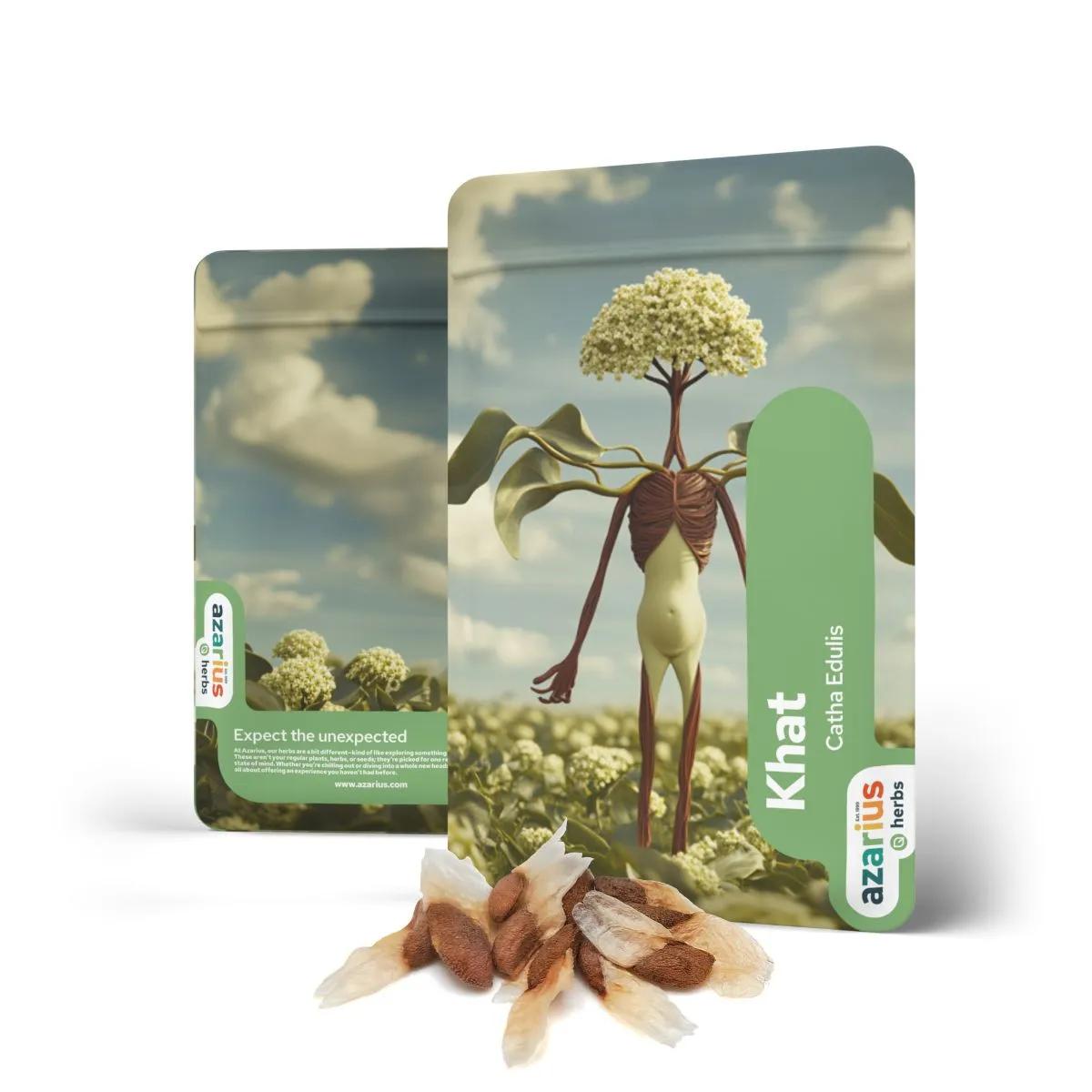
Khat
by Azarius
Khat seeds are the starting point for cultivating Catha edulis, an evergreen shrub native to East Africa and the Arabian Peninsula. Chewed fresh for centuries across Ethiopia, Yemen, Kenya, and Somalia, khat leaves contain cathinone and cathine — amphetamine analogues that, according to a review in Frontiers in Psychiatry, "provide happiness and increase energy, alertness, and self-esteem" during the first hours of chewing (PMC8875844). These seeds let you grow your own supply of this culturally significant plant, though patience and warmth are non-negotiable requirements.
Growing Catha edulis from seed gives you direct access to one of the oldest stimulant plants in continuous human use. The name itself tells you what you're dealing with: Catha derives from local languages in the Horn of Africa, and edulis is Latin for "edible" — a nod to the centuries-old practice of chewing the fresh leaves for their stimulating properties.
Fresh khat leaves lose potency fast. Within 48 hours of being picked, cathinone — the primary active alkaloid — begins degrading into the less potent cathine. That's why, in East Africa and Yemen, khat is rushed from field to market wrapped in banana leaves to keep it moist. Growing your own plant means you pick leaves minutes before use, not days. That freshness makes a real difference.
From our counter: we get asked constantly whether khat is "like coffee." Honestly, it's closer to a very mild amphetamine than to caffeine. According to research published in Substance Abuse and Rehabilitation, khat's active compounds are structurally similar to amphetamine and produce comparable — though milder — stimulant effects (PMC3905534). Coffee gives you a jolt; khat gives you a slow-building alertness with a sociable edge. Different animals entirely.
| Spec | Detail |
|---|---|
| Botanical name | Catha edulis |
| Family | Celastraceae |
| Native range | East Africa, Arabian Peninsula |
| Seed type | Untreated, natural |
| Germination temperature | 20-25°C (68-77°F) |
| Germination time | 1-4 weeks |
| Mature plant height | Up to 6 metres in ideal conditions |
| Hardiness zone | USDA 10-12 (frost-free) |
| Soil preference | Well-draining, slightly acidic to neutral |
| Watering | Moderate — tolerates some drought once established |
| Active compounds | Cathinone, cathine, norephedrine |
| Traditional preparation | Fresh leaves chewed, tea infusion |
Khat chewing is a communal activity with roots going back at least 600 years. In Yemen, the afternoon qat session is a social institution — men and women gather separately, chew fresh leaves, drink tea, and talk for hours. In Ethiopia and Somalia, similar traditions exist under different names. The plant isn't just a stimulant; it's a social glue.
Fresh leaves are the standard. According to Drugs.com's pharmacological profile, "leaves of khat are chewed fresh for their psychostimulant properties," with acute effects including "enhanced mood and alertness" and "increased flow of ideas" (Drugs.com). The typical session involves stuffing a wad of young leaves and tender stems into the cheek, chewing intermittently over 3-5 hours, and swallowing the juices while discarding the fibrous residue.
Beyond chewing, dried khat leaves can be brewed into a tea or infusion — though the effects are notably milder than fresh leaf. The drying process accelerates cathinone degradation, so you're mostly getting cathine and norephedrine, which are less potent stimulants. If you're growing your own, fresh is always the way to go.
Here's the thing nobody tells you upfront: Catha edulis is a tropical to subtropical plant that thrives in the highlands of Ethiopia and Yemen, where temperatures sit between 15-30°C year-round with distinct wet and dry seasons. A Dutch or British windowsill in January is not that environment.
You can absolutely grow khat indoors — we've seen customers do it successfully — but it takes commitment. Without supplemental lighting (at least 12 hours of bright light daily during winter), growth stalls. Without consistent warmth above 15°C, the plant goes dormant or drops leaves. And even with ideal indoor conditions, you're looking at 2-3 years minimum before the plant is large enough to harvest meaningful quantities of leaves.
The best results we've heard about come from growers who use a heated greenhouse or a grow tent with a decent LED setup. If you've already got indoor growing experience — say, from cultivating herbs or chillies — you'll find khat manageable. If this is your first plant project, be prepared for a learning curve. It's not difficult; it's just slow.
One more thing: germination rates for khat seeds are variable. Catha edulis seeds lose viability quickly — fresh seeds germinate far better than old stock. Plant more seeds than you think you'll need, and don't be discouraged if only 50-60% come up. That's normal for this species.
The taste is bitter and astringent — not pleasant at first, and honestly not pleasant at the hundredth time either. Most traditional chewers offset the bitterness with sweet tea or sugary drinks. The leaves have a crisp, slightly fibrous texture when fresh, similar to chewing young spinach stems but tougher.
According to research published in Frontiers in Psychiatry, the desirable stimulant effects "are felt during the first hours" of a chewing session, with cathinone and cathine acting as amphetamine analogues that increase energy and alertness (PMC8875844). Users typically describe a gradual onset of mental clarity and talkativeness, building over 30-60 minutes into a state of focused sociability.
The typical amount consumed in a traditional session is substantial. As a general guideline, khat is typically consumed in doses of between 100 and 300 grams of fresh leaves, with heavy users chewing up to 400-500 grams in a single session. That's a lot of plant material — another reason why growing your own makes sense if you plan to use it regularly.
Khat is not without risks, and we'd be doing you a disservice if we glossed over them. The research literature is clear on several points.
According to Drugs.com, khat use "has been associated with cardiovascular complications, including tachycardia, palpitations, hypertension, arrhythmias, vasoconstriction" and myocardial infarction (Drugs.com). If you have any existing heart conditions, this is not a plant to experiment with.
A systematic review in BMC Complementary Medicine and Therapies found that khat use "had adverse effects on the sexual and reproductive health of male subjects," including erectile problems and reduced fertility markers (PMC10008818). Chronic, heavy use appears to carry the most risk.
Research in the Journal of Enzyme Inhibition and Medicinal Chemistry noted that "chronic use of khat is associated with a variety of mental and personality disorders" (PMC6109098). The literature also suggests potential drug-herb interactions, particularly with medications metabolised by the liver — including certain antibiotics and blood thinners.
Oral health effects are well-documented too: periodontal disease, mucosal lesions, and dental caries are all associated with regular chewing. The abrasive nature of the fibrous leaves, combined with the sugar-heavy drinks traditionally consumed alongside, creates a poor combination for your teeth.
Avoid khat during pregnancy. And if you're taking any prescription medication — particularly MAOIs, SSRIs, or cardiovascular drugs — consult a healthcare professional before use.
Growing Catha edulis indoors? A heated propagator will dramatically improve your germination rates, and a quality LED grow light is practically essential for Northern European winters. If you're interested in other traditional stimulant plants, have a look at our Guarana Seed Powder or Cola Nut — both pair well with a botanical collection focused on natural energy.
Khat occupies a unique position among the world's stimulant plants. In Ethiopia, it's been cultivated since at least the 14th century. In Yemen, the afternoon qat chew is so embedded in daily life that an estimated 70-80% of men and 30-50% of women participate regularly. Entire agricultural economies revolve around its cultivation — in Yemen, khat farming uses an estimated 40% of the country's irrigation water.
The social dimension is hard to overstate. A khat session isn't about getting wired — it's about conversation, connection, and community. The slow release of stimulant compounds over a multi-hour chewing session creates a sustained, sociable alertness that's fundamentally different from the quick hit of coffee or energy drinks. There's a reason these traditions have persisted for centuries.
For growers in Europe, cultivating Catha edulis connects you to this deep cultural history. Even if you never harvest a single leaf, it's a genuinely interesting specimen plant — an attractive evergreen with glossy leaves and a growth habit somewhere between a shrub and a small tree.
Between 1 and 4 weeks at 20-25°C with consistent moisture. Some seeds are slower than others — don't discard pots until at least 6 weeks have passed. Soaking seeds for 12-24 hours before planting improves germination rates noticeably.
Yes, but you'll need supplemental lighting and consistent warmth above 15°C. A grow tent or heated greenhouse gives the best results. Growth will be slower than in tropical conditions — expect 2-3 years before the plant is large enough for meaningful leaf harvests.
Traditional chewing sessions typically use 100-300 grams of fresh leaves, consumed over 3-5 hours. Heavy users may chew up to 400-500 grams. The leaves are stuffed into the cheek and chewed intermittently, with juices swallowed and fibrous residue discarded.
You can dry them, but potency drops significantly. Cathinone — the primary active compound — degrades rapidly once leaves are picked, converting to the less potent cathine within about 48 hours. Dried khat works for tea but delivers a much milder effect than fresh leaves.
Bitter and astringent. Not something you chew for the flavour. Traditional users typically drink sweet tea or sugary soft drinks alongside to offset the taste. Fresh young leaves and tender shoots are less bitter than mature leaves.
Combining khat with other stimulants (caffeine, amphetamines, or synthetic cathinones) increases cardiovascular strain. According to Drugs.com, khat alone is associated with tachycardia, hypertension, and palpitations — stacking stimulants compounds these risks. If you're on any medication, speak with a healthcare professional first.
In its native habitat, Catha edulis can reach 6 metres or more as a tree. Indoors in Northern Europe, expect a compact shrub of 1-2 metres after several years. Regular pruning keeps it manageable and encourages the bushy growth that produces more harvestable young leaves.
Catha edulis seeds lose viability quickly — freshness matters more than almost anything else. A 50-60% germination rate is considered normal. Always plant more seeds than you need, soak before planting, and maintain consistent warmth and humidity during the germination period.
Last updated: April 2026
Medical disclaimer. This content is for informational purposes only and does not constitute medical advice. Consult a qualified healthcare provider before use of any substance.