Cultivation supplies
by Azarius
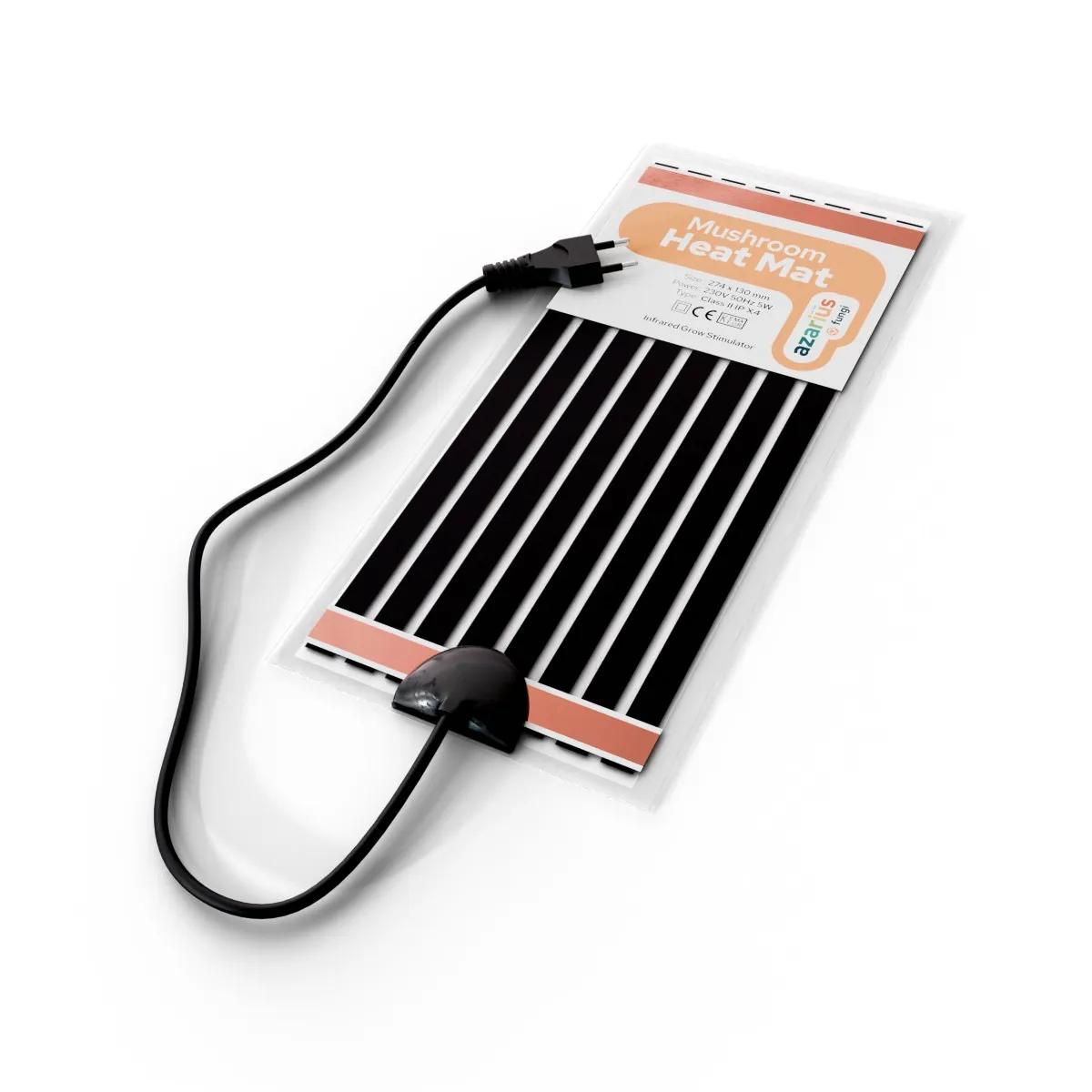
The Mushroom Heat Mat is an infrared heating pad designed specifically for 1200 ml magic mushroom grow kits, keeping substrate temperatures stable so your mycelium colonises faster and your flushes come in fuller. If your flat drops below 20°C — and let's be honest, most European homes do for half the year — this mat sits underneath your grow kit and gently raises the temperature to the sweet spot where psilocybin mushrooms actually want to fruit. Plug it in, place your kit on top, and stop worrying about whether your radiator is doing enough.
Mushroom mycelium is fussy about temperature. Too cold and it stalls — sometimes for weeks. Too hot and you're inviting contamination or, worse, cooking the mycelium outright. The sweet spot for most cubensis strains sits between roughly 22°C and 25°C, and the Mushroom Heat Mat uses infrared technology to deliver gentle, even warmth across the entire base of your grow kit. No hot spots, no cold corners.
We've seen customers lose entire grows because their room temperature swung between 15°C at night and 22°C during the day. That kind of fluctuation confuses the mycelium. It starts pinning, then stops, then tries again — and you end up with a patchy, underwhelming flush. A heat mat won't turn a bad setup into a good one, but it removes the single most common variable that trips people up: inconsistent temperature.
Here's the honest bit: a heat mat is not always necessary. If your room naturally sits at 21–24°C around the clock, you can skip it. But if you're growing between October and April in northern Europe — the Netherlands, Germany, Scandinavia, the UK — your ambient temperature almost certainly dips below the ideal range at night. That's when this mat earns its keep.
The package contains one infrared mushroom heat mat, sized to fit standard 1200 ml magic mushroom grow kits. It comes with a built-in plug-and-switch mechanism — no separate controller, no fiddly wiring. The mat itself is thin enough to slide under your grow kit without raising it awkwardly, and light enough that you'll barely notice it's there. Dimensions are compact, designed specifically around the footprint of a 1200 ml kit.
| Specification | Detail |
|---|---|
| Heat type | Infrared |
| Designed for | 1200 ml mushroom grow kits |
| Setup | Plug and play (built-in switch) |
| Heat distribution | Even, full-surface infrared |
| Energy use | Low consumption |
| Weight | Lightweight, compact profile |
| Placement | Underneath grow kit |
Standard heat mats — the kind sold for seed germination or reptile tanks — blast heat from a single element, creating hot spots directly above the heating coil and cooler zones everywhere else. Infrared technology works differently. It radiates warmth across the full surface area of the mat, so the bottom of your grow kit receives a consistent temperature from edge to edge. Think of it like the difference between a space heater pointed at one corner of a room and underfloor heating that warms everything evenly.
This matters more than you'd think. Mycelium grows towards warmth. If one side of your substrate is 26°C and the other is 19°C, colonisation happens unevenly, and your pins emerge in patches rather than across the whole surface. Even heat distribution means even pinning, which means a more uniform flush — and a better yield per kit.
One thing to watch: don't stack the mat on top of a thick towel or blanket thinking you'll insulate the heat. The mat is designed to radiate upward through the base of the grow kit. Insulating underneath can cause heat to build up beyond the intended range. Place it on a flat, hard surface — a shelf, a table, a desk — and let the infrared do its work.
No thermostat is built into this mat. It provides a constant, gentle heat output, which works brilliantly in rooms that sit between 15–20°C. But if your room is already at 23°C in summer, adding a heat mat on top could push substrate temperatures above 27°C — and that's where problems start. Contamination thrives in overly warm, humid conditions. If your room runs warm, switch the mat off during hotter months or use a separate plug-in thermostat to cut power when the temperature exceeds your target.
We'd also note that this mat is sized for 1200 ml kits specifically. If you're running a larger 2100 ml kit, the mat won't cover the full base, and you'll get uneven heating — which is exactly what you're trying to avoid. For bigger kits, look at a larger heat mat or a heat guard setup.
Complete your grow setup: pair the Mushroom Heat Mat with a 1200 ml magic mushroom grow kit — we carry several strains from Golden Teacher to McKennaii. A small digital thermometer is worth grabbing too, so you can verify substrate temperature rather than guessing.
After 25 years of selling grow kits from the shop in Amsterdam, we can tell you the single biggest reason first-time growers get disappointing results: temperature. Not contamination (though that's second), not light, not humidity. Temperature. Specifically, temperatures below 20°C that slow colonisation to a crawl and delay pinning by a week or more.
| Factor | Without heat mat (room at 17–19°C) | With mushroom heat mat (substrate at 22–25°C) |
|---|---|---|
| Colonisation speed | Slow — can stall for days | Steady — visible progress within days |
| Time to first pins | 3–4 weeks typical | 1.5–2.5 weeks typical |
| Pin distribution | Often patchy and uneven | More uniform across the surface |
| Contamination risk | Higher (slow growth gives mould a head start) | Lower (fast colonisation outpaces contaminants) |
| Overall yield | Variable, often below kit potential | Closer to the kit's full potential |
The numbers above aren't lab data — they're patterns we've observed from customer feedback and our own test grows over the years. Your results will depend on strain, kit quality, and how well you maintain humidity and fresh air. But temperature is the foundation everything else sits on.
We get asked about heat mats at least a few times a week, especially from October onwards. The most common question: "Do I really need one?" And the honest answer is — it depends on your room. Grab a thermometer, check the temperature where you plan to keep your grow kit at 3 AM on a cold night. If it's below 20°C, a heat mat is the cheapest insurance you can buy against a slow or failed grow. If it's consistently above 21°C, save your money.
The second most common question: "Can I use a reptile heat mat instead?" You can, but reptile mats often run hotter and have more localised heating. This mushroom-specific mat uses infrared for a reason — the heat spread is gentler and more even. A reptile mat with a thermostat controller can work in a pinch, but for the price of this mat, it's not worth the risk of frying your mycelium with a hot spot.
No. If your room temperature stays between 21–25°C around the clock, you can grow without one. The mat is most useful when ambient temperatures drop below 20°C, which happens in most northern European homes during autumn and winter.
It's not recommended. The mat is sized for 1200 ml kits. A larger kit will overhang the heated area, causing uneven substrate temperatures. For bigger kits, look for a mat that matches the kit's footprint.
Yes. Consistent temperature is the goal. Switching the mat on and off creates the kind of fluctuations that slow colonisation and confuse pinning. Leave it running continuously unless your room gets too warm during the day.
In a warm room (above 23°C), yes. The mat adds heat on top of your ambient temperature. Use a thermometer to monitor substrate temperature, and switch the mat off or use an external thermostat if temperatures exceed 26°C.
Very little. Infrared heat mats are energy efficient — comparable to leaving a small LED light on. You won't notice it on your electricity bill, even running it continuously for weeks.
On a flat, hard surface like a table or shelf. Don't place it on carpet, towels, or soft materials — these trap heat underneath and can cause the mat to overheat. The grow kit sits directly on top of the mat.
No. It has a simple plug-and-switch mechanism. If you want precise temperature control, pick up a separate plug-in thermostat — they're inexpensive and let you set a maximum temperature cutoff.
Last updated: April 2026
Medical disclaimer. This content is for informational purposes only and does not constitute medical advice. Consult a qualified healthcare provider before use of any substance.