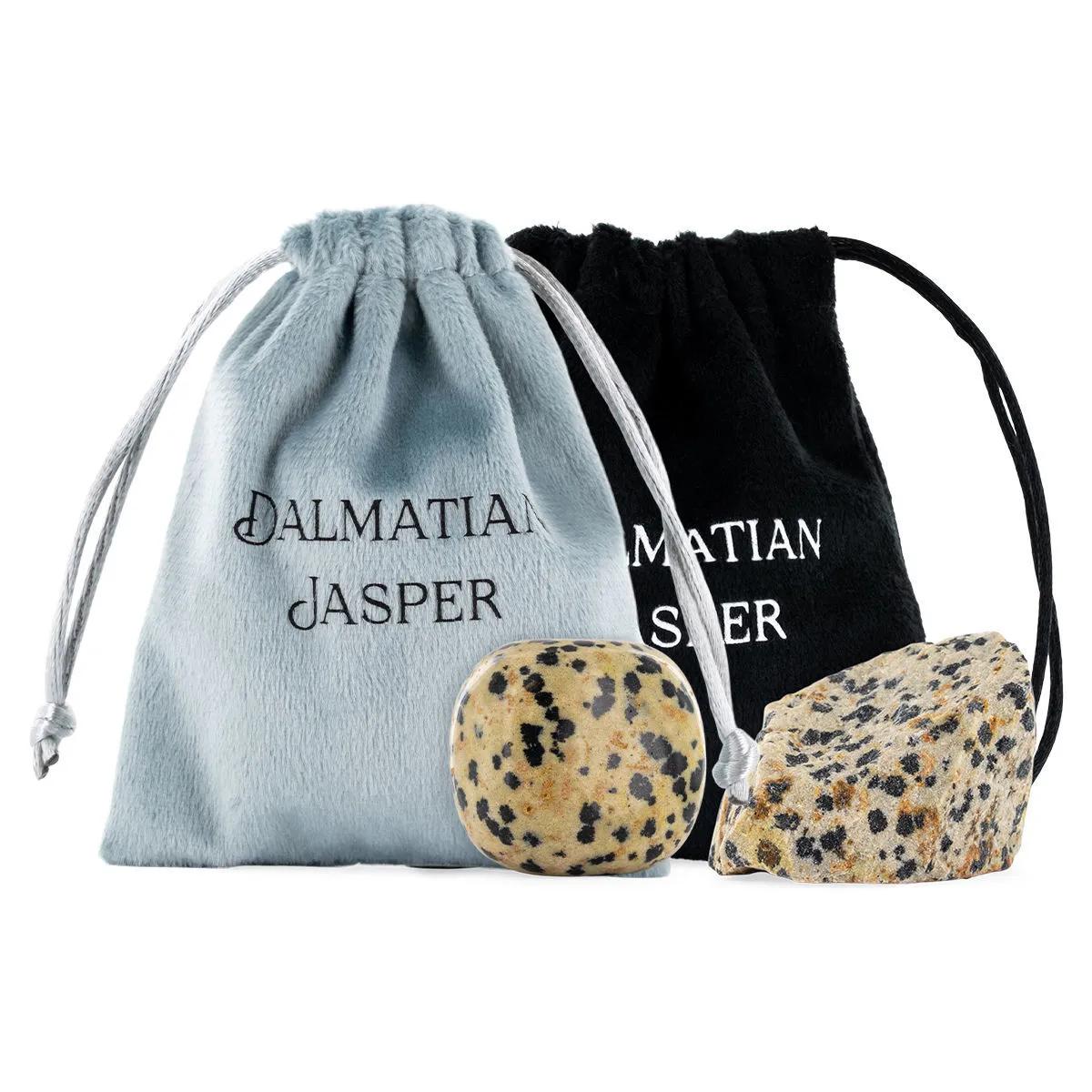
Dalmatian Jasper is a speckled white quartz mineral that brings a bit of grounding charm to your shelf, pocket, or altar. Sourced from the Chihuahua region of Mexico, each piece carries that unmistakable black-on-white spotting that earned it the "Dalmatian Stone" nickname. Pick between natural raw chunks or smooth polished tumbles — both measure 3–5 cm and both look genuinely good sitting on a windowsill.
What makes Dalmatian Jasper worth picking up
Dalmatian Jasper is a white quartz-based mineral peppered with dark spots of arfvedsonite (and occasionally tourmaline) — the contrast is what gives it the dog-breed nickname. It's one of those stones that doesn't try too hard. No shimmer, no flash, just clean black-and-white spotting that works whether you're stacking it with other crystals or letting it sit solo on a desk.
Within crystal-collecting traditions, Dalmatian Jasper is associated with grounding, confidence and a sense of calm completeness. We're not making medical claims — that's the folklore around the stone, and it's why a lot of customers reach for it. If you're building a small altar, putting together a gift, or just want something tactile to fidget with, it does the job without being precious about itself.
Natural vs Polished — which one to grab
| Finish | Looks like | Best for |
|---|---|---|
| Natural (SM0779) | Raw, matte, textured surface with visible edges | Altars, shelves, display pieces, anyone who likes the unworked look |
| Polished (SM0780) | Smooth, glossy, rounded tumble — fits in your palm | Pocket carry, worry stones, gifts, jewellery wrapping |
Honestly? If you can't decide, get one of each. They're small stones and they look great side by side — the rough one shows you what the earth gave you, the polished one shows what a tumbler can do with it.
Specifications
| Mineral | Dalmatian Jasper (white quartz with arfvedsonite inclusions) |
| Also known as | Dalmatian Stone |
| Origin | Chihuahua region, Mexico |
| Size | 3–5 cm per stone |
| Finishes available | Natural (SM0779), Polished (SM0780) |
| Care | Wipe with a damp cloth as needed |
| Sold as | Single stone — variations in pattern and size are normal |
Pairs well with other grounding stones in our crystals collection — Tiger's Eye for confidence, Black Tourmaline for protection, or Clear Quartz to amplify whatever you're working with. A small velvet pouch keeps polished tumbles from scratching when you carry them.
Why people keep coming back for this one
Dalmatian Jasper sits in a sweet spot that not many stones hit: it's affordable, it's distinctive, and it doesn't look like every other tumble in the bowl. We've watched customers walk past flashier crystals — labradorite, fluorite, the whole shimmery lot — and pick up a Dalmatian Jasper because the spotting catches their eye in a quieter way.
It's also a gateway stone. If you're new to crystals and don't want to drop serious money on a fist-sized chunk of something, a 3–5 cm Dalmatian tumble is a low-stakes way in. And if you've been collecting for years, it's one of those pieces that fills a gap in a display — the matte black-and-white reads almost like a graphic design choice next to colourful stones.
The honest limitation: every stone is different. Some have heavy spotting, some have sparse spotting, some lean more grey than black. We can't pick a specific pattern for you. If you want a perfectly even Dalmatian look, this is the wrong product — go for a designed jewellery piece instead. If you like the natural variation, you'll get a stone that's genuinely one of a kind.
How to use Dalmatian Jasper
- Decide where it lives — pocket, desk, altar, windowsill, plant pot. There's no wrong answer.
- For pocket carry, go polished — the smooth finish won't catch on fabric or scratch your phone.
- For display, either finish works. Natural pieces look better in groups; polished pieces look better solo or as part of a set.
- Clean it occasionally with a slightly damp cloth. Don't soak it, don't use soap, don't put it in salt water — quartz is hardy but the dark inclusions can react.
- If you're into the meditative side, hold the stone in your palm and focus on its weight and temperature. Whether that "does" anything is between you and your practice — what it definitely does is give your hands something to focus on.
- Keep it out of direct sunlight for hours on end if you can. Quartz doesn't fade like amethyst, but it's good practice.
Frequently Asked Questions
Is Dalmatian Jasper actually a jasper?
Technically no — mineralogically it's closer to a white quartz or feldspar with arfvedsonite inclusions. "Jasper" stuck as a trade name because of the speckled appearance, and it's how the stone is sold worldwide. The name is sticky; the science is a footnote.
What's the difference between natural and polished?
Natural stones are raw — matte surface, visible edges, more textured to the touch. Polished stones have been tumbled smooth and have a glossy finish that fits comfortably in your palm. Same mineral, same origin, same size range (3–5 cm) — just a different feel and look.
Will each stone look exactly like the photo?
No — and that's part of the appeal. Each Dalmatian Jasper has its own spotting pattern, density and shape. You'll get a stone that fits the 3–5 cm size range and the natural-or-polished finish you picked, but the exact pattern will be unique to your piece.
How do I clean it?
Wipe it down with a damp cloth when it gets dusty. Avoid soaking, harsh chemicals, or salt water — the dark inclusions can be sensitive. That's genuinely all the maintenance it needs.
Where does Azarius source it from?
Our Dalmatian Jasper comes from the Chihuahua region of Mexico, which is the primary deposit location for this stone. You don't have to fly to Mexico to get a piece — we ship across the EU from Amsterdam.
Is this a good starter crystal?
Yes — it's one of the better entry-level stones. Small, affordable, visually distinctive, and easy to care for. If someone's just getting into crystals and asks where to start, Dalmatian Jasper alongside a clear quartz and a black tourmaline is a solid little starter trio.
Last updated: April 2026