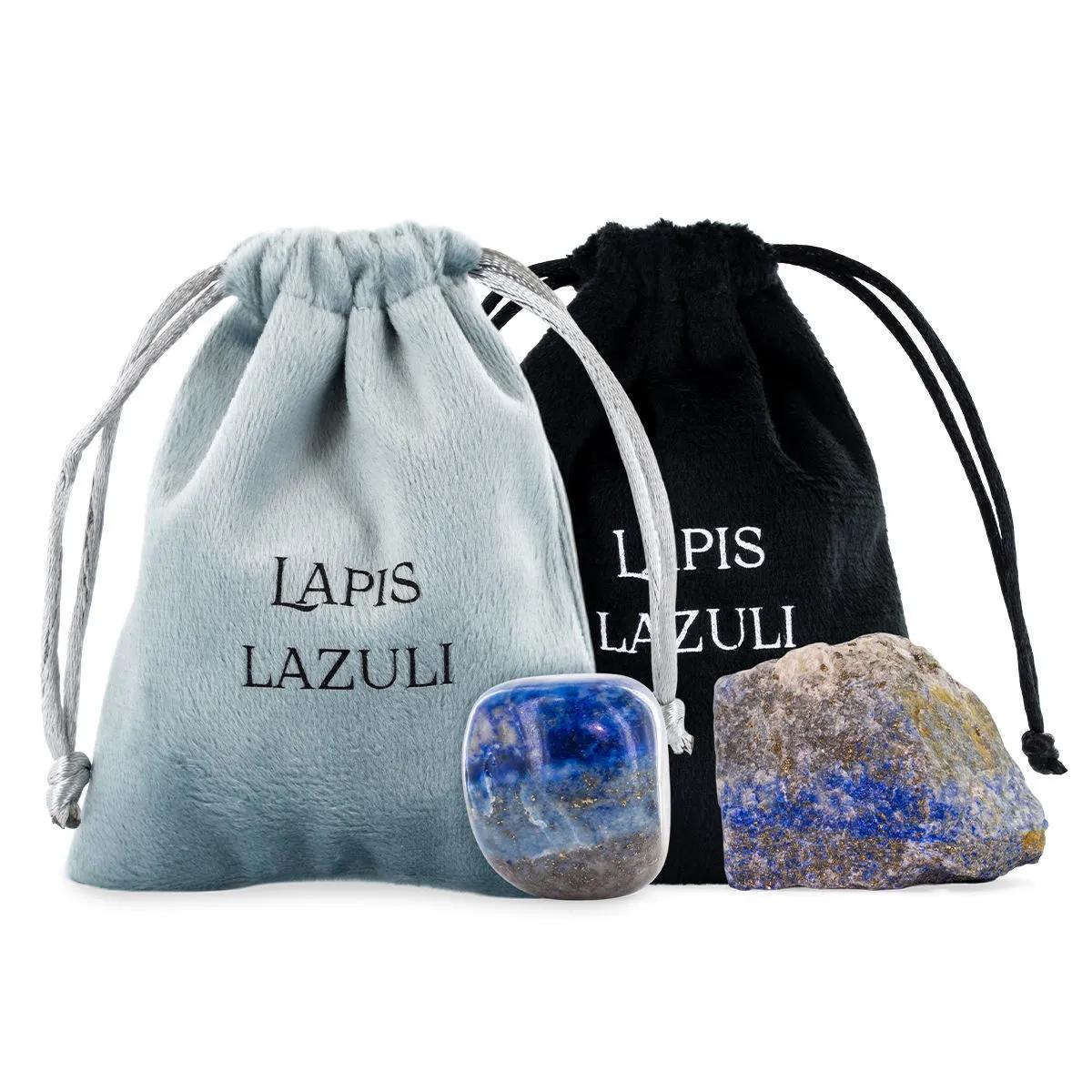
Lapis lazuli is a deep-blue semiprecious gemstone that has been mined for over 6,000 years, primarily in the Hindu Kush mountains of Afghanistan. This sodium aluminium silicate — often flecked with golden pyrite and white calcite — is one of the oldest spiritual stones we stock, used since ancient Egypt for jewellery, pigment, and meditation. Each piece measures 3–5 cm and comes in two finishes: natural or polished, so you can buy the variant that suits your practice.
Why lapis lazuli has lasted 6,000 years
Lapis lazuli has held cultural and spiritual weight across civilisations for six millennia. It ended up in Tutankhamun's tomb, was ground into the ultramarine pigment used on the Virgin Mary's robes in Renaissance paintings, and appeared in medieval European medical texts. According to a femtosecond pump-probe microscopy study on Renaissance pigments, analysis of the Virgin Mary's robe showed lapis applied in a layer up to 60 µm thick (PMC3918778) — that's how prized this stone was as a colour source. Egyptian medical papyri also referenced it: according to a historical review of Ancient Egyptian medical prescriptions, it was described in historical texts as having "such virtue, that all melancholy passions might be cured by it" (PMC7946098) — a traditional belief recorded by the source, not a claim we make.
We're not claiming it does anything pharmacological — that's the historical record talking. What we can say is that this stone has outlasted most civilisations and is still one of the most-asked-for stones across our counter. The deep ultramarine blue with golden pyrite flecks doesn't really photograph well — it looks better in your hand than on a screen.
Natural vs polished: which finish suits you
Both variants are the same stone from the same mines — the difference is purely surface treatment. Natural lapis keeps the raw, matte texture with visible calcite veining and pyrite specks. Polished lapis has been tumbled smooth to a glossy finish that brings out the depth of the blue and makes the pyrite flecks sparkle like tiny gold stars.
| Variant | Finish | Best for |
|---|---|---|
| Natural (SM0766) | Raw, matte, unpolished | Altar work, grid layouts, those who prefer the stone as it came out of the ground |
| Polished (SM0767) | Tumbled, glossy, smooth | Pocket carry, meditation hand-hold, jewellery making, gift-giving |
From our counter: if you're carrying the stone daily in a pocket or holding it during meditation, get the polished one — the smooth finish feels better against skin and won't snag on fabric. If it's living on a shelf or in a crystal grid, natural keeps more visual character. We get asked which is "more powerful" at least once a week — there's no difference in mineral composition. It's the same lapis, just one's had a polish.
Properties and traditional uses
This stone is traditionally associated with the third eye and throat chakras, used for introspection, self-discovery, and clear communication. In crystal healing tradition, it's considered a stone of knowledge — given as a gift to mark spiritual journeys, support learning and teaching, and help draw attention beyond the everyday. It belongs to the wind element in classical correspondence systems.
Tibetan medicine also placed this stone at the heart of its healing pantheon. According to a 2016 review of Tibetan precious pills, traditional practitioners invoked "the Teacher of Medicine, the King of Lapis Lazuli Light" as part of their healing tradition (PMC5154374) — symbolic of medical authority rather than a pharmacological agent.
Specifications
| Stone | Lapis lazuli (sodium aluminium silicate) |
| Inclusions | Pyrite, white calcite |
| Size | 3–5 cm |
| Origin | Primarily Afghanistan (Hindu Kush); also Chile, Russia |
| Variants | Natural (SM0766) or Polished (SM0767) |
| Chakra association | Third eye, throat |
| Element | Wind |
| Historical use | Ancient Egyptian jewellery, ultramarine pigment, Tibetan medicine |
Pairs well with a small velvet pouch for pocket carry, or with clear quartz and amethyst for a third-eye-focused crystal grid. If you're building a meditation set, order one of our selenite charging plates — they make a clean home for tumbled stones between sessions.
How to use your tumbled stone
- Rinse the stone briefly under cool running water when it arrives — not hot, as thermal shock can crack pyrite inclusions.
- Hold it in your dominant hand during meditation, or place it at the throat or forehead while lying down.
- For crystal grids, position it at the centre or at points associated with communication and insight.
- Carry the polished variant in a pocket or small pouch for daily use — the smooth finish won't scratch.
- Cleanse periodically with moonlight, sound, or smoke (sage, palo santo). Avoid prolonged salt-water soaks — the stone is porous and can degrade.
- Store away from direct sunlight long-term to prevent the blue from fading.
An honest note on what crystals do
Crystals are tactile focus objects, not medicine. We've sold spiritual stones since 1999 and we'll be straight with you: there's no clinical evidence that this gemstone does anything pharmacological to your body or brain. What it does do is give you a physical object to focus on — a tactile anchor for intention, meditation, or ritual. That's not nothing. Plenty of practices across 6,000 years of human history have used objects this way, and the placebo and focus effects are real even when the mechanism isn't mineralogical. Buy it because it's beautiful and meaningful to you. That's reason enough.
Frequently Asked Questions
What is lapis lazuli used for?
Traditionally, it's used for meditation, crystal grids, jewellery, and as a decorative spiritual stone. It's associated with the third eye and throat chakras and used to support introspection and communication in crystal healing practice. Historically it was also ground into ultramarine pigment for Renaissance paintings.
Where does it come from?
The vast majority comes from the Sar-i Sang mines in Afghanistan's Hindu Kush mountains, where it's been mined for over 6,000 years. Smaller deposits exist in Chile and Russia. Afghan material is generally considered the highest grade due to its deep blue and pyrite content.
How can I tell if mine is real?
Genuine material shows uneven, organic colour distribution with visible pyrite flecks (gold) and often white calcite veining. Dyed howlite or synthetic substitutes tend to look too uniformly blue and lack the metallic pyrite sparkle. Real stone also feels cool and dense in the hand.
Can I get it wet?
Brief contact with water is fine, but avoid prolonged soaking, salt water, or harsh cleaners. It's relatively soft (5–5.5 on the Mohs scale) and porous, so extended water exposure can dull the polish and degrade the calcite inclusions. Wipe with a soft damp cloth instead.
What's the difference between the natural and polished variants?
Same stone, different finish. Natural is raw and matte with visible texture; polished is tumbled smooth and glossy. Polished feels better for pocket carry and meditation hand-holds; natural has more visual character for altars and grids. Neither is "stronger" — that's a question of personal preference.
How do I cleanse it?
Use moonlight overnight, sound (singing bowls, bells), or smoke cleansing with sage or palo santo. Avoid salt water, prolonged sunlight, and ultrasonic cleaners. Many people also cleanse new stones on a selenite plate, which doesn't require recharging itself.
How does lapis compare to sodalite?
Both are deep-blue stones often confused at a glance, but sodalite lacks the golden pyrite flecks and tends toward a more uniform navy with white veining. Lapis is denser, typically a richer ultramarine, and considerably more expensive due to its Afghan origin and slower extraction. According to MAPS-affiliated ethnobotanical surveys and Beckley Foundation cultural-heritage notes referenced in the EMCDDA's broader literature on traditional materia medica, lapis has the longer documented ritual lineage of the two.
Last updated: April 2026