Drug tests
by Dope or Nope
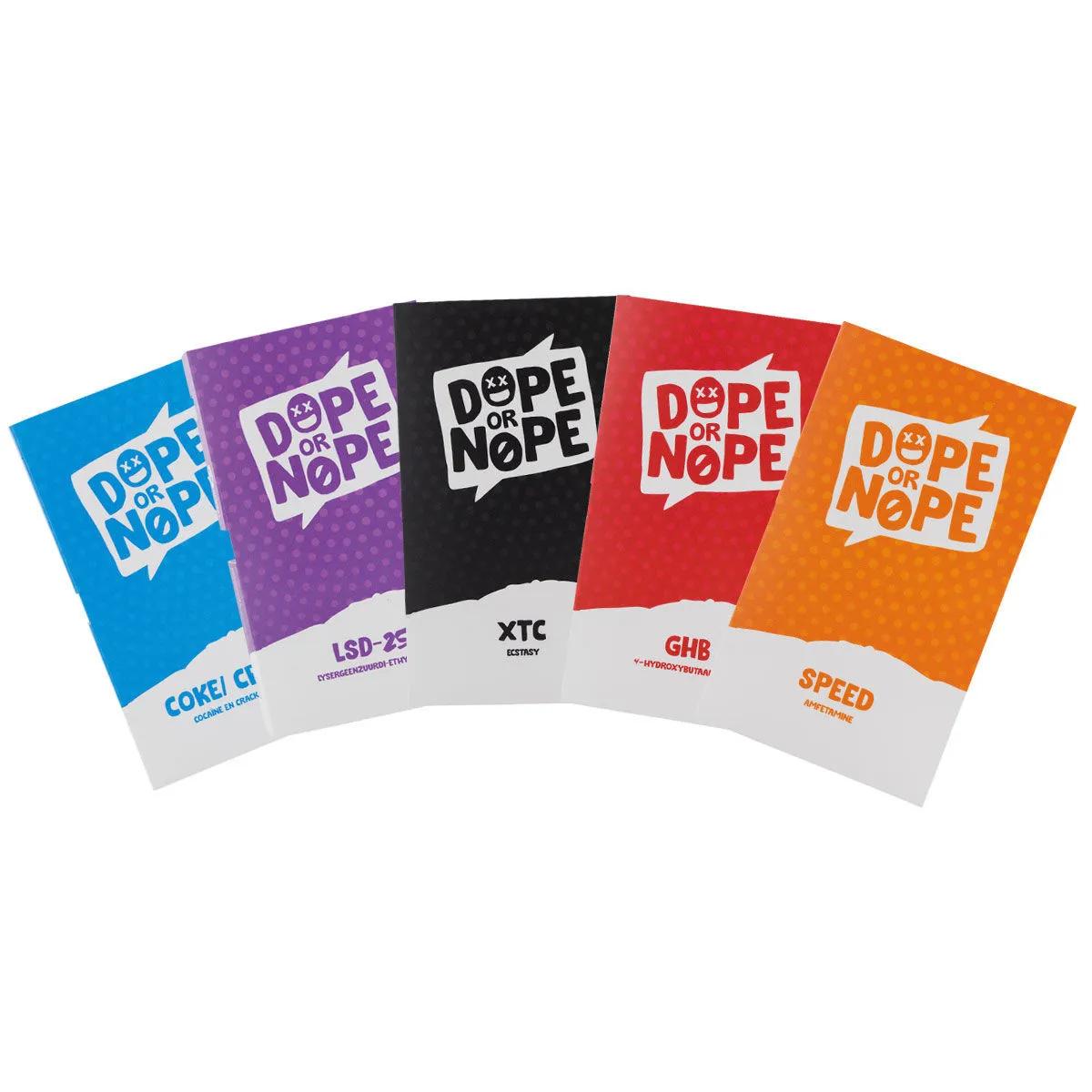
The Dope or Nope drug test is a reagent-based testing kit that helps you verify whether your substances actually contain what you think they do. Available in 11 substance-specific variants — from amphetamine and cocaine to psilocybin and GHB — each kit uses a colour-reaction system to flag the presence (or absence) of a target compound in seconds. One of the simplest harm-reduction tools you can keep in your bag.
Each Dope or Nope kit tests for one specific substance. Pick the variant that matches what you want to verify. If you're testing multiple substances across a night out or a stash, you'll need one kit per substance type. Here's the full lineup:
| Variant | SKU | Tests For |
|---|---|---|
| Amphetamine | SM0319 | Amphetamine / speed |
| 4-FMP/4-FA | SM0318 | 4-fluoromethamphetamine / 4-fluoroamphetamine |
| XTC | SM0328 | MDMA / ecstasy |
| THC | SM0327 | THC (cannabis compounds) |
| Opiates | SM0326 | Opiates (heroin, morphine, codeine) |
| LSD | SM0325 | LSD (lysergic acid diethylamide) |
| Ketamine | SM0324 | Ketamine |
| Cocaine | SM0323 | Cocaine |
| Psilocybin | SM0322 | Psilocybin (magic mushrooms / truffles) |
| GHB | SM0321 | GHB (gamma-hydroxybutyrate) |
| Crystal Meth | SM0320 | Methamphetamine |
Not sure which one to grab? If you're heading out for a club night, the XTC and cocaine variants are the most commonly used. For home sessions with truffles or tabs, the psilocybin and LSD kits are your go-to.
A reagent drug test is the cheapest insurance you can buy. The reality of unregulated substances is that you genuinely do not know what's in them — no matter how much you trust your source. We've been selling harm-reduction tools from our Amsterdam shop since 1999, and the single most common regret we hear is "I didn't bother testing it." That one sentence has preceded some genuinely scary stories across our counter.
The risks are not theoretical. According to research published in the International Journal of Drug Policy, exposure to fentanyl-contaminated heroin has been directly linked to overdose clusters (PMC5560423). And it's not just opiates — according to a study in Substance Abuse Treatment, Prevention, and Policy, poly-drug contamination can be linked to distinct morbidity and mortality consequences (PMC2577634). Research into methamphetamine adulteration has documented long-term effects including psychosis, memory loss, aggressive behaviour, and severe dental problems (PMC4127374). A colour reaction that takes 2 minutes could be the difference between a good night and a hospital visit.
Here's the honest limitation: a reagent test tells you whether a target substance is present. It does not tell you the exact purity percentage, and it won't catch every possible adulterant. Think of it as a first line of defence, not a lab-grade analysis. If the colour doesn't match the chart, bin it. No substance is worth the gamble.
Each kit contains a reagent solution that reacts with a specific chemical compound to produce a visible colour change. You take a tiny sample of your substance — a scraping, a corner of a tab, a few milligrams of powder — add the reagent, and compare the resulting colour against the included reference chart.
If you see a colour match on the chart, your sample contains at least some of the target substance. A match does not mean 100% purity — it confirms presence only. If you see no colour change, or a colour that doesn't appear on the chart at all, your sample does not contain the listed substance and should be discarded immediately. No exceptions.
The physical experience of using the kit is straightforward. The reagent liquid has a sharp chemical smell — don't sniff it deliberately — and the colour change typically appears within 30 to 90 seconds. You'll want a clean, dry surface and decent lighting. Doing this in a dark club toilet is possible but not ideal. We'd say: test before you leave the house.
| Spec | Value |
|---|---|
| Brand | Dope or Nope |
| Test type | Reagent colour-reaction |
| Number of variants | 11 |
| Substances covered | Amphetamine, 4-FMP/4-FA, MDMA, THC, opiates, LSD, ketamine, cocaine, psilocybin, GHB, crystal meth |
| Results time | 30–90 seconds |
| Sample size needed | A few milligrams (tiny scraping) |
| Result format | Colour match against included reference chart |
| Use | Single-use per kit |
| Storage | Cool, dark place — away from direct sunlight |
Testing one substance? You'll likely want to test others too. Grab multiple Dope or Nope variants to cover your bases — the XTC and cocaine kits are the most popular combination for a night out. If you're looking for a broader screening tool, check out the General Drug Test by Dope or Nope, which uses a single colour-coded system to screen across substance categories in one go.
We started stocking drug test kits in the early 2000s, and the conversation hasn't changed much. People walk in confident that their stuff is clean, and about 1 in 5 times the test tells a different story. The most common reaction we see? Genuine surprise. The second most common? Relief that they tested before taking it.
The one thing we'd change about these kits: they're single-use. If you're testing multiple batches or substances across a weekend, you'll burn through kits quickly. It's worth buying 2–3 variants if you're heading to a festival or a multi-day event. The cost of a few extra kits is negligible compared to the alternative.
We'd also point out that reagent testing is not the same as lab testing. Professional testing services — like those offered at some festivals and harm-reduction centres — use gas chromatography and mass spectrometry, which identify exact compounds and concentrations. A reagent kit gives you a yes/no on the presence of a target substance. That's a critical first step, but if you have access to professional testing, use it as well. According to research on harm-reduction attitudes, chronic health conditions associated with long-term drug use may pose additional risks, making substance verification even more important (PMC9675127).
No. It confirms whether the target substance is present, not how pure it is. A positive colour match means at least some of the compound is there. For exact purity percentages, you'd need professional lab testing with gas chromatography or mass spectrometry.
Each kit is single-use and substance-specific. The amphetamine variant only tests for amphetamine, the cocaine variant only for cocaine, and so on. If you need to test 3 different substances, you need 3 separate kits matched to each one.
No colour change means the target substance is not present in your sample. Discard it immediately. A lack of reaction doesn't tell you what is in the sample — only that the expected compound isn't there.
Reagent tests are a reliable first screening tool for confirming the presence of a target compound, but they can't identify every possible adulterant or give you concentration data. Professional lab analysis is more thorough. Think of reagent testing as the minimum — not the ceiling — of harm reduction.
Keep it in a cool, dark place away from direct sunlight. Heat and light degrade the reagent over time, which can produce inaccurate colour reactions. A drawer or cupboard at room temperature works fine. Check the expiry date on the packaging before use.
The reagent is corrosive — avoid contact with skin, eyes, and clothing. If it splashes on your skin, rinse with plenty of water straight away. Work on a surface you don't mind staining, and keep the vial upright when not in use. It smells sharp, so use it in a ventilated space.
The XTC and cocaine variants are the most popular for club and festival settings. If you're bringing multiple substances, grab one kit per type. The LSD and ketamine variants are also worth packing if those are on the menu. Testing before you leave home gives you the best lighting and calmest conditions.
Last updated: April 2026
Medical disclaimer. This content is for informational purposes only and does not constitute medical advice. Consult a qualified healthcare provider before use of any substance.