Fun Attributes
by Azarius
We'll only email you about this product — no marketing.
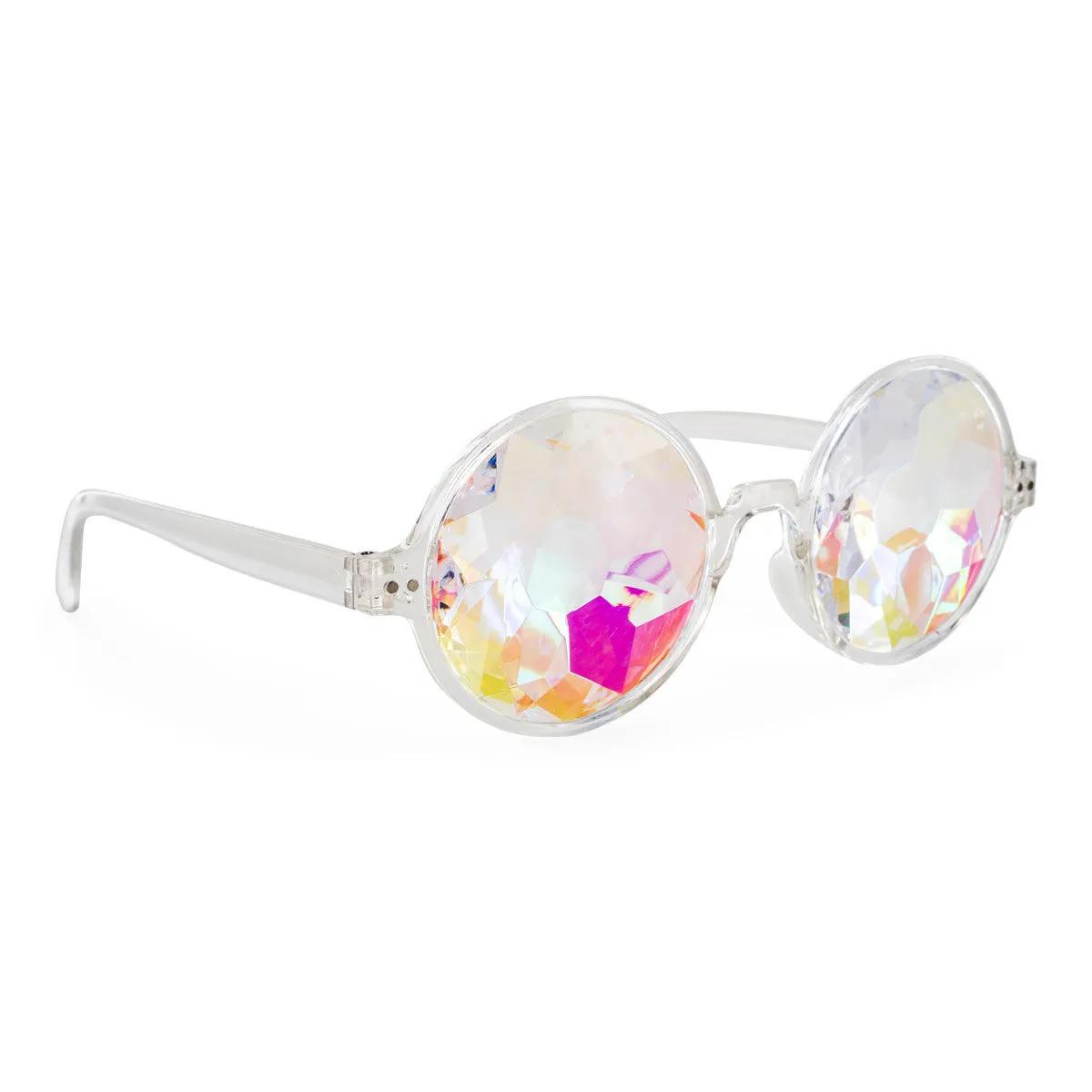
Kaleidoscope glasses are a wearable optical accessory that splits and refracts light through faceted prism lenses, turning ordinary scenes into fractured, swirling mosaics of colour and pattern. Pop them on under a laser rig or in front of a DJ booth and every beam of light multiplies into dozens, layering geometric shapes across your entire field of vision. They weigh next to nothing, fit over most face shapes, and cost less than a festival burger — yet they genuinely change how a night looks and feels.
We've kept a pair behind the counter in Amsterdam since we first stocked them, and they still get passed around whenever someone asks "what's the weirdest thing you sell for under a tenner?" The answer is always these. One look through the lenses and you get it.
Each lens contains multiple faceted prism segments — small angled surfaces cut into the glass or polycarbonate. When light hits these facets, it refracts at different angles simultaneously, creating repeated and rotated copies of whatever you're looking at. The effect is strongest with point-source lighting: LEDs, lasers, strobes, phone torches, candle flames. Under flat daylight the fractal effect is subtler but still noticeable — trees and clouds get a stained-glass quality that's surprisingly pleasant.
The "Clear" variant in this listing uses transparent faceted lenses, meaning they don't tint or darken your vision. You still see full-colour light — it just arrives at your eyes in 6, 8, or more overlapping copies depending on the lens cut. Compared to diffraction glasses (which split light into rainbow spectra along a grating), kaleidoscope glasses produce a more geometric, tessellated look. Both are worth owning, honestly, but kaleidoscope glasses tend to be the bigger crowd-pleaser because the effect is immediately obvious even to people who've never worn them before.
| Spec | Value |
|---|---|
| Variant | Clear |
| SKU | HS1786 |
| Lens type | Faceted kaleidoscope prism |
| Lens tint | None (clear) |
| Frame material | Lightweight plastic |
| Fit | One size, standard adult |
| Weight | Approx. 30–40 g |
| UV protection | Not rated — not a substitute for sunglasses |
Festivals and raves spend thousands on lighting rigs designed to dazzle you. Kaleidoscope glasses take that investment and multiply it — literally. A single laser line becomes a spiralling web. A strobe becomes a pulsing crystal grid. LED totems in the crowd fracture into dozens of floating jewels. You're getting more visual spectacle from the same show, without changing anything except what's sitting on your nose.
They're also a brilliant social tool. Hand them to a stranger and you've made a friend for the next 20 minutes. We've watched people queue up at festival stalls just to try a pair on — the reaction is always a grin followed by "where did you get these?" At this price point, buying a spare pair to give away is a genuine option.
The honest limitation: these are lightweight plastic-frame glasses, not titanium-hinged optics. They'll survive a weekend in a bum bag or jacket pocket, but sitting on them or stuffing them loose into a packed rucksack is asking for trouble. A small hard case or even a sock wrapped around them solves that. Also, wearing them while walking on uneven ground — festival fields, cobblestones — can be disorienting because depth perception goes sideways. Put them on when you're stationary or dancing, take them off when you're navigating tent ropes in the dark.
We get asked at least once a week whether these "actually do anything." Yes — emphatically. The effect isn't subtle. You don't need to squint or tilt your head at a special angle. You put them on, look at any light, and the world turns into a living geometry lesson. The clear variant is our pick over tinted versions because you keep the full colour spectrum of whatever lighting you're under. Tinted lenses can look cool in photos but they wash out the reds or blues that make a laser show worth watching.
One thing we'd flag: these aren't sunglasses. They don't block UV. Wearing them outdoors on a bright summer day is fine for a laugh, but don't rely on them to protect your eyes. If you're at a daytime festival and want both the kaleidoscope effect and UV protection, wear them over contact lenses or alternate with actual sunnies.
Complete your festival sensory kit: pair these kaleidoscope glasses with a set of diffraction glasses for a different prismatic effect, or grab a UV-reactive accessory to give your mates something extra to look at through the lenses. A small hard glasses case keeps them safe in your bag between sets.
| Feature | Kaleidoscope glasses | Diffraction glasses |
|---|---|---|
| Lens type | Faceted prism | Holographic grating film |
| Visual effect | Geometric tessellation — repeated, rotated copies of the scene | Rainbow spectrum halos around every light point |
| Best for | Laser shows, LED rigs, strobes | Single-colour LEDs, gloving, fire spinning |
| Colour shift | None (clear variant) | Splits white light into full rainbow |
| Wow factor for first-timers | Immediate and dramatic | Subtle until you see a bright point source |
| Depth perception impact | High — multiple overlapping images | Moderate — halos add visual noise but scene stays recognisable |
Both types are worth owning. If you're only grabbing one pair for a rave with heavy laser production, kaleidoscope glasses are the bigger spectacle. For a gloving circle or fire show, diffraction glasses edge it. At these prices, honestly, just get both.
They work in any lighting, but the effect is most dramatic with distinct point-source lights — lasers, LEDs, strobes, candles. In daylight, you get a pleasant stained-glass look rather than the full swirling fractal show you see at night under artificial lighting.
It depends on the size of your frames. These fit over some slimmer prescription glasses, but bulkier frames won't sit comfortably underneath. Contact lenses are the easier solution if you need vision correction at a festival.
They don't emit or amplify light — they just refract what's already there. Wearing them for extended periods can cause mild eye strain or a slight headache because your brain works harder to process the fractured image. Take breaks every 20–30 minutes, especially if you feel any discomfort.
Kaleidoscope glasses use faceted prism lenses to create repeated geometric copies of the scene. Diffraction glasses use a holographic grating to split light into rainbow spectra. Kaleidoscope glasses produce a more tessellated, mosaic effect; diffraction glasses produce rainbow halos around light points.
They're lightweight plastic, not indestructible. They'll handle normal wear — on your face, in a pocket, in a bag — but sitting on them or crushing them under gear will snap the frame. Toss them in a small hard case or wrap them in a cloth between uses and they'll last well beyond one weekend.
Yes, noticeably. The multiple overlapping images make it harder to judge distances. Wear them while stationary or dancing, not while navigating stairs, tent ropes, or uneven ground. Take them off when you need to move through a crowd.
Last updated: April 2026