Fertilizers & nutrients
by Green House Feeding
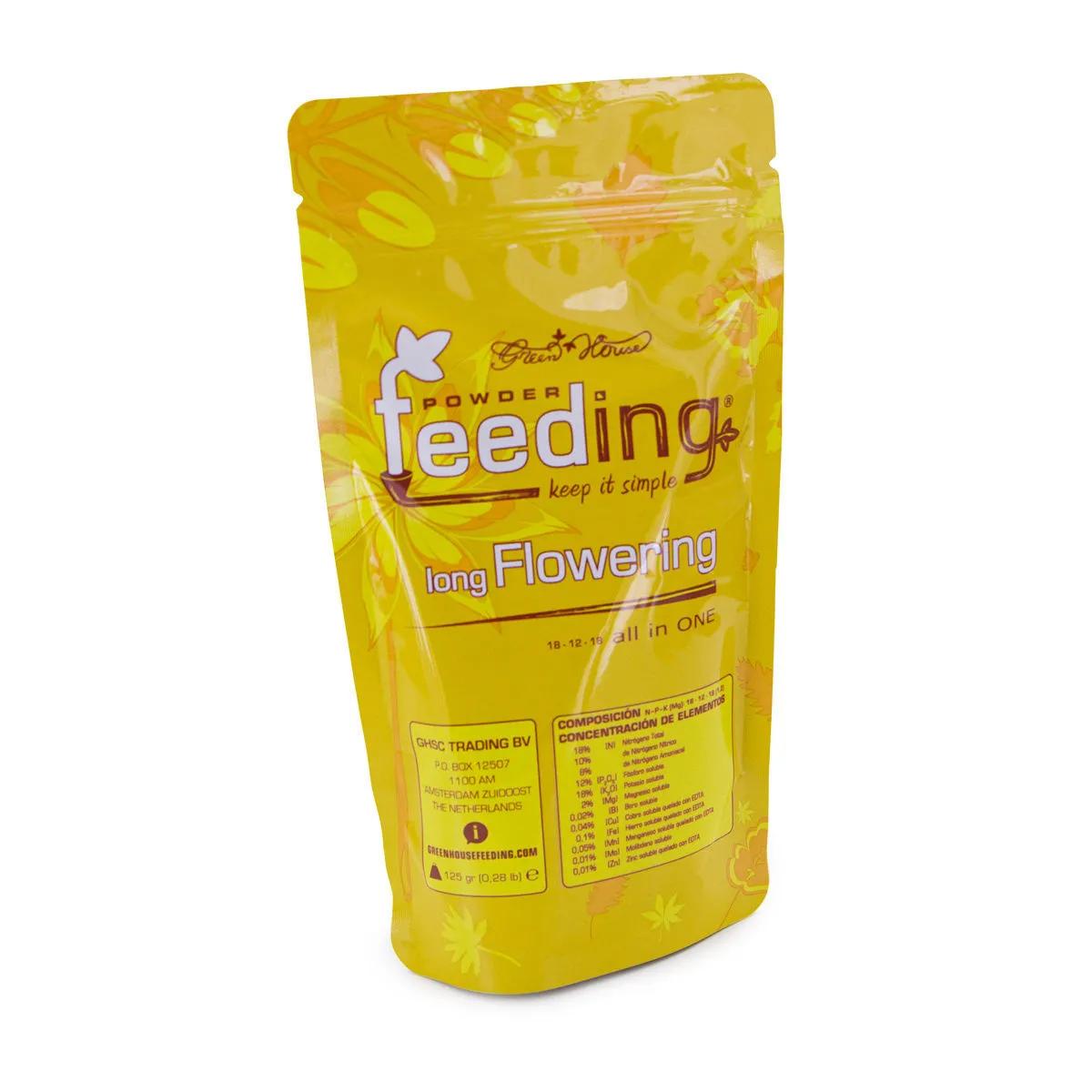
PowderFeeding Long Flowering is a complete mineral fertilizer from Greenhouse Seeds, engineered specifically for cannabis strains with 60% or more Sativa genetics. One powder, mixed with water, delivers every macro and micronutrient a long-flowering plant demands from seedling through harvest — no bottles, no complicated feed charts, no guesswork. The N-P-K-Mg ratio of 18-12-18-(1.2) is calibrated for the extended metabolic cycle that Sativa-dominant strains run on, keeping nitrogen available deep into flowering when most single-part feeds fall short. You can buy PowderFeeding Long Flowering at Azarius in a 125 g bag or a full box of 50 bags.
The 125 g bag mixes roughly 12.5 litres of full-strength solution at the recommended 10 g per 10 litres — enough for a small tent run of 2–4 plants through a single flowering cycle. If you're running a larger operation or want to stock up for the season, the full box of 50 bags gives you serious bulk without worrying about shelf life. Powder keeps indefinitely in a cool, dry spot, so there's no waste.
Sativa-dominant genetics metabolise nitrogen throughout their entire flowering cycle, unlike Indica strains that taper off after week 7 or 8. Where an Indica might wrap up in 7–8 weeks, a proper Sativa can stretch to 12, 14, even 16 weeks of flowering. That's weeks of additional nutrient demand, and a feed designed for short-flowering hybrids simply runs out of steam. Plants start cannibalising fan leaves, bud development stalls, and you end up with airy, underwhelming flowers after months of patience.
PowderFeeding Long Flowering addresses this with a balanced 18-12-18 ratio. The nitrogen sits at 18% — split between 10% nitrate nitrogen (immediately available) and 8% ammoniacal nitrogen (slower release). That split matters because it means your Sativa keeps getting a steady drip of N even in late flower, preventing the premature yellowing and leaf drop that plagues long-flowering strains on standard bloom feeds. The 12% phosphorus contributes to flower formation without the excessive P that can lock out calcium and magnesium, while the 18% potassium drives resin production and cell wall strength right through to harvest. According to data published by the European Monitoring Centre for Drugs and Drug Addiction (EMCDDA), Sativa-dominant cultivars have seen a marked increase in popularity across European markets, which tracks with the growing demand we see for long-flowering nutrient formulas.
From Our Counter: We've had growers come into the shop frustrated after losing the last three weeks of a Haze run to deficiency. Nine times out of ten, their bloom feed was designed for an 8-week Indica. Switching to a long-flowering formula is the single change that makes the biggest difference for Sativa growers — bigger than any additive or booster. One regular customer switched from a three-part liquid system to PowderFeeding Long Flowering mid-grow and told us the difference in leaf colour alone was visible within five days.
PowderFeeding Long Flowering contains 10 declared nutrients: four macroelements and six chelated trace minerals, all water-soluble and immediately available after dissolving.
| Element | Content | Form |
|---|---|---|
| Nitrogen (N) | 18% | 10% nitrate / 8% ammoniacal |
| Phosphorus (P2O5) | 12% | Soluble |
| Potassium (K2O) | 18% | Soluble |
| Magnesium (Mg) | 1.2% | Soluble |
| Boron (B) | 0.02% | Soluble |
| Copper (Cu) | 0.04% | Soluble |
| Iron (Fe) | 0.1% | Soluble |
| Manganese (Mn) | 0.05% | Soluble |
| Molybdenum (Mo) | 0.01% | Soluble |
| Zinc (Zn) | 0.01% | Soluble |
That's 6 trace elements on top of the primary N-P-K and magnesium. Iron at 0.1% is the standout — iron deficiency shows up as interveinal chlorosis on new growth, and it's annoyingly common in coco and hydro setups where pH drifts above 6.5. Having it baked into the powder means one less bottle of chelated iron on the shelf.
The table below covers every technical detail you need before you order PowderFeeding Long Flowering for your setup.
| Spec | Value |
|---|---|
| Brand | Greenhouse Seeds / PowderFeeding |
| Product type | Complete mineral fertilizer (powder) |
| N-P-K-Mg | 18-12-18-(1.2) |
| Target genetics | 60%+ Sativa strains / long-flowering varieties |
| Compatible media | Soil, coco, hydroponics, aeroponics |
| Dosage (seedlings) | 2.5–5.0 g per 10 litres of water |
| Dosage (veg/flower) | 10 g per 10 litres of water |
| Included | 10 g dosage spoon |
| Available sizes | 125 g bag / Full box (50 bags) |
| SKU (125 g) | HS0570 |
| SKU (full box) | NLA-HS0571 |
| Shelf life | Indefinite when stored cool and dry |
Complete your setup: If you're running the PowderFeeding Long Flowering, pair it with a reliable pH meter and a set of measuring syringes or a digital scale accurate to 0.1 g. Powder feeds are only as good as your measuring — eyeballing 10 g vs 15 g is the difference between healthy plants and nutrient burn. Also worth grabbing: PowderFeeding Calcium if you're growing in coco, where calcium demand is naturally higher. For growers who want to compare short-flowering options, check out PowderFeeding Hybrids or the PowderFeeding Short Flowering formula in the Azarius plant nutrition category.
A standard bloom fertilizer assumes flowering wraps up in 8 weeks, which starves Sativa-dominant strains during their most productive final phase. Here's the honest version: you can grow a Sativa on a standard bloom feed. Plants are resilient. But "surviving" and "thriving" are different outcomes when you've spent 4 months on a single run. The difference shows up in the final 3–4 weeks — exactly when a short-flowering formula assumes the plant is wrapping up. Your Haze or Thai-cross is still pushing out new pistils, still stacking calyxes, still demanding nitrogen and potassium. A standard bloom feed has already shifted to a heavy P-K finish ratio that starves the plant of what it actually needs.
The result? Premature leaf drop, reduced resin coverage, and buds that look done but aren't dense. We've seen growers blame genetics for what was actually a feeding problem. PowderFeeding Long Flowering keeps the N at 18% — unusually high for a flowering feed — precisely because Sativas metabolise nitrogen throughout their entire cycle. The phosphorus stays moderate at 12% rather than spiking to 20%+ like many PK boosters, which avoids the lockout cascade that hits calcium and magnesium when P gets too aggressive.
Honest limitation: This is a mineral salt fertilizer, not an organic line. If you're committed to a fully organic soil food web approach — living soil, compost teas, mycorrhizal networks — this is not the product for you, and we'll say that plainly. But if you want predictable, repeatable results with precise control over what your plants receive, mineral powder feeding is hard to beat. No bottles going off in the cupboard, no measuring five different liquids, no pH swings from organic decomposition. Just powder, water, stir, done.
Dissolve the powder in room-temperature water, adjust pH, and water your plants — the entire mixing process takes under two minutes.
From Our Counter: One tip from the shop floor — start at the lower end of the dosage range (7–8 g per 10 litres) for the first week or two, then ramp up to the full 10 g. Sativas are generally more sensitive to overfeeding than Indicas, and tip burn on those narrow leaves shows up fast. Better to underfeed slightly and increase than to chase a lockout with flush after flush. We had a customer bring in a photo of his Super Silver Haze with perfect green leaves at week 14 — he credited starting low and ramping up slowly.
PowderFeeding Long Flowering uses an 18-12-18 N-P-K ratio with higher sustained nitrogen, while PowderFeeding Hybrids shifts toward phosphorus and potassium earlier to match faster-finishing genetics. The key difference is nitrogen content — the Long Flowering formula keeps nitrogen higher for the extended cycle, while the Hybrids version shifts the ratio toward phosphorus and potassium earlier, matching the faster finish of 50/50 or Indica-leaning strains. If your strain is listed as 60%+ Sativa, reach for Long Flowering. If it's a balanced hybrid or Indica-dominant, the Hybrids formula is the better match. Using the wrong one won't kill your plants, but you'll leave yield and quality on the table — and after 12+ weeks of flowering, that's a frustrating place to be. Both products are available to buy in the Azarius grow shop, and you can also browse the full PowderFeeding range in the plant food and fertilizer category.
Yes — it works in soil, coco, hydroponics, and aeroponics. In coco, keep your pH between 5.5 and 6.0 after mixing. Coco tends to bind calcium, so monitor for deficiency signs and consider supplementing with PowderFeeding Calcium if needed.
If the breeder lists 60% or more Sativa genetics, or a flowering time of 10+ weeks, it qualifies. Classic examples include Haze crosses, Thai genetics, and most equatorial landrace-derived strains. When in doubt, the longer formula is the safer bet for anything over 9 weeks.
For most setups, no — it's a complete feed with all macro and micronutrients included. The main exception is coco growers who may need extra calcium. You won't need separate cal-mag, iron, or trace element supplements in soil or hydro.
Sativa-dominant strains continue metabolising nitrogen well into late flower, unlike Indicas that taper off quickly. The 18% N (split between fast-acting nitrate and slower ammoniacal forms) prevents the premature yellowing and leaf cannibalisation that ruins the final weeks of a long run.
At the full flowering dose of 10 g per 10 litres, a 125 g bag gives you 12–13 full-strength mixes. For a small tent with 2–4 plants watered every 2–3 days, that's roughly 4–6 weeks of feeding. Stock up if you're running a full Sativa cycle — get the 50-bag box for the best value.
It's designed to be dissolved in water, not mixed dry into substrate. Dissolving it first gives you precise control over concentration and prevents hot spots in the soil that could burn roots. Always mix with water, stir until dissolved, then apply.
You'll see leaf tip burn first — the tips turn brown and crispy. Flush with plain pH-adjusted water at 2–3 times your pot volume, then resume feeding at a lower dose. Sativas show overfeeding symptoms quickly on their narrow leaves, so it's easy to catch early.
Last updated: April 2026