Grow tents
by Dark Box
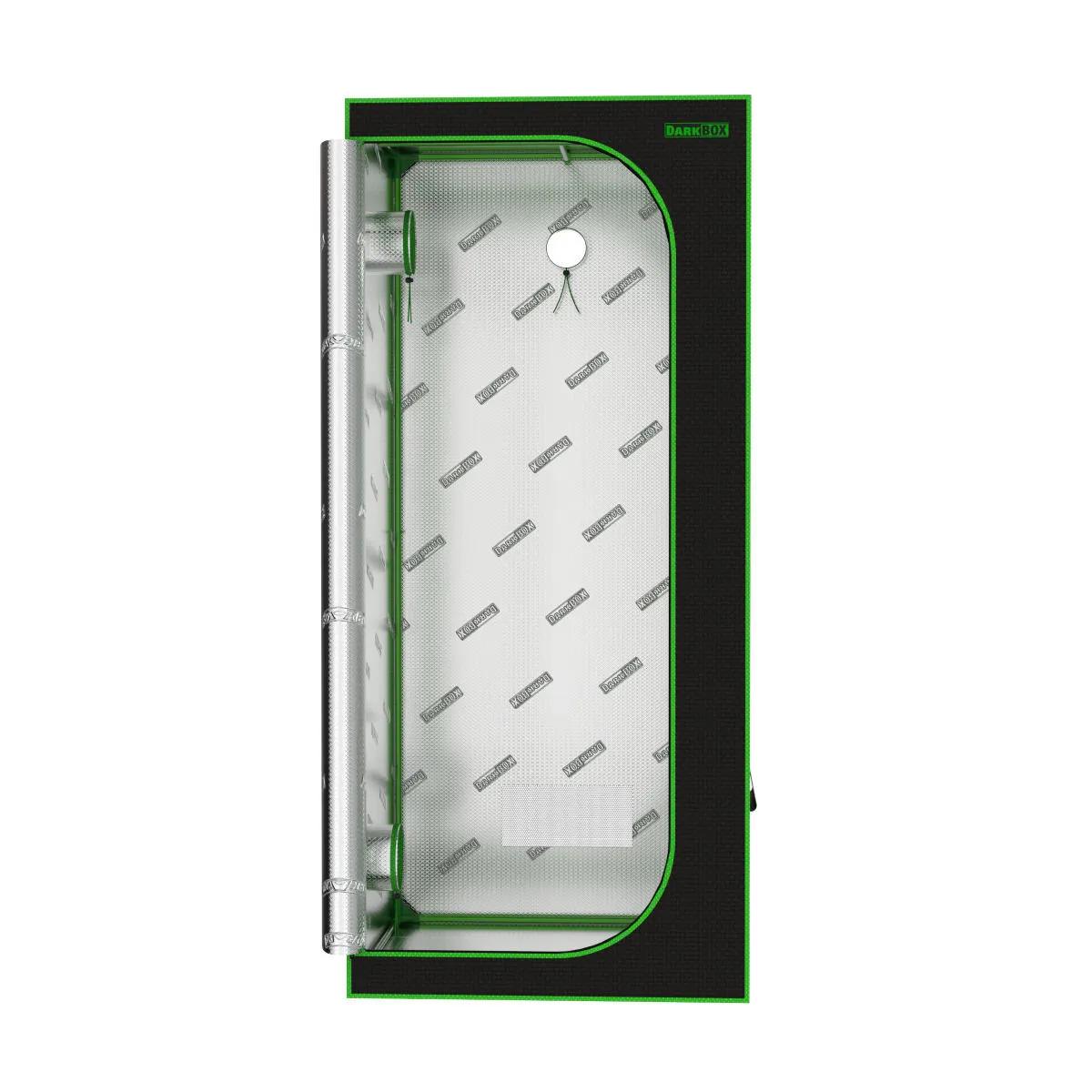
The Dark Box Grow Tent 80x80x200 cm is a lightproof indoor growing enclosure that gives you full control over your plants' environment — light, temperature, humidity, airflow. At 80 cm wide, 80 cm deep, and 200 cm tall, it's the sweet spot between "too cramped to work in" and "where did my spare room go." We've set up dozens of these in the shop, and the 80x80 is the size we point most growers towards. Enough room for 2–4 plants, enough height for a proper light setup, and it still fits in a corner without taking over your life.
The Dark Box 80x80 ships as a flat-pack kit with everything you need to get the structure standing. Here's what comes in the box:
What it doesn't include: lighting, ventilation, or a carbon filter. Those you'll need to grab separately — more on that below.
The 600D Oxford fabric on the Dark Box is properly thick. Pick it up and you can feel the weight compared to cheaper 210D or 400D tents — it doesn't crinkle like a crisp packet. That density matters because light leaks are the enemy of any controlled grow environment. Even a pinhole of outside light during a dark cycle can stress your plants. The Dark Box seams are double-stitched, and the zippers run smoothly without snagging. Zippers are usually the first thing to fail on a grow tent, so this is worth noting.
Inside, the diamond mylar lining reflects light back onto your canopy instead of absorbing it. Compared to flat white interiors, diamond mylar scatters light more evenly across the growing area — fewer hot spots directly under the lamp, better coverage at the edges. You'll notice the difference most with LED panels, where even light distribution across an 80 x 80 cm footprint is critical.
The steel frame slots together without tools. Each pole section pushes into a corner connector, and the whole skeleton locks rigid once the fabric shell goes over it. At 200 cm tall, you've got enough vertical space for the light, a carbon filter hanging above, and still 120–150 cm of actual growing height depending on your setup. That's plenty for most indoor plants through a full cycle.
The honest limitation: the floor tray is functional but thin. It'll catch minor spills and runoff, but if you knock over a full reservoir, you're mopping. We'd suggest putting a secondary drip tray under your pots as insurance.
| Spec | Value |
|---|---|
| Dimensions (L x W x H) | 80 x 80 x 200 cm |
| Outer fabric | 600D Oxford cloth, lightproof |
| Interior lining | Diamond-pattern reflective mylar |
| Frame material | Steel push-fit poles |
| Floor area | 0.64 m² |
| Volume | 1.28 m³ |
| Ventilation ports | Multiple (various diameters) |
| Floor tray | Removable, waterproof |
| Observation window | Yes |
| Assembly time | Approximately 15 minutes |
| SKU | GS0028 |
The 80x80 sits right in the middle of the range, and that's exactly why we'd pick it for most setups. Here's how it stacks up against the smaller and larger options:
| Feature | 60 x 60 cm tent | Dark Box 80 x 80 cm | 120 x 120 cm tent |
|---|---|---|---|
| Floor area | 0.36 m² | 0.64 m² | 1.44 m² |
| Plant capacity | 1–2 plants | 2–4 plants | 6–9 plants |
| Best light wattage | 100–200W LED | 200–400W LED | 400–600W LED |
| Room footprint | Small cupboard | Corner of a room | Dedicated room |
| Working space inside | Tight — arms only | Comfortable — can reach all corners | Walk-in — full access |
The 60x60 technically works, but you'll be reaching over plants to adjust anything at the back, and light coverage drops off fast in such a small space. The 120x120 is brilliant if you've got the room and the budget for a bigger light, but it's overkill for a first setup. The 80x80 gives you 78% more floor area than the 60x60 without doubling your equipment costs. That's the maths that matters.
Growing indoors without a tent is like trying to cook in a kitchen with no walls — everything leaks. Light escapes, temperature swings with the weather outside, humidity goes wherever it wants, and your extraction fan is fighting the whole room instead of a contained 1.28 m³ space. A grow tent turns a random corner into a sealed, reflective box where every watt of light and every degree of temperature actually works for your plants instead of dissipating into nothing.
The Dark Box 80x80 is the best 80 cm tent for growers who want reliability without paying for a brand name. The 600D fabric, steel frame, and diamond mylar interior are the same spec you'd find on tents costing significantly more. We've had customers run these for 3–4 consecutive cycles without any degradation in the zippers or fabric — which is where cheaper tents always let you down first.
Temperature control is the other big win. Inside an 80x80 tent with a decent extraction fan, you can hold 24–26°C during lights-on and drop to 18–20°C during lights-off with minimal effort. Try doing that in an open room. You can't. The tent's sealed environment means your fan and filter are controlling a volume of just 1.28 cubic metres — that's nothing. A small 100 m³/h inline fan will exchange the air inside the tent roughly 78 times per hour. That's more than enough to manage heat from a 300W LED and keep fresh CO₂ cycling through.
Total assembly time: about 15 minutes if you've done it before, 25–30 minutes the first time. No tools required for the frame — just your hands and a bit of patience with the top corners.
Complete your setup: the Dark Box 80x80 is the shell — you'll still need an LED grow light, an inline extraction fan, and a carbon filter to run a proper indoor grow. A 200–400W LED panel covers the 0.64 m² footprint nicely. Pair it with a 100 m³/h extraction fan and carbon filter kit, and you've got a fully sealed, odour-controlled environment ready to go. Check the Growshop section for compatible lights and ventilation kits.
Comfortably, 2–4 plants depending on pot size and training method. In 11-litre pots, 4 fits well. If you're using 20-litre containers or letting plants grow wide without training, stick to 2–3. Overcrowding reduces airflow and light penetration to lower branches.
A 100 m³/h inline extraction fan is the minimum. For a setup with a 300W+ LED panel generating real heat, step up to 150–200 m³/h. The tent's 1.28 m³ volume means even a small fan cycles the air rapidly — the bottleneck is usually the carbon filter's resistance, not the fan itself.
Yes. The 600D Oxford fabric blocks light completely when all ports are sealed and zippers are fully closed. Do a darkness test after setup — sit inside with the room lights on and check for pinholes at seams and zip ends. We've found these tents hold up well, but a strip of gaffer tape on any suspect spots takes 30 seconds and gives you total confidence.
Diamond mylar (silver) reflects 90–97% of light and scatters it more evenly than flat white, which reflects around 85–90%. The Dark Box uses diamond-pattern mylar, so you get better light distribution across the canopy with fewer dead spots at the edges. Flat white is easier to clean, but for reflectivity, mylar wins.
Yes, without a carbon filter. The tent itself contains odour reasonably well when zipped shut, but any air exhausted through the ducting ports carries scent with it. A carbon filter on your extraction fan eliminates this. Budget for one from the start — it's not optional if discretion matters to you.
You can, but we'd recommend LED instead. A 400W HPS in a 0.64 m² tent generates serious heat — you'll need aggressive ventilation to keep temperatures below 28°C. A 300W LED panel produces comparable light output with roughly 40% less heat, making climate control far easier in a tent this size.
With normal use, expect 3–5 years minimum. The 600D fabric resists tears and the steel frame doesn't bend under the weight of lights and filters. Zippers are the component most likely to wear first — keep them clean and don't force them past bunched fabric. We've seen customers get 4+ years out of these without issues.
Last updated: April 2026