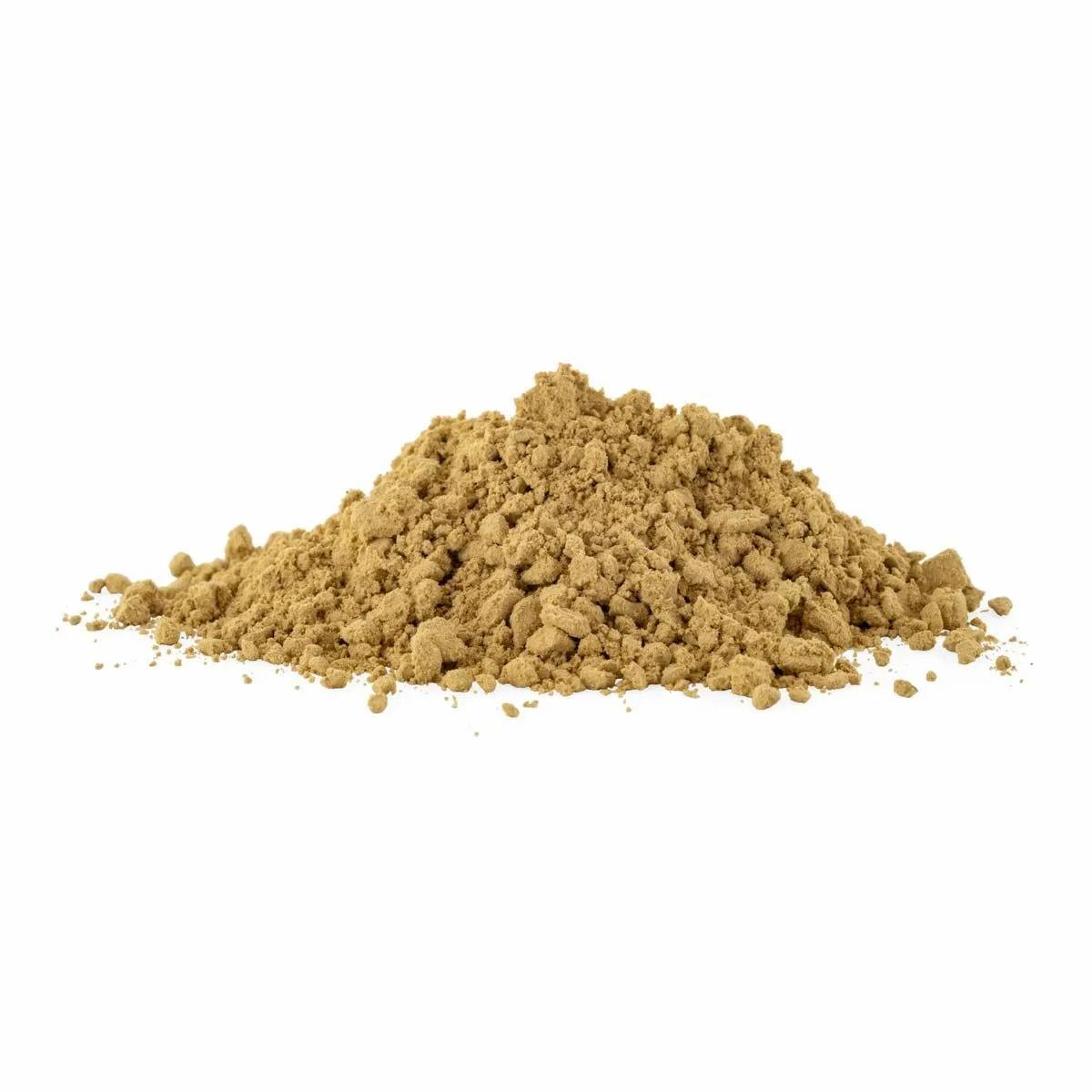
Organic Harad powder is a finely milled Ayurvedic herb made from 100% dried Terminalia chebula fruit — no fillers, no additives, no anti-caking agents. Harad (also called Haritaki) has been a cornerstone of traditional Ayurveda for centuries, and this version is certified organic and ground fine enough to stir straight into tea, yoghurt, or a smoothie.
What is organic Harad powder?
Harad powder is the dried, milled fruit of Terminalia chebula, a tree native to South Asia and one of the three fruits in the classical Triphala formula. The flavour is unusual on first taste — slightly bitter, slightly sweet, pungent, and strongly astringent on the tongue. That astringency is the giveaway: you'll feel it pull at the inside of your cheeks within a second of tasting. According to a complete review of Terminalia chebula fruit (Nigam et al., 2020, PMC11643145), the fruit contains tannins, phenolic compounds, and chebulinic acid, which give it its characteristic mouthfeel.
If you're already taking Triphala, Harad is the dominant fruit in that blend — buying it on its own lets you adjust the ratio or experiment with the single botanical. Research suggests Terminalia chebula has been studied for a range of traditional uses, with Bag et al. (2013, PMC3631759) noting its long history as a household remedy across South Asia.
Why we stock Harad powder
We carry a small, focused Ayurvedic shelf — Triphala, Harad, turmeric, ginger — and Harad is the one people come looking for once they've read past the surface of Triphala. It's the fruit that does most of the heavy lifting in that blend, and a lot of long-time Ayurveda users prefer to dose it solo.
This powder is 100% Terminalia chebula fruit, certified organic, and milled fine. No twigs, no seed fragments, no added rice flour to bulk it out. The colour is a warm tan-brown and the smell is earthy, faintly sour, with that puckery astringent edge you can almost taste through the bag. Honest limitation: the flavour is not subtle. If you're sensitive to bitter or astringent tastes, stir it into something with body — banana smoothie, full-fat yoghurt with honey — rather than trying to drink it straight in water. We've watched first-timers wince. There's no shame in adding fruit.
How Harad compares to Triphala
Triphala is three fruits: Harad (Terminalia chebula), Bibhitaki (Terminalia bellerica), and Amla (Emblica officinalis). Harad on its own is the single most prominent of those three. Here's how they differ on the shelf:
| Product | Ingredients | Best if you want |
|---|---|---|
| Harad Powder | 100% Terminalia chebula fruit | The single fruit, full control over dosing |
| Triphala Powder | Harad + Bibhitaki + Amla | The classic three-fruit blend, balanced flavour |
What the research says
Harad is well-studied for a traditional herb. We'll cite what's been observed in clinical and review literature — not what it'll do for you personally.
- According to Lopresti et al. (2018, PMC5625793), a randomised placebo-controlled trial of standardised Terminalia chebula fruit extract (AyuFlex®) examined joint comfort and mobility outcomes in healthy adults.
- A 2023 randomised double-blind placebo-controlled study (PMC9963432) observed that standardised Terminalia chebula fruit extract reduced facial sebum and erythema in participants taking the supplement.
- A 2024 review (PMC11528016) discussed T. chebula's traditional uses and chemistry in the context of cognitive research.
- A pharmacology review (Nigam et al., 2020, PMC9424961) reported that the fruit shows anti-inflammatory activity in preclinical models via peripheral and central mechanisms.
- Bag et al. (2013, PMC3631759) summarised the fruit's long use as a traditional household remedy across South Asian medicine.
None of this is a health claim about what Harad powder will do for you. EU rules don't allow that, and honestly, we wouldn't make those promises anyway — herbs work in context, not in isolation.
How to dose Harad powder
The recommendation on this product is a maximum of 2.5g daily — roughly half a level teaspoon. Traditional Ayurvedic practice has used Haritaki at 3–6g per day for adults, but stick to the label here and don't exceed 2.5g. Start lower than you think you need. A pinch (around 1g) stirred into tea or yoghurt is a sensible first dose, taken once you've checked you tolerate it.
- Measure out up to 2.5g (about half a teaspoon) — use a kitchen scale if you have one, it's more honest than eyeballing.
- Stir into warm (not boiling) water and let it steep for 5 minutes to brew like a tea, or whisk straight into yoghurt, porridge, or a fruit smoothie.
- Drink or eat reasonably quickly — the astringency intensifies as it sits.
- Store the bag in an airtight container in a cool, dry cupboard. Keep it out of direct sun and away from the hob.
- Do not exceed 2.5g per day. Speak to your doctor before using nutrient-dense supplements, especially if you take prescription medication or are pregnant.
Who should avoid Harad
Traditional Ayurvedic texts list specific contraindications for Haritaki: people who are emaciated, dehydrated, pregnant, or recovering from prolonged illness are generally advised against it. Modern reviews (PMC6870277) on oral toxicity studies of T. chebula note a wide safety margin in animal models, but human-specific contraindications still apply. If you're on blood-sugar medication, blood thinners, or any prescription drugs, talk to your doctor first — the tannin content can affect absorption of other compounds.
Pairs well with our Organic Triphala Powder if you want the full three-fruit Ayurvedic blend, or with Organic Turmeric Powder for a broader botanical kitchen shelf. Both are stocked on the same Ayurvedic herbs shelf.
Specifications
| Botanical name | Terminalia chebula |
| Common names | Harad, Haritaki, Black Myrobalan |
| Part used | Dried fruit |
| Form | Fine powder |
| Ingredients | 100% Terminalia chebula fruit |
| Certification | Organic |
| Maximum daily dose | 2.5g (approx. ½ tsp) |
| Flavour | Bitter, sweet, pungent, astringent |
| Storage | Airtight container, cool and dry |
| SKU | HE0062 |
Frequently Asked Questions
How do I take Harad powder?
Stir up to 2.5g (about half a teaspoon) into warm water, yoghurt, a smoothie, or porridge. Brewing it as a tea by steeping in warm water for 5 minutes is the traditional method. Start with a smaller pinch — around 1g — to check how you tolerate the strong astringent flavour.
Who shouldn't take Harad?
Traditional Ayurvedic guidance advises against Harad during pregnancy, breastfeeding, dehydration, or significant weight loss. If you take prescription medication — particularly blood thinners, diabetes drugs, or anything where absorption matters — speak to your doctor before using it. The tannin content can affect how other compounds are absorbed.
Can I take Harad daily?
The recommended maximum is 2.5g per day. Many traditional Ayurvedic practitioners use it daily within that range, but it's worth taking breaks rather than dosing continuously for months on end. If you're unsure, check with a qualified Ayurvedic practitioner or your GP.
What does Harad taste like?
Strongly astringent — it pulls at the inside of your cheeks — with bitter, slightly sweet, and pungent notes underneath. It's not subtle. Most people prefer it mixed into something with body and sweetness like banana smoothie or honey-sweetened yoghurt rather than drunk straight in water.
Is this the same as Haritaki?
Yes. Harad and Haritaki are two common names for the same fruit, Terminalia chebula. You'll also see it called Black Myrobalan. This product is the dried fruit, milled to a fine powder, with nothing else added.
How is Harad different from Triphala?
Triphala is a traditional blend of three fruits: Harad, Bibhitaki, and Amla. Harad on its own gives you full control over dosing the single fruit, whereas Triphala provides the balanced classical formula. If you already use Triphala and want to experiment with just one of its components, this is the one to start with.
Last updated: April 2026