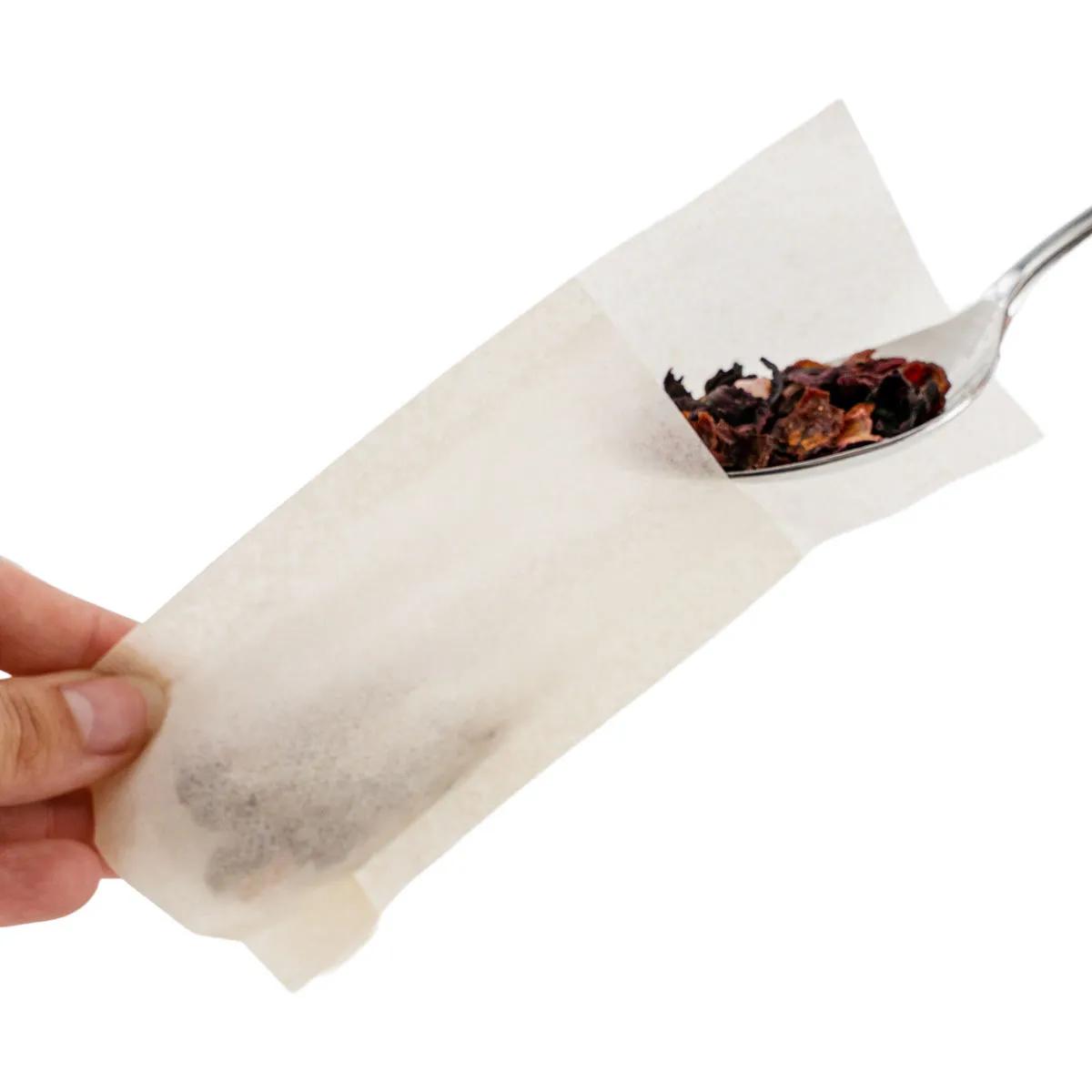
Empty Tea Filter (T-Bar) is a pack of 100 disposable, unbleached paper tea bags that lets you bag your own loose-leaf blends at home. Fill them with whatever you fancy — chamomile, mullein, lemon balm, mushroom powders, your nan's secret herbal mix — then iron the top shut and you've got a custom cuppa ready to brew. Cheap, chemical-free, and proper handy if you're tired of fishing soggy leaves out of your mug.
Why bag your own tea?
Empty tea filters are the simplest way to turn loose herbs into a clean, no-mess brew without committing to a metal infuser or stained French press. The paper is unbleached, so you're not steeping chlorine residues alongside your chamomile — and because you fill them yourself, you control exactly what goes in. No "natural flavours", no dust, no fannings. Just the herbs you chose.
There's also a quiet health angle worth knowing. Standard supermarket tea bags often contain plastic in the sealant or the bag itself, and recent research has flagged microplastic shedding during brewing. Plain paper filters like these sidestep that entirely. You're brewing through paper and water — that's it.
How big is the T-Bar size?
The T-Bar (Size S) holds enough loose herb for a standard mug — roughly 1 to 2 grams of dried plant material, depending on density. Fluffy herbs like mullein or lemon balm take up more space than dense roots or mushroom powders, so adjust by feel. The bag measures around 6 x 8 cm with the closing flap on top, which is the bit you fold and iron.
| Herb type | Approx. fill per bag | Notes |
|---|---|---|
| Light leafy herbs (mullein, lemon balm, mint) | 1 – 1.5 g | Fluffy — fills the bag visually but stays light |
| Flowers (chamomile, lavender, rose) | 1.5 – 2 g | Compact better than leaves |
| Roots & bark (ginger, liquorice, cinnamon) | 2 – 2.5 g | Dense — fills less space but weighs more |
| Mushroom powder (lion's mane, reishi) | 1 – 2 g | Fine powder — don't overfill, it needs room to swell |
Specifications
| Quantity | 100 bags per pack |
| Size | S (T-Bar) — approx. 6 x 8 cm |
| Material | Unbleached paper |
| Sealing method | Iron-sealed (heat-activated) |
| Capacity | 1 – 2.5 g loose herb per bag |
| Reusable | No — single use |
| Chemicals / bleach | None |
Pairs well with loose herbs from our herbal tea shelf — mullein, damiana, blue lotus, and lemon balm all bag up nicely in these filters. If you're blending mushroom powders, grab a small kitchen scale so your fills stay consistent across the batch.
Why you'll actually use these
If you've ever tried to drink loose-leaf tea through a metal mesh ball, you know the problem: half the herb ends up either too cramped to expand or floating freely in your mug. Strainers are fiddly. French presses need washing. Reusable cloth bags stain after three brews and start tasting of whatever you put in them last.
These solve all that. You batch-fill ten or twenty bags on a Sunday afternoon, seal them with a regular household iron, and stash them in a tin. Next time you want a cuppa, you grab one — no measuring, no mess, no leaves in your teeth. The bag expands enough for the water to circulate properly, which is the main thing strainers get wrong.
The honest limitation: they're single-use. If you're someone who's offended by disposables on principle, a stainless steel infuser is the better shout. But for batch-prepping custom blends or gifting tea to mates, nothing beats a sealed paper bag.
How to fill and seal them
- Set your iron to a medium-dry setting (no steam). Cotton setting works fine.
- Open the bag and spoon in 1 – 2 g of your loose herb or blend. Don't overfill — the herbs need room to swell and let water through.
- Tap the bag gently so any herb stuck in the seam falls down into the body. A blocked seam won't seal properly.
- Fold the top flap over once, pressing it flat.
- Press the hot iron onto the folded edge for 3 – 5 seconds. The heat melts the paper's natural fibres together to form a seal.
- Let it cool for 10 seconds, then check the seal by gently pulling. If it opens, iron again for another few seconds.
- Store sealed bags in an airtight tin or jar away from light. They'll keep as long as the herbs inside would normally last — usually 6 – 12 months for dried botanicals.
- To brew: drop one bag into a mug, pour over hot water (around 90°C for delicate herbs, full boil for roots and bark), and steep 4 – 8 minutes depending on the blend.
From our counter
We get asked at least once a week whether these can be used cold-brewed. Yes — drop a filled bag into a jug of cold water and leave it in the fridge overnight. Cold brewing pulls fewer tannins, so the result is smoother and less bitter, particularly good with hibiscus, mint, or lemon balm. The iron seal holds up fine in cold water.
Frequently Asked Questions
Do I really need an iron to seal them?
Yes, the seal is heat-activated. A household iron on a medium-dry setting works perfectly. If you don't own one, a hair straightener does the same job — just clamp the folded edge for 3 – 5 seconds.
Can I use these for mushroom or herbal powders?
Yes, but use slightly less than you would with cut herbs — around 1 – 2 grams — and don't pack it tight. Very fine powders can leak through the paper before brewing, so check the seam is clean before sealing.
Are they compostable?
Yes. The bags are unbleached paper with no plastic content, so they go straight into the compost or food-waste bin along with the spent herbs inside. One of the cleaner disposables you can buy.
How long can I store filled bags?
As long as the herbs themselves would normally keep — typically 6 to 12 months for most dried botanicals, stored airtight and away from light. The paper bag doesn't shorten shelf life, but it doesn't protect against oxygen either, so a sealed tin or jar is best.
Why not just use a metal infuser?
Infusers work fine for single cups, but they cramp the herb so it can't expand properly, which weakens the brew. Filters give the leaves room to swell. They're also handier if you want to pre-portion ten or twenty bags at once for the week ahead.
Will the paper affect the taste?
No noticeable taste from the bag itself — unbleached paper is neutral, unlike bleached commercial tea bags which can carry a faint papery note. Most people can't tell the difference between a filter-brewed and a strainer-brewed cup of the same herb.
Last updated: April 2026