Harvest & curing
by Carson
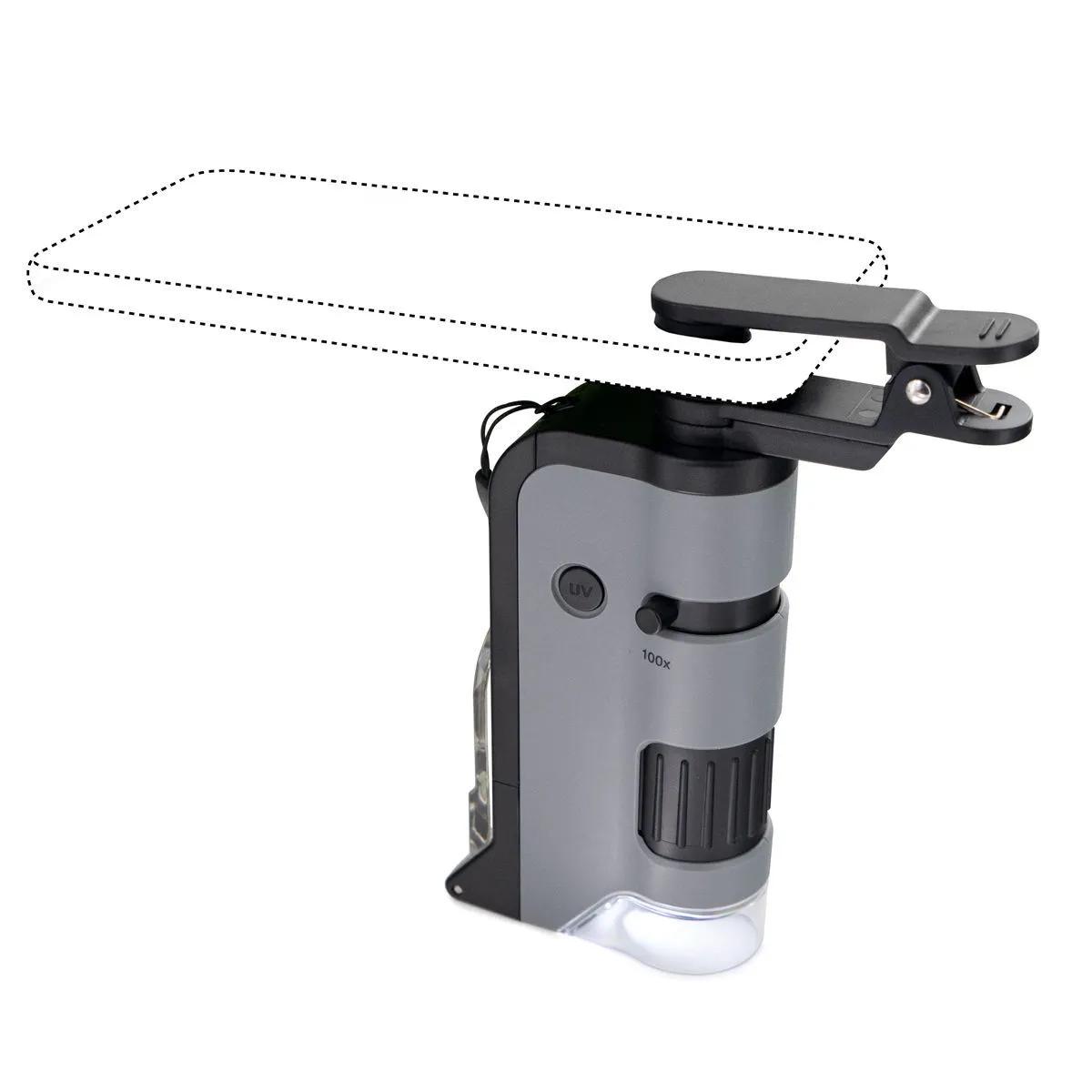
The Carson MicroFlip MP-250 is a battery-powered pocket microscope with 100x–250x magnification that lets you inspect trichomes, spot pests, and track plant health without squinting through a cheap loupe. It weighs next to nothing, clips onto your smartphone camera, and fits in your back pocket. If you've ever tried to judge harvest timing by eyeballing your buds from 30cm away, this is the upgrade you didn't know you needed.
Carson packs everything you need to start examining straight away — no hunting for extras.
That smartphone clip is the real bonus here. Most pocket microscopes in this price range give you a viewfinder and nothing else. The MP-250 lets you attach it directly to your phone's camera lens, so you can snap photos, record video, and actually share what you're seeing. We've passed one around at the shop and the first thing everyone does is photograph their own fingertip — then immediately move on to plant material once they see the level of detail.
The MicroFlip MP-250 pocket microscope runs on a single AA battery and delivers serious magnification in a body smaller than most lighters.
| Spec | Detail |
|---|---|
| Model | Carson MicroFlip MP-250 |
| SKU | HS0804 |
| Magnification range | 100x – 250x |
| Lighting | Built-in LED (white) + UV light |
| Power source | 1x AA battery (not included) |
| Dimensions | 6.1 x 4.2 x 10.9 cm |
| Smartphone compatible | Yes — adapter clip included |
| Accessories included | Smartphone clip, starter slide, wrist strap |
| Category | Harvest and curing equipment |
A 30x or 60x jeweller's loupe does the job for a rough look, but it won't show you the detail you actually need when timing a harvest. At 30x, trichomes look like tiny mushrooms. At 100x–250x with the Carson MicroFlip MP-250, you can see whether those trichome heads are clear, cloudy, or amber — and that's the difference between harvesting a week early and nailing the exact window you're after.
We've sold both loupes and pocket microscopes for years. The honest truth: most growers start with a loupe because it's cheap, then upgrade to something like the MP-250 after one harvest where they couldn't quite tell if those trichomes had turned. The 100x minimum on this unit puts you well past the useful range of any handheld magnifying glass, and the 250x top end is enough to see cell-level detail on leaf surfaces. According to a study published in the National Library of Medicine, researchers specifically chose the Carson MP-250 for field diagnostics because of its magnification up to 250x and battery-powered LED lighting — so it's not just growers who rate this thing.
The UV light is a nice extra. It's useful for spotting certain contaminants and residues that aren't visible under normal light. Not something you'll use every day, but when you need it, you'll be glad it's there.
The MicroFlip MP-250 pocket microscope is genuinely simple to operate — no lab experience required, no calibration, no fuss.
We've had the MP-250 kicking around the shop since we started stocking it, and a few things stand out. First, the build quality is solid for something this small — it doesn't feel like it'll snap if you grip it too hard, and the focus wheel has a satisfying resistance to it. The body has a slight rubberised texture that stops it slipping out of sweaty hands. It weighs barely anything — pocket it and forget it's there until you need it.
The one honest limitation: at 250x magnification, you need a very steady hand. Any wobble gets amplified massively, which makes freehand viewing at the top end a bit tricky. The smartphone clip actually helps here, because resting the phone against a surface steadies the whole setup. If you're doing serious trichome documentation, prop your elbow on something solid or use a small stand. At 100x–150x, hand tremor isn't really an issue.
Compared to the Carson MicroBrite Plus (the 60x–120x model), the MP-250 gives you roughly double the magnification ceiling and adds the smartphone clip as standard. If you only need a quick look to check whether trichomes are milky or clear, the MicroBrite Plus does the job at a lower price point. But if you want to photograph what you see, share it, or keep detailed records, the MicroFlip MP-250 is the better pick. We'd choose the MP-250 every time for anyone who grows more than once a year.
The Carson MicroFlip MP-250 is the best pocket microscope for home growers who want to make data-driven harvest decisions rather than guessing.
| Use Case | What You'll See at 100x–250x |
|---|---|
| Trichome inspection | Individual trichome heads — clear, cloudy, or amber colouration visible |
| Pest identification | Spider mites, thrips, and fungus gnat larvae become clearly visible |
| Mould detection | Early-stage mould filaments visible before they spread |
| Seed inspection | Surface cracks, immature shells, and viability indicators |
| General plant health | Stomata condition, leaf surface texture, nutrient deficiency signs |
The UV light adds another dimension for contamination checks. Under ultraviolet, certain organic residues and fungal colonies fluoresce in ways that are invisible to the naked eye. It's a quick screening tool — not a replacement for lab testing, but handy for a first pass.
Complete your harvest setup: pair the MicroFlip MP-250 with a set of precision trimming scissors and a drying rack. If you're documenting your grow from seed to harvest, a digital thermometer/hygrometer for your grow space rounds out the monitoring kit nicely.
We get asked this constantly — is a pocket microscope actually worth it over a basic loupe? Here's the straight comparison.
A standard jeweller's loupe gives you 30x–60x magnification. That's enough to see trichomes exist, but not enough to reliably judge their colour or maturity. The Carson MicroFlip MP-250 starts where most loupes stop — 100x — and goes up to 250x. That 100x floor means you're always working with enough detail to make real decisions. The built-in LED means you're not trying to angle natural light onto a tiny lens. And the smartphone clip means you can actually show someone else what you're looking at, rather than saying "trust me, they're cloudy."
The trade-off is size and simplicity. A loupe is smaller, has no battery, and requires zero setup. The MP-250 needs a AA battery and a bit more care when focusing. But for the actual job of inspecting your plants — the MP-250 wins on every metric that matters. At 6.1 x 4.2 x 10.9 cm, it's still genuinely pocketable.
No. It requires one AA battery, which is not included. Any standard AA battery works — alkaline or rechargeable. Pop one in and you're ready to go in seconds.
Yes. The included smartphone clip is designed to fit over most phone cameras. It works with both iPhone and Android devices. If you have a particularly thick phone case, you may need to remove it for the clip to sit flush against the lens.
Absolutely. At 100x you can already distinguish trichome heads from stalks. At 200x–250x, the difference between clear, cloudy, and amber heads is unmistakable. This is more than enough for accurate harvest timing.
The UV light causes certain organic materials and contaminants to fluoresce, making them visible when they'd otherwise be hidden. It's useful for spotting early-stage mould or residues on plant surfaces. Twist the barrel to switch between LED and UV modes.
No protective case is included — you get the microscope, smartphone clip, starter slide, and wrist strap. The unit is small enough to wrap in a microfibre cloth and toss in a drawer or bag. A small zippered pouch works well if you want extra protection.
At 250x, even small hand movements get amplified. Rest your elbows on a table, or use the smartphone clip and prop your phone against a stable surface. At 100x–150x, freehand viewing is perfectly manageable.
Definitely. It works on anything you can get the lens close to — coins, stamps, insects, fabric, skin, electronics. The starter slide included is a prepared specimen slide, so you can practise focusing before moving to your own samples.
Last updated: April 2026