Climate control
by Vanguard Hydroponics
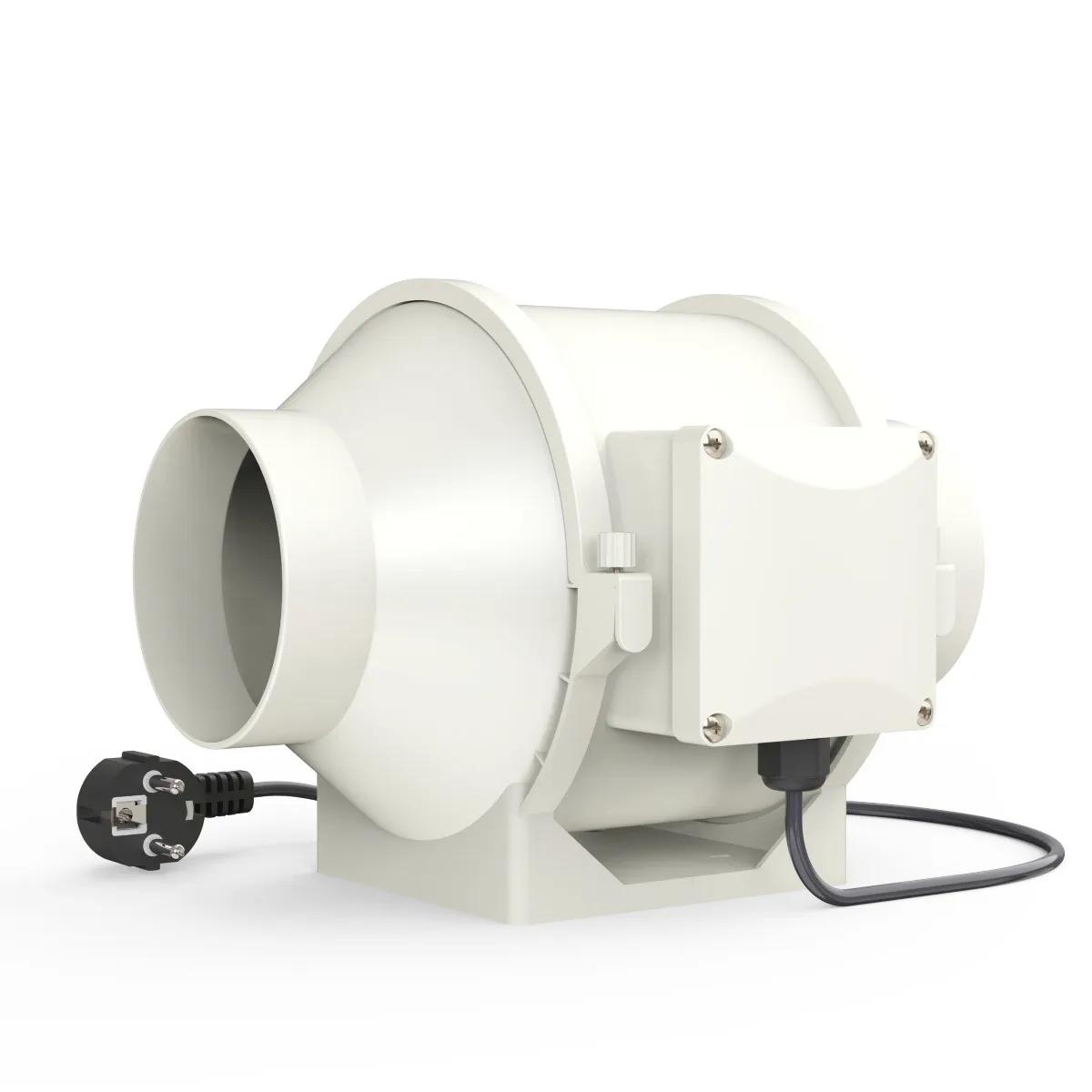
The Extractor Fan TT is a twin-speed inline extraction fan designed to keep small grow tents properly ventilated without filling your room with noise. Vanguard Hydroponics built this one with a pre-attached cable, two speed settings, and a wall-mount bracket that pops on and off in seconds. Available in 100mm and 125mm sizes, it handles airflow for tents up to about 80x80cm without breaking a sweat — or your eardrums. If you're looking to buy an extractor fan TT that works straight out of the box, this is the one we recommend to most home growers who visit our shop.
The 100mm fits tents up to 60x60cm with a single plant, while the 125mm suits spaces up to 80x80cm or smaller tents with dense canopies. Picking the right one depends on your tent size and ducting setup.
| Variant | Duct Diameter | Best For | SKU |
|---|---|---|---|
| 100mm | 100mm (4 inch) | Micro tents and propagation spaces up to roughly 60x60cm | GS0016 |
| 125mm | 125mm (5 inch) | Small to mid tents around 80x80cm or 60x60cm with heavy canopy | GS0033 |
Running a 60x60 tent with a single plant? The 100mm does the job and keeps things compact. Got a slightly bigger space or you're pushing more plants into a small footprint? Go 125mm. We'd pick the 125mm in most cases — the extra airflow headroom means you can run it on low speed more often, which keeps noise down even further. Upsizing your fan is almost always smarter than maxing out a smaller one.
The Extractor Fan TT runs on two speed settings with a pre-attached cable and quick-release wall mount bracket included in every box. Here are the full details.
| Spec | Value |
|---|---|
| Brand | Vanguard Hydroponics |
| Model | Extractor TT (Twin Speed) |
| Available Sizes | 100mm / 125mm |
| Speed Settings | 2 (Low / High) |
| Cable | Pre-attached, ready to plug in |
| Mounting | Wall mount bracket with quick-release |
| Noise Level | Among the quietest in its class |
| Category | Climate Control / Extraction |
Complete your ventilation setup with a carbon filter matched to your duct size — without one, extraction just moves smells around rather than eliminating them. A clip-on oscillating fan inside the tent pairs well too, keeping air moving across the canopy while the TT handles exhaust. Consider browsing our climate control category and our carbon filters range to get everything in one order.
Extraction removes excess heat, humidity, and stale air from enclosed grow spaces, preventing the conditions that lead to mould and stunted growth. Without it, even a small tent becomes a problem within days.
Stale air degrades grows gradually. Humidity creeps up past 70%, condensation forms on leaves, and suddenly you've got mould spreading through a canopy you spent weeks training. Temperature spikes follow because there's no airflow pulling hot lamp heat out through the top of the tent. CO2 gets depleted around the stomata and photosynthesis slows to a crawl. Your plants look fine for a while, then they just... stop growing.
We've seen growers blame nutrients, blame genetics, blame their lights — when the actual problem was a tent with no extraction fan or a cheap bathroom fan duct-taped to a port. The Extractor Fan TT from Vanguard Hydroponics addresses this properly. According to data published by the EMCDDA on indoor cultivation environments, stable airflow and humidity control are consistently identified as critical factors in preventing crop loss in enclosed growing spaces. The twin-speed motor lets you dial back airflow during early veg when plants are small and humidity isn't a battle yet, then crank it up during flower when dense buds trap moisture. That flexibility matters more than raw power in a small tent. Running a fan flat out 24/7 creates negative pressure problems — tent walls sucking in, light leaks opening up, and noise that makes the whole setup pointless if you're after discretion.
The honest limitation? This fan is built for small spaces. If you're running a 120x120 tent or anything with serious wattage overhead, you'll want something with more cubic metres per hour. But for a 60x60 or 80x80 setup — which is what most home growers actually run — the TT handles it without drama. It's the fan we'd point you towards if you walked into the shop and said "I need extraction but I don't want to hear it from the next room."
Installation takes under ten minutes with no tools beyond a screwdriver for the wall mount bracket. Follow these steps to get the fan running.
The most common extraction mistake we see is growers skipping it entirely on small tents. We've sold extraction fans since we started stocking grow gear, and the number one thing we hear is "It's only a 60x60, it doesn't need a fan." It does. Even a single plant in a small tent transpires enough moisture to push humidity into danger territory within hours of lights-off. The TT on low speed uses barely any electricity and weighs next to nothing — there's no reason not to run one. If you want to order an Extractor Fan TT alongside the rest of your tent kit, we ship everything from our Amsterdam warehouse.
The feel of this fan is reassuringly solid for its size. The plastic housing has a decent thickness to it, not the brittle stuff you get on no-name fans that crack the first time you overtighten a jubilee clip. The speed switch has a satisfying click between settings. On low, you can hold your hand over the exhaust and feel consistent, steady airflow. On high, there's noticeably more pull — enough to make a tent wall dimple inward on a well-sealed 60x60. Noise-wise, on low speed you genuinely have to put your ear near the ducting to confirm it's running. High speed produces a soft hum, roughly on par with a laptop fan under load. Compared to the Mammoth TT extraction fans we also carry, the Vanguard sits at a similar noise level but typically comes in at a lower price point — worth considering if budget matters more than brand loyalty. We also stock the Secret Jardin DF16 clip fan, which pairs nicely for internal canopy circulation alongside the TT handling exhaust duties.
Barely audible. On low, the Vanguard Hydroponics TT produces less noise than a quiet desk fan. You'll hear ducting vibration before you hear the motor itself. On high speed there's a gentle hum, but nothing that carries through a closed door.
Yes, and you should. Mount the carbon filter inside your tent and connect it to the fan's intake side with ducting and jubilee clips. Match the filter diameter to your fan — 100mm filter for the 100mm fan, 125mm for the 125mm.
The 100mm handles a 60x60 tent with a single plant comfortably. If you're running 2 or more plants, or using a powerful light that generates extra heat, go 125mm. The 125mm on low speed gives you the same airflow as the 100mm on high — but quieter.
No. It comes with a pre-attached cable and plug. Take it out of the box, mount it or connect ducting, and plug it into a standard socket. No electrician needed, no terminal blocks to mess with.
Yes. The motor is designed for continuous operation. Many growers run extraction fans around the clock to maintain stable humidity and temperature. On low speed, electricity consumption is minimal — a few pence per day at most.
It should — that's the goal. Slight negative pressure means air only enters through your intake vents, not through zip seams or light leaks. If your tent walls suck in dramatically, open another passive intake vent or switch to low speed.
Unplug it, pop it off the wall mount bracket, and wipe the fan blades with a damp cloth. Dust builds up over time and reduces airflow efficiency. A quick clean every 4-6 weeks keeps it running at full capacity.
Last updated: April 2026