
Dit artikel bespreekt psychoactieve stoffen bedoeld voor volwassenen (18+). Raadpleeg een arts als je een aandoening hebt of medicijnen gebruikt. Ons leeftijdsbeleid
How to Make Cannabutter: Step-by-Step Guide
Definition
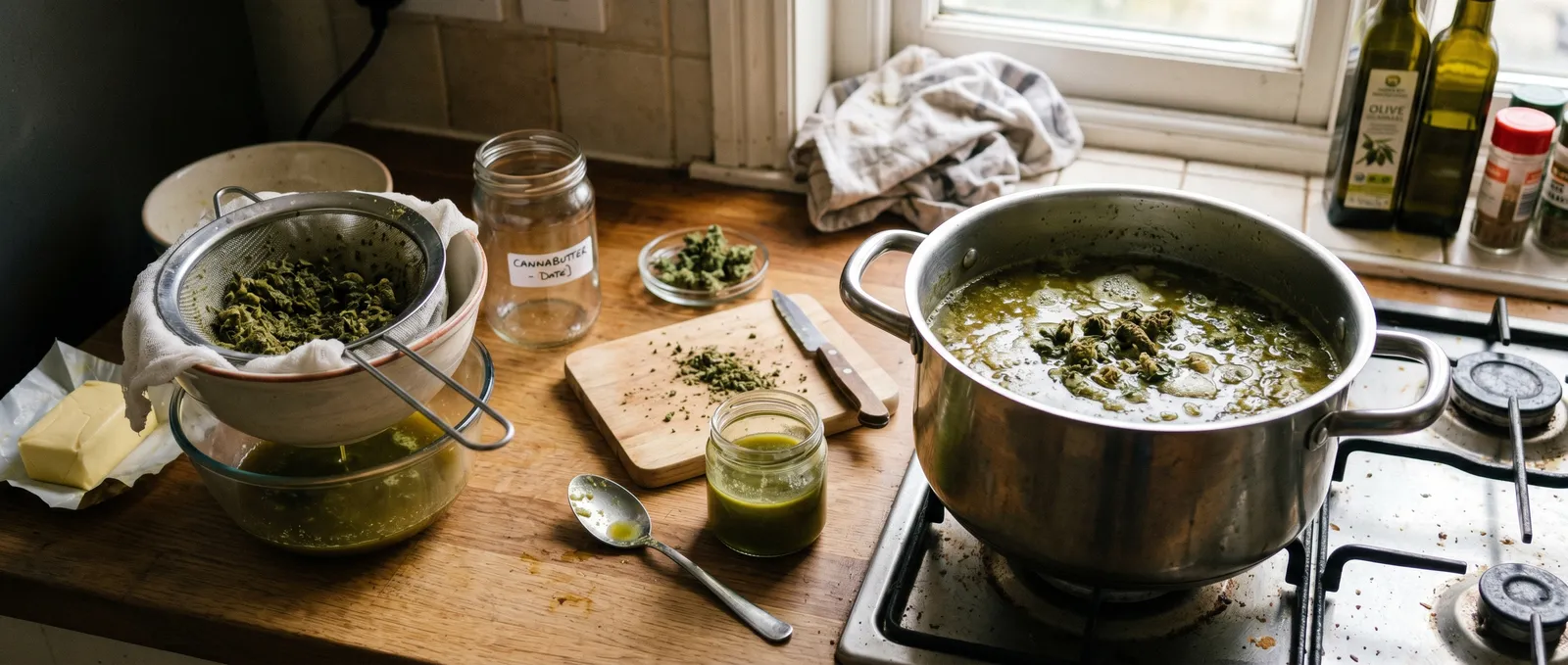
How to Make Cannabutter is a kitchen technique that infuses decarboxylated cannabis flower into unsalted butter, exploiting cannabinoids' fat-solubility to create a THC-rich fat base for edibles with delayed onset (30–120 min) and 4–8 hour duration.
What is cannabutter?
How to make cannabutter is a kitchen technique that turns unsalted butter into a cannabinoid-rich fat base for edibles like brownies, cookies, or pasta sauce. The method works because THC, CBD, and other cannabinoids are fat-soluble — they bind to the milk fat during a long, low-heat simmer. This guide is written for adults aged 18 and over; effects and dosing ranges below apply to adult physiology.
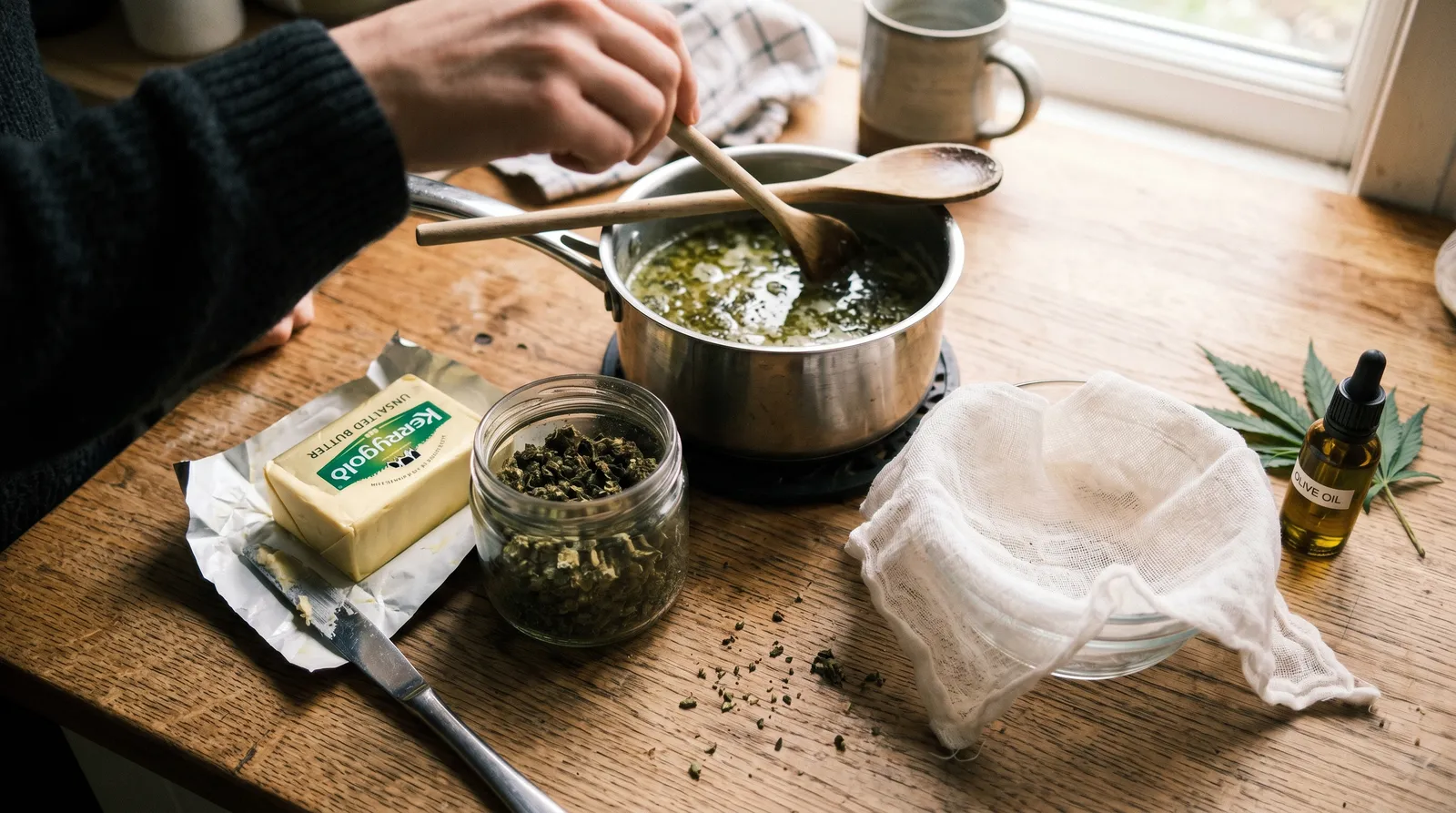
18+ only Making cannabutter is essentially a two-step kitchen procedure: decarboxylate the flower first (heat converts THCA into active THC), then infuse that flower into butter. Get those two steps right and the rest is just recipe. Get either wrong and you end up with greasy hay that does nothing.
Key facts
- Decarboxylation converts non-psychoactive THCA to psychoactive THC via heat — roughly 240°F (115°C) for 30–40 minutes (Wang et al., 2016).
- Cannabinoids are lipophilic: they dissolve into fat, not water, which is why butter works and plain boiling does not.
- Edibles have delayed onset (30–120 minutes) and last 4–8 hours, far longer than inhaled cannabis (Barrus et al., 2016).
- Oral THC undergoes first-pass liver metabolism into 11-hydroxy-THC, a metabolite 2–3x more potent than THC itself at crossing the blood-brain barrier (Lemberger et al., 1972).
- Typical home recipes use 7–14g of flower per 250g (one cup) of butter, though potency varies wildly with starting material.
- Cannabutter keeps 2 weeks refrigerated, 6 months frozen.
A note on our position
Azarius is a smartshop; we sell cannabis-adjacent products and have commercial interests in this category. This article is educational only — no products are recommended inside the method. Our editorial process includes pharmacological review to keep commercial framing out of how-to guidance.
Before you start — who shouldn't make or eat this
Edibles are not equivalent to smoking a joint. Because oral THC becomes 11-hydroxy-THC in the liver, the subjective intensity can be significantly stronger and less predictable, so beginners who learn how to make cannabutter should start conservatively (Lemberger et al., 1972). Avoid cannabutter if any of the following apply:
- Pregnancy or breastfeeding — THC crosses the placenta and is secreted in breast milk (Bertrand et al., 2018).
- Liver disease — cannabinoids are metabolised by hepatic CYP450 enzymes; impaired liver function alters clearance unpredictably.
- Concurrent SSRIs, MAOIs, benzodiazepines, opioids, or alcohol — additive sedation and serotonergic interactions are documented.
- Warfarin or other CYP2C9/CYP3A4 substrates — cannabinoids inhibit these enzymes and can raise drug plasma levels (Alsherbiny & Li, 2018).
- History of psychosis, bipolar disorder, or cardiovascular disease — higher-risk population for acute adverse events.
- Before driving or operating machinery — impairment from edibles can persist 6+ hours after dosing.
What you need
Cannabutter needs only basic kitchen tools — a saucepan, a sieve, and an oven thermometer are enough. You don't need a MagicalButter machine, a sous vide, or anything fancy; most home cooks who want to buy equipment for this already own what's required. If you do want to order a dedicated infuser later, it saves time but doesn't improve potency in a meaningful way.
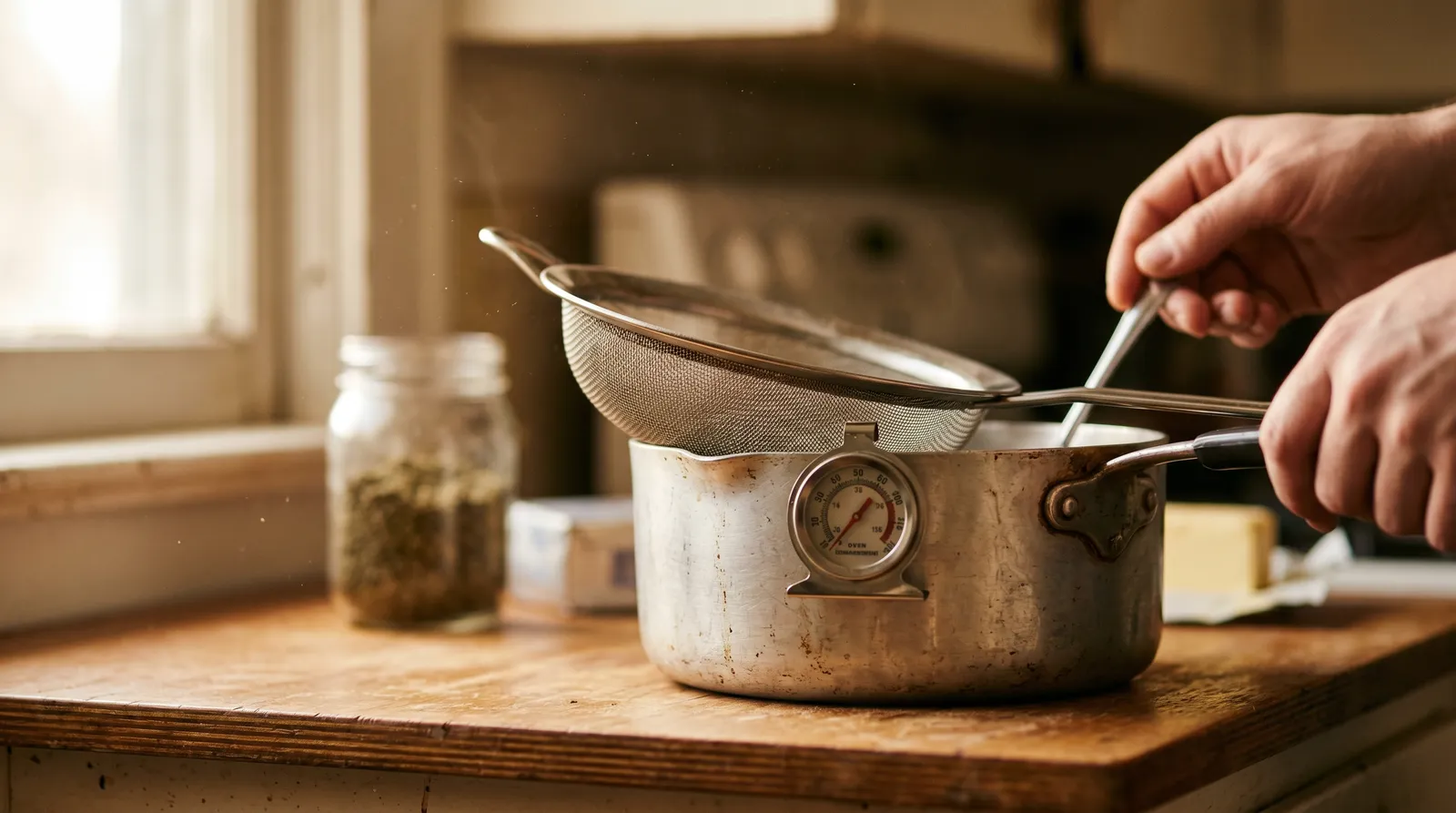
- Unsalted butter, 250g (one cup) — higher fat content = more cannabinoid binding capacity
- Cannabis flower, 7–14g depending on desired potency and starting THC%
- Baking tray + parchment paper (for decarb)
- Oven thermometer — most home ovens run 10–20°F off their dial
- Heavy-bottomed saucepan or slow cooker
- Fine mesh sieve, cheesecloth, or a nut-milk bag
- Glass jar or storage container
- Water — roughly equal volume to the butter
Step 1: Decarboxylation
Decarboxylation is the single non-negotiable step: raw cannabis contains THCA, not THC, and only heat converts it. Heat drives off a carboxyl group (releasing CO2) and turns THCA into the psychoactive THC your recipe depends on. A 2016 study in Cannabis and Cannabinoid Research mapped the conversion curve and found near-complete decarboxylation at 110–120°C over 30–45 minutes, with degradation into CBN accelerating above that (Wang et al., 2016).
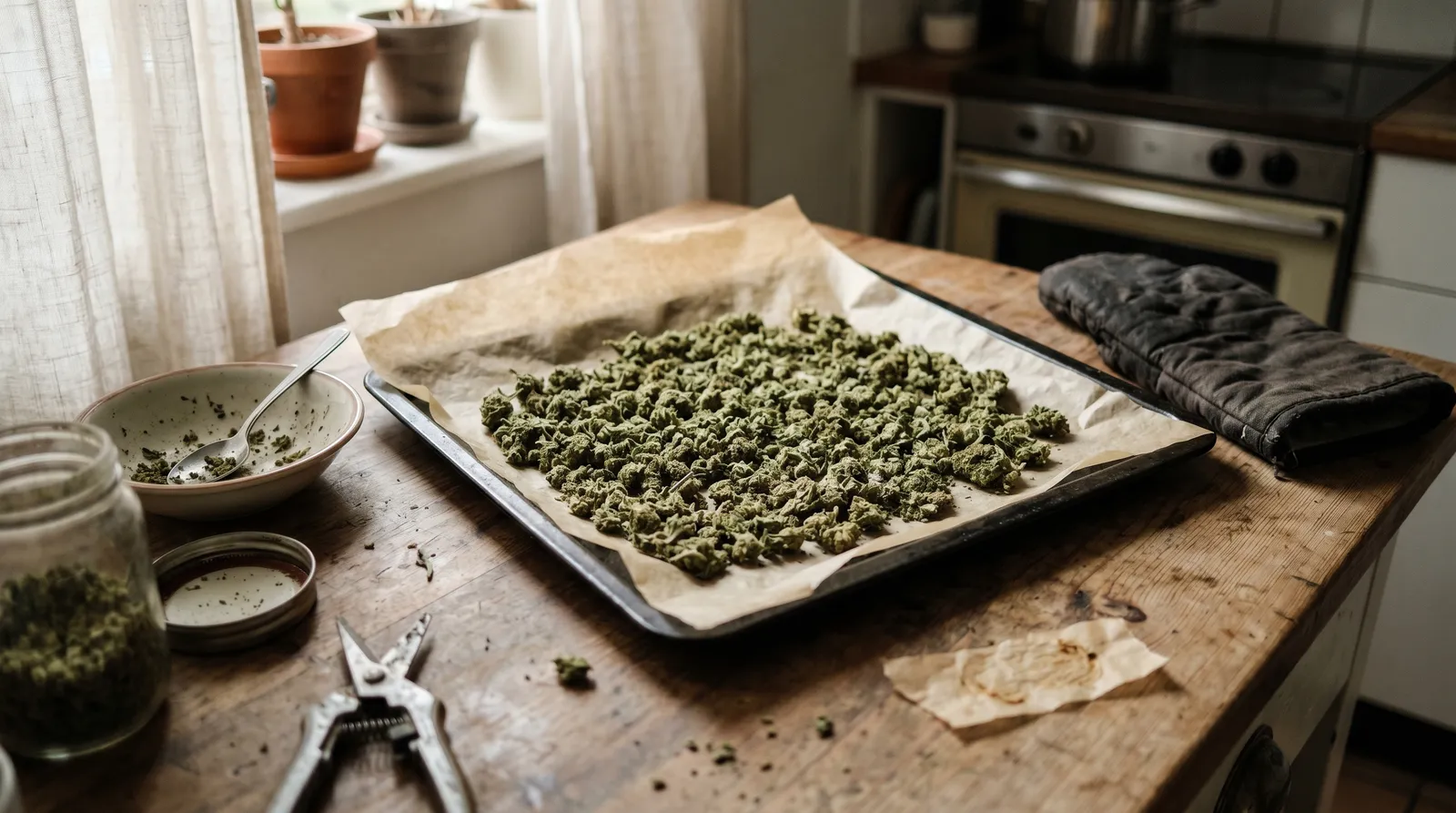
- Preheat oven to 115°C (240°F). Verify with a thermometer.
- Break up the flower loosely by hand — don't grind to powder. You want airflow around the buds, not espresso dust that scorches.
- Spread across a parchment-lined tray in a single layer.
- Bake 30–40 minutes. Give the tray a gentle shake at the 15-minute mark.
- Remove when the flower has darkened from bright green to a toasted brown-green and is dry enough to crumble. It will smell strong. Open a window.
The two most common decarb failures we hear about at the Azarius counter: ovens running hot (burning off terpenes and degrading THC into CBN, which is why the butter feels sedating but not psychoactive), and grinding the flower too fine before baking so it scorches against the tray. Break it up with your fingers. An oven thermometer costs four euros and solves half the problem. Compared to using a dedicated decarb device, a verified oven gives nearly identical results for a fraction of the cost.
Step 2: Stovetop infusion
Stovetop infusion extracts cannabinoids from plant matter into fat at a bare simmer of 70–95°C. The water in the pot serves two purposes: it buffers the butter from scorching, and it sinks plant debris and chlorophyll, which reduces the grassy taste. Cannabinoids start to degrade meaningfully above 150°C (Wang et al., 2016), so a gentle simmer with small bubbles — never a rolling boil — is the target.
- Combine 250g butter with ~250ml water in a heavy-bottomed saucepan over low heat. Let the butter melt fully.
- Add your decarbed cannabis. Stir to saturate.
- Maintain a bare simmer — surface shimmering, small bubbles only. If it's rolling, it's too hot.
- Cook 2–3 hours, stirring every 20–30 minutes. The mixture will thicken and take on a deep green-brown colour. Top up with hot water if it reduces too far.
- Strain through cheesecloth or a nut-milk bag into a heat-safe container. Press gently with a spoon — don't wring the cloth out completely, as that forces bitter plant matter through.
- Cover and refrigerate 4+ hours. The butter hardens on top; the water (with dissolved impurities) stays at the bottom.
- Lift the solid butter disc off the water. Scrape any leftover sludge off the underside. Transfer to a clean jar.
Estimating potency
Estimating potency in homemade cannabutter is inherently imprecise unless your flower has been lab-tested. Published clinical edible studies typically use standardised 2.5–10mg THC doses (Vandrey et al., 2015) — a range that is very hard to hit consistently with homemade butter. Honest limitation: no home method gives you lab-grade dose certainty.
The arithmetic, assuming a best-case scenario:
- 10g of 18% THC flower contains 1,800mg of theoretical THC.
- Decarb efficiency is typically 70–85%, so figure ~1,400mg active THC.
- Infusion efficiency into butter is typically 40–60% for home methods (MacCallum & Russo, 2018 note wide variability).
- Realistic yield: ~700–900mg THC in 250g butter, or roughly 3–3.5mg per gram of butter.
| Category | Approx. THC per serving | Reported context |
|---|---|---|
| Microdose | 1–2.5mg | Below standard clinical edible dosing |
| Low | 2.5–5mg | Typical entry-level dose in clinical trials (Vandrey et al., 2015) |
| Moderate | 5–10mg | Standard single edible dose in regulated markets |
| High | 10–20mg | Associated with increased adverse event reports in ER data (Monte et al., 2019) |
| Very high | 20mg+ | Not included in most published clinical edible studies |
For any homemade batch, the only safe way to calibrate is to bake a small test portion (e.g., one cookie from a batch of 20), wait a full two hours before deciding whether to take more, and use that reference point for future servings. Barrus et al. (2016) found that 69% of accidental edible overconsumption cases were driven by the 30–120 minute onset delay — people redosing before the first dose peaked.
Tips and adjustments
Small process tweaks make a measurable difference in flavour, strength, and shelf life of your finished cannabutter.
- Slow cooker method: same ratios, on low for 4–6 hours with the lid slightly ajar. Lower temperature = better cannabinoid and terpene retention.
- Reducing grassy taste: a quick 5-minute water soak of the decarbed flower before infusion removes some water-soluble chlorophyll. Pat dry before adding to butter.
- Strength adjustment: if the first test batch is too strong, cut your finished cannabutter with plain butter at a 1:1 ratio in the recipe. If too weak, use less plain butter in the recipe and more cannabutter — don't re-infuse, which wastes fat.
- Storage: refrigerated airtight for up to 2 weeks, frozen for 6 months. Cannabinoids degrade with light and oxygen — a dark jar in the back of the fridge is better than a clear one in the door.
- Trim vs. flower: trim and shake work, but the cannabinoid content is lower and more variable. Expect roughly half the potency of the same weight in flower.
Safety and drug interactions
The most common adverse event with homemade cannabutter edibles is overconsumption caused by delayed onset. Clinical literature notes edibles as the dominant cause of cannabis-related ER visits in regulated markets, disproportionate to their market share (Monte et al., 2019). Wait two hours. Then wait another hour. Do not redose based on "not feeling anything yet."
Cannabinoids interact with hepatic cytochrome P450 enzymes — specifically CYP3A4, CYP2C9, and CYP2C19 (Alsherbiny & Li, 2018). This affects a substantial list of common medications. The table below is not exhaustive.
| Drug class / substance | Interaction mechanism | Risk level |
|---|---|---|
| Warfarin, anticoagulants | CYP2C9 inhibition raises plasma levels; bleeding risk | Severe |
| Benzodiazepines, opioids | Additive CNS depression; respiratory depression risk | Severe |
| Alcohol | Additive impairment; increased dizziness and nausea | High |
| SSRIs, SNRIs | Serotonergic interaction; increased anxiety in some cases | Moderate |
| Clobazam, valproate | CYP-mediated level changes (well-documented with CBD; also relevant for THC) | Moderate |
| Statins (simvastatin, atorvastatin) | CYP3A4 inhibition raises statin levels | Moderate |
| Antihistamines, sleep aids | Additive sedation | Low–moderate |
Common acute side effects include tachycardia, dry mouth, dizziness, anxiety or panic at high doses, nausea, and in susceptible individuals, transient paranoia or psychotic symptoms (Barrus et al., 2016). Most resolve within 6–12 hours as metabolites clear, though 11-hydroxy-THC can remain detectable longer than inhaled THC. Pet exposure is a separate hazard — chocolate edibles are doubly toxic to dogs, and veterinary cannabis exposure calls have risen sharply in regulated markets.
If something goes wrong
Acute overconsumption is frightening but rarely medically dangerous in healthy adults. Symptoms — racing heart, panic, nausea, dissociation — peak within 2–4 hours and resolve over 6–12 hours. Keep the person hydrated, seated or lying down, and calm. Do not leave them alone.
Seek medical help if: chest pain, difficulty breathing, sustained vomiting, seizure, loss of consciousness, or acute psychosis occurs; if a child or pet has eaten any; or if the person is on interacting medications. Tell medical staff exactly what was consumed and the approximate dose and time.
- Netherlands: Nationaal Vergiftigingen Informatie Centrum — 030 274 8888 (24/7, medical professionals)
- UK: NHS 111 or 999 for emergencies
- Germany: Giftnotruf Berlin — 030 19240
- Belgium: Antigifcentrum — 070 245 245
- France: Centre Antipoison — 01 40 05 48 48 (Paris)
Commercial disclosure
Azarius sells cannabis-adjacent products and has a commercial interest in this topic. Our editorial process keeps product placement out of how-to guides; this article recommends no products.
Disclaimer
This article is for educational and harm-reduction purposes only. It is not medical advice. Consult a qualified healthcare professional before consuming cannabis edibles, particularly if you are pregnant, breastfeeding, taking prescription medication, or managing a chronic health condition. Individual responses to cannabis vary, and the dose estimates here are approximations based on published research, not guaranteed outcomes.
Frequently Asked Questions
Last updated: April 2026
Veelgestelde vragen
8 vragenDo I have to decarboxylate my cannabis before making cannabutter?
How long does it take to feel the effects of cannabutter edibles?
How much cannabis should I use per cup of butter?
How long does cannabutter last in the fridge or freezer?
Why does my cannabutter taste so grassy, and can I fix it?
Can I make cannabutter without decarbing in the oven first?
Can I substitute coconut oil for butter when making cannabutter?
How long does cannabutter keep, and what's the best storage method?
Over dit artikel


Joshua Askew serves as Editorial Director for Azarius wiki content. He is Managing Director at Yuqo, a content agency specialising in cannabis, psychedelics and ethnobotanical editorial work across multiple languages. Th
Dit wiki-artikel is opgesteld met hulp van AI en gecontroleerd door Joshua Askew, Managing Director at Yuqo. Redactioneel toezicht door Adam Parsons.
Medische disclaimer. Deze inhoud is uitsluitend bedoeld ter informatie en vormt geen medisch advies. Raadpleeg een gekwalificeerde zorgverlener voordat je een stof gebruikt.
Laatst beoordeeld op 26 april 2026