
Dit artikel bespreekt psychoactieve stoffen bedoeld voor volwassenen (18+). Raadpleeg een arts als je een aandoening hebt of medicijnen gebruikt. Ons leeftijdsbeleid
How to Roll a Joint
Definition
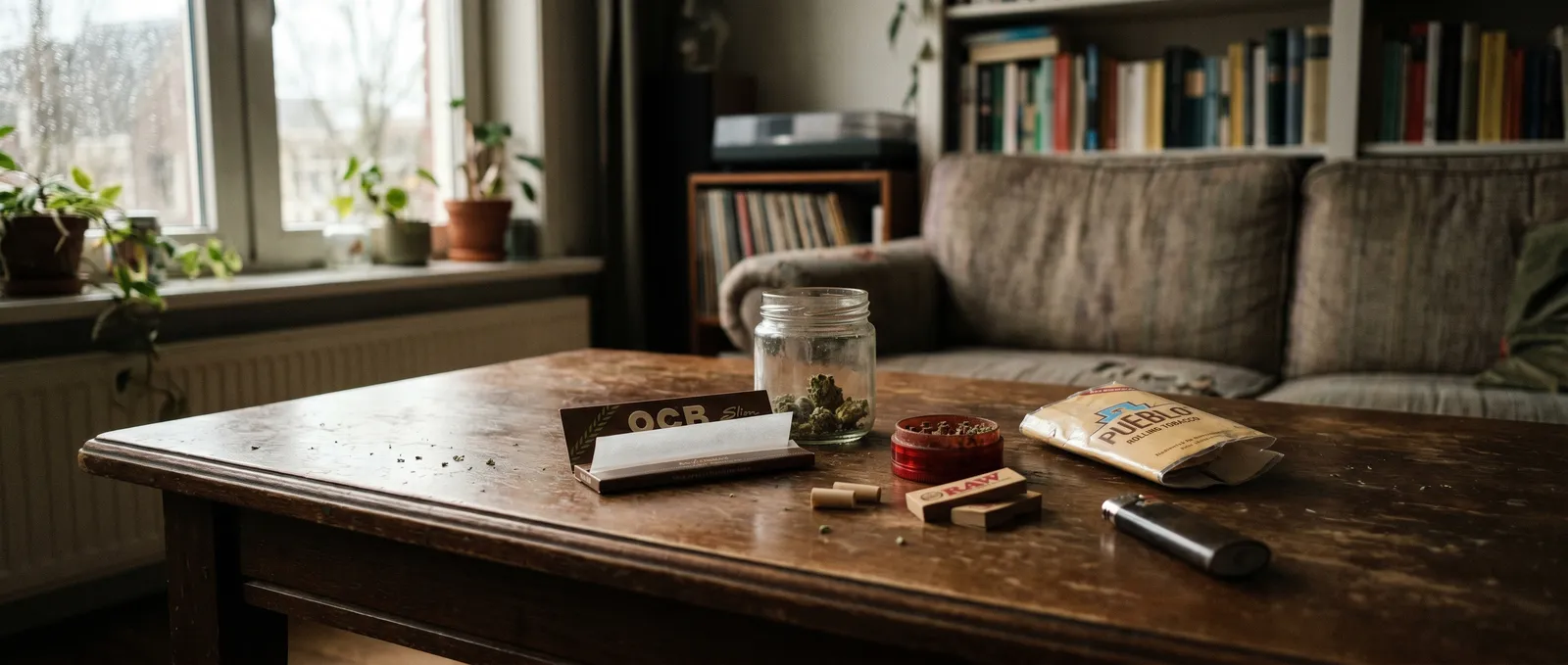
A joint is ground cannabis rolled in a thin paper with a filter tip — it is the most common method of smoking flower worldwide. According to Ridgeway & Kilmer (2021), the average joint contains roughly 0.32 g of cannabis. This guide breaks the rolling process into repeatable steps so you can build the skill from scratch.
18+ only — This guide is written for adults. The technique and material handling described below apply to adult cannabis users.
Rolling a joint is a method of preparing ground cannabis inside a thin rolling paper with a filter tip for smoking. A joint is a cannabis cigarette that uses thin rolling paper and a cardboard filter tip to hold ground flower in a smokeable cylinder — it is the most common way to consume cannabis flower worldwide. The technique looks effortless when someone experienced does it and feels impossible the first dozen times you try. But the difference between a joint that burns evenly for five minutes and one that canoes, runs, or falls apart in your hands comes down to how to roll a joint properly: a few specific steps done with care. This guide on how to roll a joint breaks the process into repeatable steps so you can build muscle memory and stop relying on someone else at the table.
Disclaimer: This article is for informational purposes only. Cannabis is a controlled substance in many jurisdictions. Azarius does not encourage illegal activity. Always check and comply with the laws in your country or region before purchasing or using cannabis products. You must be 18 or older to use this information.
What You Actually Need to Roll a Joint
You need exactly five items to roll a joint: cannabis flower, rolling papers, filter tips, a grinder, and a flat surface. Every successful joint starts with these gathered before you touch a paper. Missing one item mid-roll is how you end up with a crumpled paper and a lap full of ground flower.
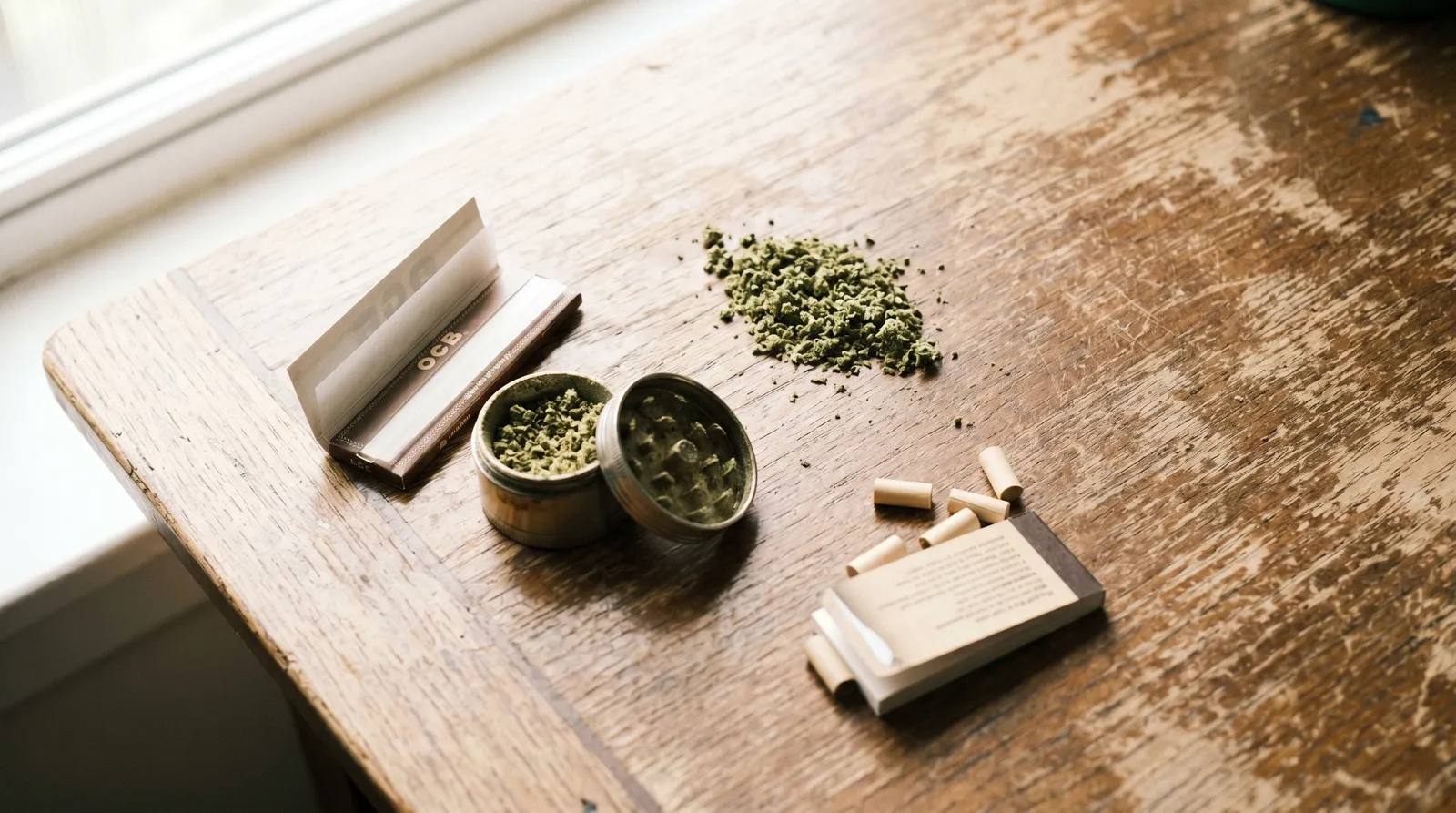
- Cannabis flower — roughly 0.25–0.5 g for a standard single-paper joint. A 2021 survey published in Drug and Alcohol Dependence found the average joint in the US contained approximately 0.32 g (Ridgeway & Kilmer, 2021), though European joints — especially Dutch ones — tend to be slightly larger. The European Monitoring Centre for Drugs and Drug Addiction (EMCDDA, 2023) reports similar averages across Western Europe.
- Rolling papers — standard king-size (roughly 110 mm × 44 mm) or 1¼ size. Material options include wood pulp, rice, hemp, and flax. Rice papers are thinnest and burn slowest; wood pulp is easiest to handle for beginners because it grips better. You can buy rolling papers from most headshops, including king-size RAW or Elements papers from the Azarius rolling papers category.
- Filter tips (also called crutches or roach cards) — a strip of stiff card, roughly 50 mm × 18 mm. Pre-cut tips exist, or you can tear a strip from the flap of most rolling paper booklets. Order filter tip booklets alongside your papers so you always have them on hand.
- A grinder — two-piece, three-piece, or four-piece herb grinder. A two-piece is fine. Scissors and a shot glass work in a pinch. If you want to buy a grinder that lasts, aluminium four-piece models from the Azarius grinder range collect kief and produce a consistent grind.
- A flat surface — a rolling tray, a book, a clean table. Anything that lets you recover spilled material. Metal rolling trays with curved edges are worth the small investment — you can order one from the Azarius smoking accessories range.
Step 1: Grind the Flower
The ideal grind consistency for a joint resembles coarse sea salt — fluffy, uniform, and dry enough to not clump together. Break your bud into smaller pieces by hand first, removing any stems. Then grind it. Over-grinding into a fine powder actually causes problems: particles pack too tightly, restrict airflow, and produce harsh, hot draws. A 2020 analysis from the University of British Columbia noted that particle size directly affects combustion efficiency and draw resistance (Gieringer, 2020). Two or three twists of a standard grinder is usually enough.
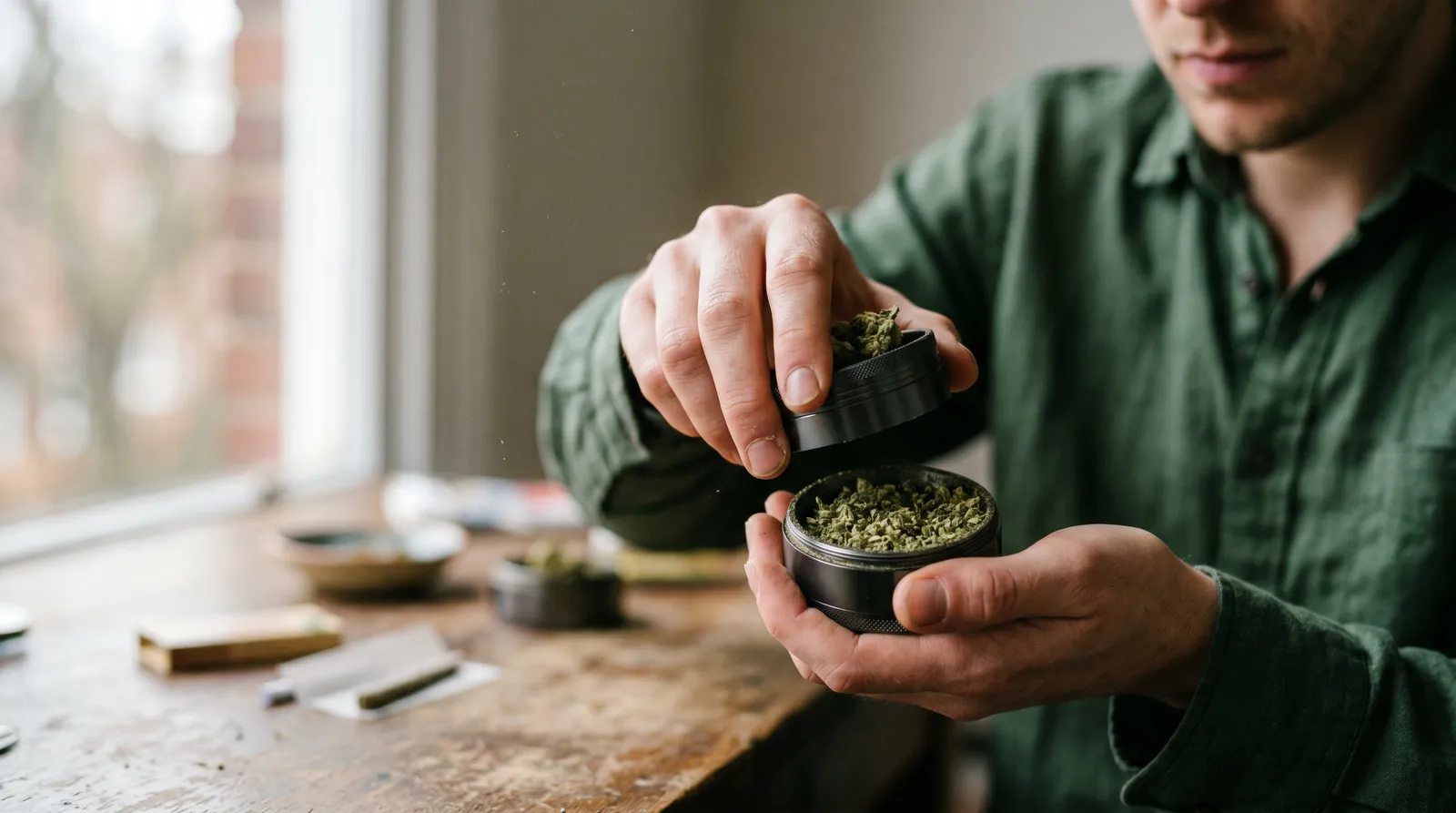
If your flower is sticky or very fresh, give it an extra twist or two. If it's already dry and crumbly, go easy — you can always break it down more, but you can't un-grind dust. A study by the Beckley Foundation (2022) on cannabis preparation methods confirmed that medium-coarse grinds produce the most consistent burn rate across different paper types.
Step 2: Make the Filter Tip
A filter tip is a small cylinder of folded card that forms the mouthpiece of your joint, providing structure, airflow, and a barrier against loose material. Take your strip of card. Make three or four small accordion folds at one end — these form an M or W shape inside the tip. Then roll the remaining card tightly around those folds to form a cylinder roughly 5–7 mm in diameter. The accordion folds prevent loose material from pulling through into your mouth while still allowing airflow.
Some people skip the filter when they roll a joint. Don't. It gives the joint structural rigidity at the mouthpiece end, prevents the last centimetre from becoming a soggy, unsmokeable mess, and means you don't burn your lips. It also defines the diameter of your joint — a wider filter means a wider cone, a tighter one means a thinner stick. If you want to buy pre-cut filter tips that are already the right size, the Azarius filter tips selection has several options.
Step 3: Fill the Paper
Filling the paper correctly is the step that determines whether your joint holds together or falls apart. Hold the rolling paper between your thumbs and index fingers, adhesive strip facing you at the top, sticky side up. Place the filter tip at one end — left or right, whichever feels natural for your dominant hand. Most right-handed rollers place it on the left.
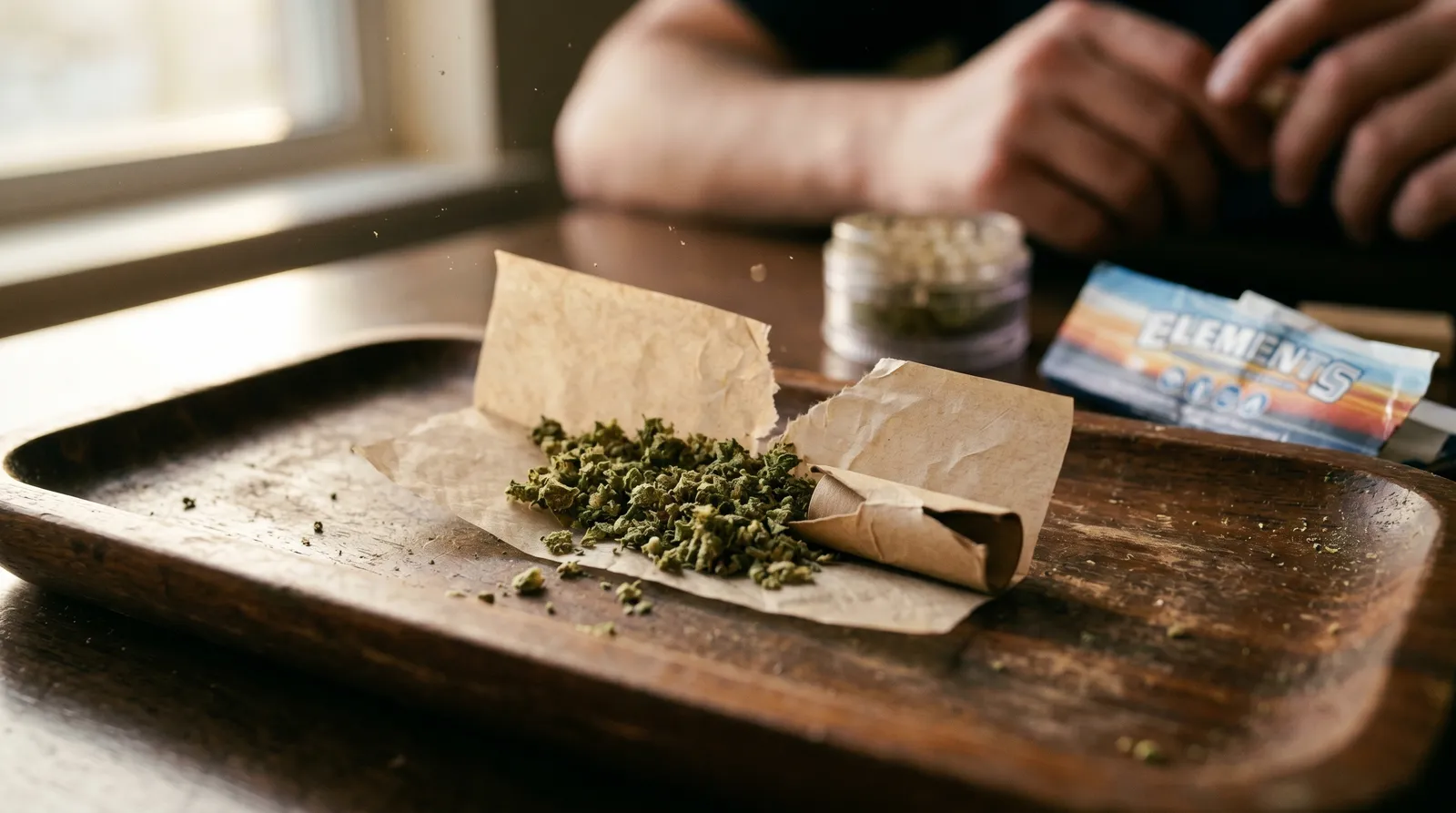
Sprinkle your ground cannabis along the crease of the paper. Distribute it evenly, with slightly more material toward the non-filter end if you want a classic cone shape. For a 0.3 g joint, you're looking at a thin, even line of material — not a mound. Overfilling is the single most common reason joints fail when learning how to roll a joint. If the paper can't close around the material, you've used too much.
There's a persistent debate among the staff about whether to pack the filter end slightly tighter or leave it loose. Half the team swears a snug pack near the tip prevents the dreaded "air pocket" that makes the first few draws taste like paper. The other half says it restricts flow. The honest answer: both approaches work, and the difference is smaller than either side admits.
Step 4: Shape and Tuck
The tuck is the single most important mechanical movement when you roll a joint — get it right at the filter end and the rest follows. Use your thumbs to roll the material back and forth inside the paper, gently compacting it into a cylinder. You're not pressing hard — you're persuading the cannabis into shape. Think of it like rolling a piece of clay between your palms, except you're doing it between your thumbs and forefingers.
Once the material feels evenly distributed and roughly cylindrical, tuck the non-adhesive edge of the paper around the cannabis and the filter. Start the tuck at the filter end — the card gives you a firm edge to wrap around. This is the critical moment. If the paper catches the filter cleanly, the rest follows. Roll upward with your thumbs, guiding the paper around the cannabis with your index fingers.
The tuck doesn't need to be perfect across the entire length simultaneously. Get it right at the filter, then work your way along. Speed comes with practice; precision matters more right now when learning how to roll a joint properly.
Step 5: Seal and Pack
Sealing locks the paper in place and packing eliminates air gaps that cause uneven burning. Once the paper is wrapped around the material, lick the adhesive strip lightly — you need moisture, not a soaking. Press the adhesive down, starting from the filter end and smoothing toward the tip. If you've rolled a cone, the open end will be wider. Use a pen, chopstick, or the end of a lighter to gently tamp down the cannabis from the open end.
Twist the excess paper at the tip to close it. Some rollers fold it; twisting is simpler and gives you a wick to light. This step is where knowing how to roll a joint transitions from construction to quality control.
Step 6: The Dry Run (Optional but Useful)
A dry run is a quick quality check before you light — squeeze the joint gently along its length to find soft spots. Hold the finished joint horizontally and give it a gentle squeeze. It should feel firm but not rock-hard — like a slightly underripe banana, not a pencil. If there are soft spots, those are air gaps where it'll burn fast and unevenly. You can tap the filter end against a hard surface to settle the material downward, then pack a tiny bit more in from the top if needed.
Light the twisted tip while rotating the joint slowly to create an even cherry. Don't inhale while lighting — toast it like a cigar first, then take your first draw once the tip is glowing evenly.
Common Mistakes and How to Fix Them
Most joint-rolling failures fall into six predictable categories, each with a straightforward fix that improves your next attempt immediately.
| Problem | Likely Cause | Fix |
|---|---|---|
| Joint canoes (burns down one side) | Uneven packing or uneven lighting | Pack more evenly; rotate while lighting the tip |
| Too tight, hard to draw | Over-packed or ground too fine | Use a coarser grind; use less material |
| Too loose, burns fast | Under-packed or poor tuck | Roll tighter at the shaping stage; pack from the tip after sealing |
| Paper tears during rolling | Too much moisture or aggressive handling | Use dry hands; handle gently; try a thicker paper like hemp |
| Material falls out the end | No filter or filter too loose | Always use a filter; roll it tighter |
| Harsh, hot smoke | Grind too fine, packing too dense | Coarser grind; slightly looser pack |
Quick Note: Joint vs Spliff vs Blunt
A joint contains only cannabis in thin paper, a spliff adds tobacco, and a blunt uses a thicker tobacco or hemp leaf wrap. Terminology shifts depending on where you are. In the Netherlands and most of Europe, a "joint" often contains a mix of cannabis and tobacco — what North Americans call a spliff. A pure-cannabis roll is sometimes called a "pure" here. In the US, a joint is cannabis-only in thin paper, a spliff adds tobacco, and a blunt uses a thicker tobacco or hemp leaf wrap that holds 1–3 g of flower. The technique described in this how to roll a joint guide works for all three — the rolling mechanics are identical. The dedicated Azarius wiki comparison article on joints, spliffs, and blunts covers flavour, nicotine considerations, and burn characteristics in more detail.
Rolling Paper Materials Compared
The paper you choose affects burn rate, taste, and how easy it is to roll a joint. Not all rolling papers behave the same, and the material matters more than most beginners realise.
| Material | Burn Speed | Taste | Beginner Friendliness |
|---|---|---|---|
| Wood pulp | Medium | Slight paper flavour | High — grips well, forgiving tuck |
| Rice | Slow | Very neutral | Low — thin, slippery, tears easily |
| Hemp | Medium-slow | Mild earthy note | Medium — good grip, slightly thicker |
| Flax | Slow | Neutral | Medium — similar to hemp but thinner |
The EMCDDA's 2023 report on cannabis consumption trends in Europe noted that hemp papers have grown in popularity across Western European markets, partly due to the perception of a "cleaner" smoke. If you want to buy hemp rolling papers to try the difference, the Azarius rolling papers category stocks several brands in both king-size and 1¼ formats.
We ran a blind taste test with eight staff members last autumn — same flower, same grind, same roller, four different paper materials. Six out of eight correctly identified the wood pulp paper by taste alone. Only two could distinguish rice from flax. The takeaway: paper material matters most at the extremes (wood pulp vs rice), and the middle options are closer than marketing suggests.
The Rolling Machine Shortcut
A rolling machine handles the shaping and tucking for you, producing a consistent cylinder in under thirty seconds. You open the roller, lay in your filter and ground cannabis, close it, spin the rods toward you a few times to shape the material, insert a paper with the adhesive strip facing you at the top, and roll until only the gummed edge is visible. Lick, seal, done. It produces a consistent, tight cylinder every time — though it won't give you a cone shape without some creative loading (more material on one side).
Rolling machines are genuinely useful tools, not a sign of failure. Plenty of people with years of experience use them when they want consistency or when rolling conditions are poor — windy festivals, cold fingers, that sort of thing. You can buy a basic RAW rolling machine or similar device from the Azarius smoking accessories range. If you want to order one alongside papers and tips, the Azarius rolling supplies section has bundled options.
We tested five different rolling machines side by side last winter — plastic ones, metal ones, the hemp composite RAW roller. The honest limitation: none of them handle very sticky, resinous flower well. The apron gums up after a few rolls and starts dragging. For dry to moderately sticky bud they're flawless, but if your flower leaves residue on your fingers, hand-rolling or a pre-roll cone is the more reliable choice.
Hand-Rolled Joints vs Pre-Roll Cones
Pre-roll cones skip the hardest part of learning how to roll a joint — the tuck — by giving you a pre-shaped paper cone with a filter already attached. You fill them, pack them, twist, and smoke. The trade-off is less control over density and shape, and they cost more per unit than flat papers. For someone who rolls fewer than a few times a week, cones are a practical alternative. For anyone building the skill, flat papers teach you more. Both are available in the Azarius rolling supplies section, so you can get each approach and decide which suits your routine.
No written guide fully replaces the tactile feedback of watching someone roll a joint in person. Text and photos can describe the tuck, but the pressure, the angle, and the feel of the paper catching the filter are things your fingers learn by doing. If you have a friend who rolls well, sit next to them and copy their hand position. Five minutes of that is worth more than re-reading any article — including this one.
Tips for Building the Skill
Consistent daily practice builds joint-rolling skill faster than years of occasional attempts. A 2018 observational study in the Journal of Cannabis Research noted that self-reported rolling proficiency correlated with frequency of practice rather than duration of cannabis use — meaning someone who rolls daily for a month typically outperforms someone who's been an occasional user for years (Hindocha et al., 2018). The skill is motor, not magical.
- Practice with tobacco or dried herbs first. Rolling is a mechanical skill. The material doesn't matter while you're learning the tuck — knowing how to roll a joint is about hand technique, not the contents.
- Use king-size papers. More paper means more room for error. You can always downsize later.
- Watch your hands, not the paper. Your thumbs do the work. Your eyes should track thumb position, not the paper edge.
- Roll ten in a row. Muscle memory builds through repetition, not through rolling one joint a week and hoping for improvement.
- Accept the first few will be ugly. A lumpy joint that smokes is better than a pretty joint that doesn't. Function over form.
Recommended Starter Kit
A complete starter kit for learning how to roll a joint includes four items that you can buy together to start practising immediately. King-size hemp rolling papers, a booklet of pre-cut filter tips, a two-piece or four-piece herb grinder, and a small metal rolling tray. All of these are available in the Azarius smoking accessories category and the Azarius grinder collection. You can also order pre-roll cones from the Azarius rolling supplies section if you want a fallback while you learn. Starting with quality materials makes the learning curve noticeably shorter.
For a deeper look at grinder types and which size suits different rolling styles, the Azarius wiki guide on herb grinders covers two-piece versus four-piece models in detail. And if you're curious about vaporising as an alternative to smoking joints, the Azarius blog article on smoking versus vaporising compares the two methods side by side.
Last updated: April 2026
Veelgestelde vragen
8 vragenHow much cannabis do you need for one joint?
Why does my joint burn unevenly on one side?
Do you need a filter tip to roll a joint?
What grind consistency is best for rolling a joint?
Is using a rolling machine cheating?
What is the difference between a joint and a spliff?
How do you tuck the paper when rolling a joint?
How do you seal and pack a joint after rolling?
Over dit artikel


Joshua Askew serves as Editorial Director for Azarius wiki content. He is Managing Director at Yuqo, a content agency specialising in cannabis, psychedelics and ethnobotanical editorial work across multiple languages. Th
Dit wiki-artikel is opgesteld met hulp van AI en gecontroleerd door Joshua Askew, Managing Director at Yuqo. Redactioneel toezicht door Adam Parsons.
Medische disclaimer. Deze inhoud is uitsluitend bedoeld ter informatie en vormt geen medisch advies. Raadpleeg een gekwalificeerde zorgverlener voordat je een stof gebruikt.
Laatst beoordeeld op 24 april 2026
References
- [1]Russo, E. B. (2016). Beyond cannabis: Plants and the endocannabinoid system. Trends in Pharmacological Sciences, 37(7), 594-605. DOI: 10.1016/j.tips.2016.04.005
- [2]MacCallum, C. A., & Russo, E. B. (2018). Practical considerations in medical cannabis administration and dosing. European Journal of Internal Medicine, 49, 12-19. DOI: 10.1016/j.ejim.2018.01.004